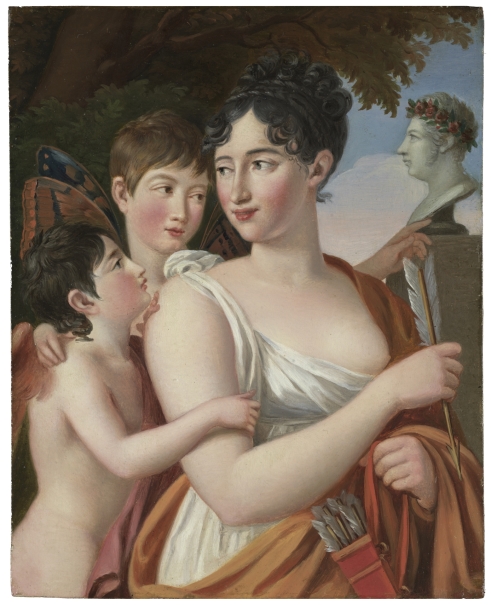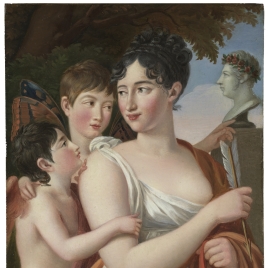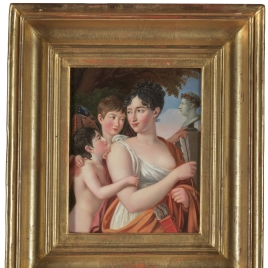
Josefa Tudó with her sons Manuel and Luis Godoy, in a garden
Ca. 1812. Oil on panel.Not on display
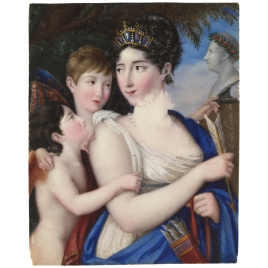
This group portrait depicts Josefa Tudó (1779–1869), first countess of Castillo Fiel, with her two sons, Manuel and Luis, around a portrait bust of their father, Manuel Godoy (1767–1851). It is the artistic expression of an atypical family reality through allegorical code. Produced during the Roman exile of King Charles IV’s favourite, this painting synthesises the predilection for classical culture that both Godoy and Madrazo shared. This picture first introduced into the Museo del Prado collections the singular image of a family that, broadly stated, suffered a complicated depiction of their relationships in court, and of which there are almost no examples of all of their members depicted together. The head of household, Manuel Godoy, married María Teresa de Borbón Vallabriga, (1780–1828), countess of Chinchón, in order to finally be related to the Spanish royals. Nevertheless, he would always be romantically involved with Pepita Tudó: he did not leave her side until her death, but he could not marry her until 1839, following the death of his first wife in Paris and of Luis, the little son he had with Tudó.
Following the European portraiture conventions of the day, Madrazo portrayed Josefa as embodying a classical deity; with her left bosom exposed, holding an arrow and a quiver that she removed from the hands of her son, who is depicted as Cupid. It can be assumed that Tudó’s image epitomizes an allusion to Philia – who is often represented with an unclothed chest – which would allow us to identify the older son’s portrait as a personification of Agape, the third form of love that Plato defended in his Symposium and other texts about his love theory. This would immediately turn this small work into a reflexion on the nature of such a Platonic feeling. At the same time, it is also possible that Tudó is embodying Aphrodite herself, who is sometimes shown with only one breast, in which case the older son’s figure would come to represent Psyche – which corresponds to his butterfly wings as well as to Manuel’s older age over his brother’s, who would personify small Cupid – and therefore the work would have been inspired by the well-known legend of Apuleius. Beyond the inspiring literary source of this singular iconography, what seems to be clear is that it is a logogriph about love intended to justify the family representation of this group, which refers to Godoy’s most particular interests. He would be the probable addressee of this canvas, and he may be ambiguously depicted – decorated as a bust – in the background of the composition.
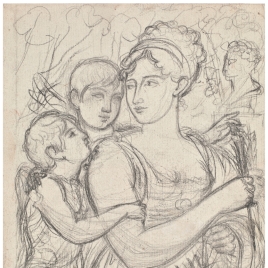
The Museo del Prado keeps a drawing by José de Madrazo closely related to this group portrait (D008417) and a miniature copy (O003391). The ages of the Godoy Tudó children, born in 1805 and 1807, respectively, allow us to date this work to around 1812, when the smaller one was close to five or six years old, as the portrait reveals. On the other hand, the mother’s face coincides exactly, both in features and in hairstyle, with another portrait of this lady before a landscape, painted by José de Madrazo and dated 1813. The use of classical iconographic sources allowed representing the whole family in a work of art. For this purpose, Madrazo followed a neoclassical European trend. This composition is also akin to the enlightenment convention of alluding to reverence for the father through the background presence of the bust crowned with flowers. The depiction of Godoy as a bust avoids representing him as interacting with a family that, despite being his, he could not officially recognise.
G. Navarro, Carlos, "Josefa Tudó con sus hijos Manuel y Luis Godoy, en un jardín" en Memoria de actividades 2016, Madrid, Ministerio de Educación, Cultura y Deporte, 2017, p.70-72