The Death of Viriatus, Chief of the Lusitanians
1807. Oil on canvas.Room 064
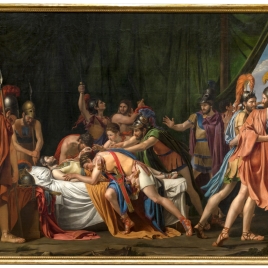
This massive canvas has traditionally been considered José de Madrazo’s masterpiece as well as the most emblematic painting of Spanish Neoclassicism. It has been exhibited in the Museo del Prado since it opened in 1819 in the Galería de Artistas Contemporáneos. As a result, it has since acquired enormous fame and recognition within the 19th century official milieu, as well as in Spanish art historiography up to the present day.
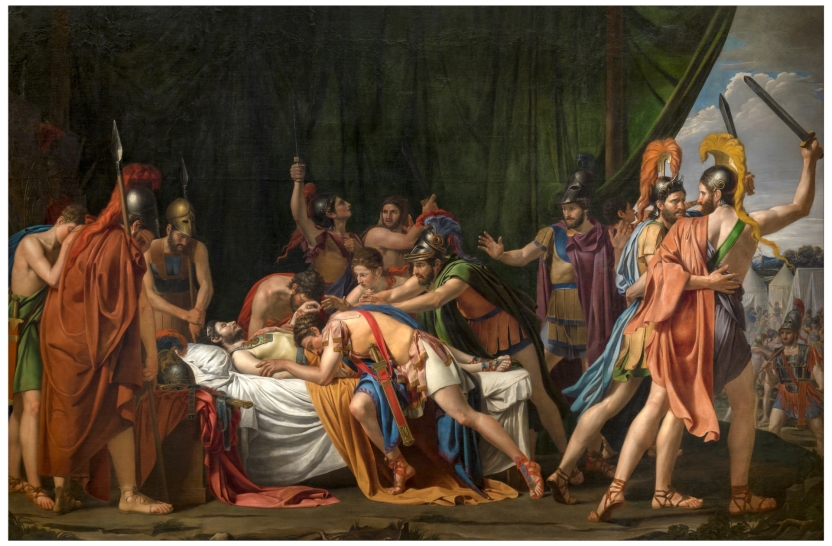
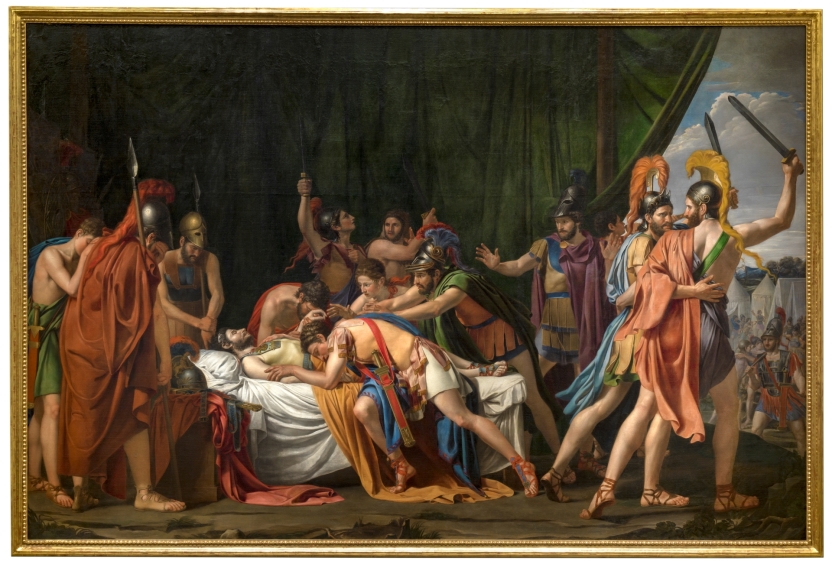
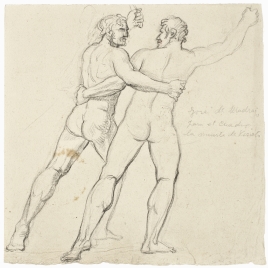
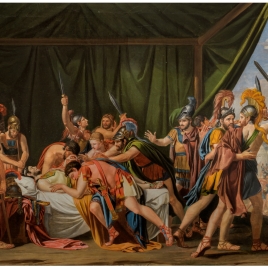
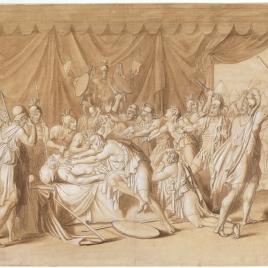
This work was painted in Rome thanks to the allowance granted to José de Madrazo by the King of Spain, Charles IV. The painting was intended as the first in an ambitious series of large canvases with scenes recalling how the people of the Iberian Peninsula resisted Roman domination in Hispania. This project was conceived by the young artist shortly after his arrival in the Eternal City, when he was determined exclusively to paint pictures of his homeland. The paintings, in addition to The Death of Viriatus, were to be The destruction of Numantia (P007225, D006771), The funerals of Viriatus, and Megara forces the Romans to surrender. The two first paintings were the only ones Madrazo ever executed. The artist wanted to capture this dramatic historical scene with all the monumental grandeur of the works he had seen and studied during his earlier training in Paris with the great neoclassical master Jacques-Louis David (1748–1825). Madrazo’s stay in Rome reinforced his direct knowledge of the vestiges of the splendour of Classical Antiquity. Naturally, the core of this composition is the deathbed of the deceased general over whom his generals and closest servants rush in grief, the slain leader’s weapons lying beside him. This set of elements is the most carefully executed and well-designed, its importance underlined by a very clear general illumination that makes it stand out from the rest. Two spearmen and a servant mourning the death of his lord surround the core of the composition on the left. Several standards and trophies won from the Romans are visible at the far end of the headboard. On the right, a soldier with his arms raised appears in shock at the sight of the murder. Behind him, a young man blowing his horn gives warning of the crime to the rest of the camp, visible behind the large tent curtain, which is partially drawn. Two warriors in Greek clothing march towards him, intending to rally the troops to avenge the soldier’s death. The archaeological arbitrariness of the characters’ costumes has been repeatedly justified by Madrazo’s convictions. The artist, influenced by his master David, held that Classical Greece embodied the true and genuine Classical period, of which Rome was merely a copy. Therefore, any argument relating to the ancient world should be inspired by Greek aesthetics. The great conceptual novelty of the painting lies in the fact that it is probably the first known case in 19th-century history painting in which the interpretation of the great events of Classical Antiquity turns its gaze towards an episode in Spanish history. Throughout the 19th century, Spanish history will become a major source of inspiration in the later development of the genre. Nevertheless, it was an even greater originality for the neoclassical period.
The scene was conceived as an embossment, since the characters are arranged in a single main shot well delimited by the curtain of the tent, which also serves as a vanishing point when pulled back to show the background of the camp.The scene is conceived as a warning to rulers of the constant danger of betrayal plotted by their closest allies, as happened to Viriatus. It praises the courage of leaders, invincible on the battlefields and only vulnerable in their sleep.
Díez, José Luis, 'José de Madrazo. La muerte de Viriato'. El siglo XIX en el Prado, Madrid, Museo Nacional del Prado, 2007, p.116-119 n.5