formularioRDF
The itinerary <em>TITULORECORRIDO</em> has been successfully created. Now you can add in works from the Collection browser
<em>TITULOOBRA</em> added to <em>TITULORECORRIDO</em> itinerary

Metabuscador

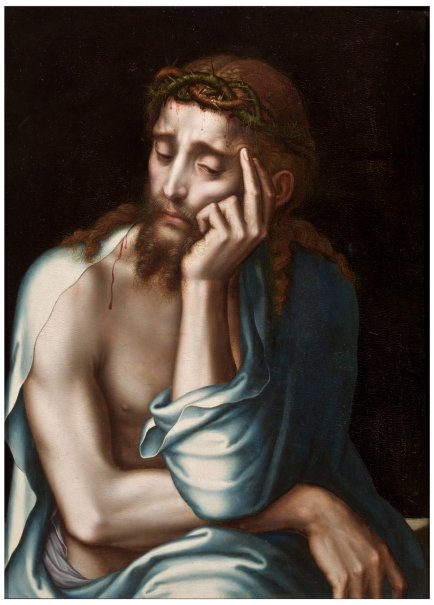
Ecce Homo
Oil on panel. 1566
Like The Virgin and Child with a Spindle (P07864), this panel formed part of the altar of St Anne in Badajoz Cathedral, commissioned by the bishop of the time, Juan de Ribera (1532-1611). It is really a reduction to a half-length format of the picture of the same title at the Minneapolis Institute of Arts, also shown in this exhibition. After being scourged, crowned with thorns and cloaked in a blue robe that reveals part of his muscular naked torso, Christ is seen seated on a stone block, just
ARTWORK
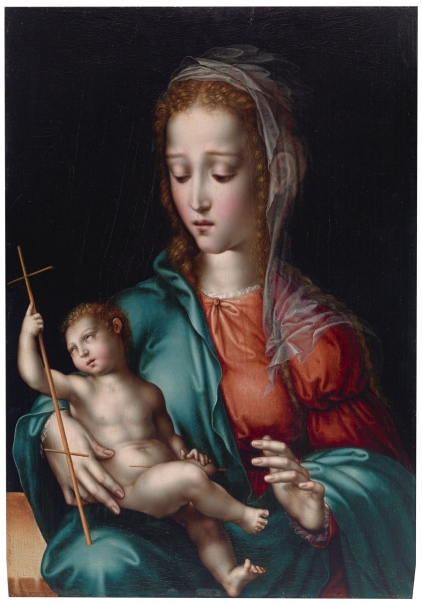
The Virgin and Child with a Spindle
Oil on panel. 1566
This panel formed part of an altar dedicated to St Anne at Badajoz Cathedral. Commissioned by the bishop at that time, Juan de Ribera (1532-1611), it shows the young Virgin Mary seated half-length against an intensely dark background while the Christ Child, approximately a year old, rests on her lap. Jesus reclines and turns his head to look more intently at a winding frame in the form of a cross, which he grasps with his right hand, while with the other he clutches a small spindle with its ball
ARTWORK
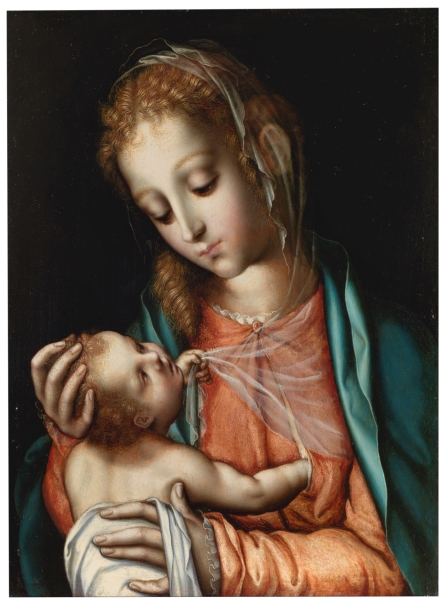
The Virgin nursing the Child
Oil on panel. 1560 - 1565
These works (P7948 and P944) embody a more decorous variation of the breastfeeding Madonna, a reference to the succour afforded by the Virgin to all believers. Morales designed a composition which avoids both the representation of Mary’s nude breast and explicit lactation. With both hands, Mary holds a Child who seeks maternal consolation, lifting the veil with one hand and touching the modestly covered breast with the other. The compositional sources that have been suggested for this are linked
ARTWORK
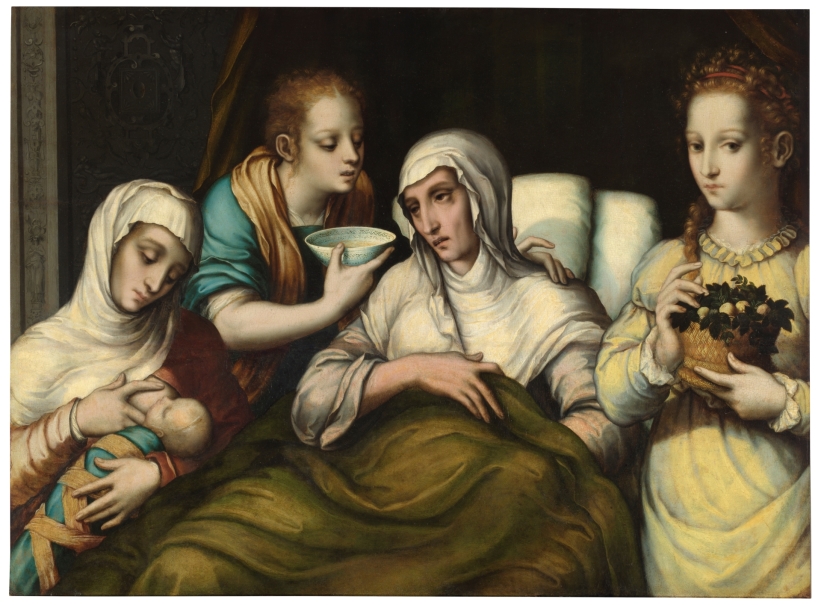
The Birth of the Virgin
Oil on panel. 1562 - 1567
The Birth of the Virgin at the Museo del Prado, the only painting on this subject by the hand of Luis de Morales and a work that remained unpublished until 2003, and the two pieces at the Museum Schloss Fasanerie in Eichenzell, The Presentation in the Temple and The Visitation, which are little known in Spain, belong in all probability, as Gabriele Finaldi pointed out, to one and the same set, a judgement based on their measurements, the proportion of the figures, their style, subjects and decor
ARTWORK
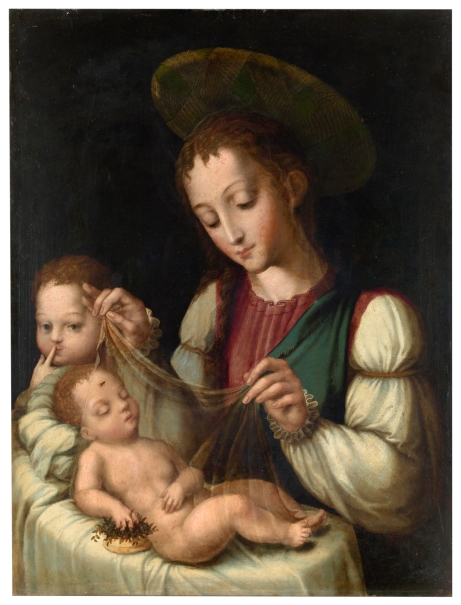
The Virgin and Child with the Infant Saint John the Baptist
Oil on panel. Ca. 1570
Morales here presents us with one of his most successful and heartwarming subjects, that of the Virgin and Child, although he also includes in this case the figure of the infant St John the Baptist, who looks out at the viewer with his blue eyes and, with a Harpocratic gesture, asks for silence so that Jesus’s sleep will not be disturbed. Illuminated by a strong light source, the scene stands out intensely against an almost black background. While the Child sleeps placidly with his right hand re
ARTWORK
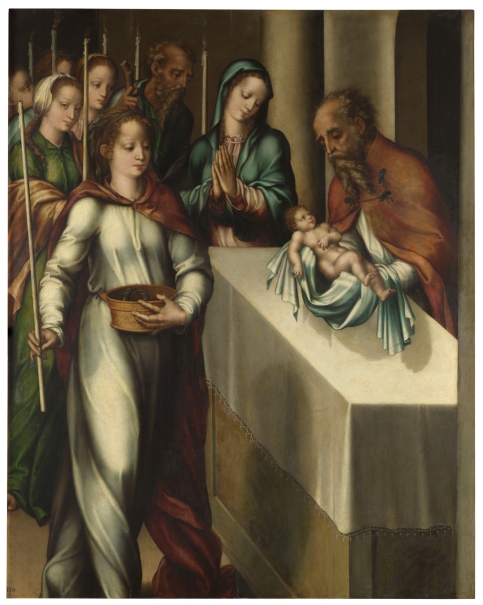
The Presentation of Jesus in the Temple
Oil on panel. Ca. 1562
In this picture in the Prado, Morales combines elements that allude to both moments, -the Presentation in the Temple and the Purification of the Virgin-, although it might appear at first that he inclines towards the Purification, since only the group formed by the Holy Family and the priest Simeon, together with the two young pigeons carried by the woman in the foreground, are taken from the Gospel text which narrates the Presentation of Jesus in the Temple (Luke, 2, 22-39). However, it is not
ARTWORK
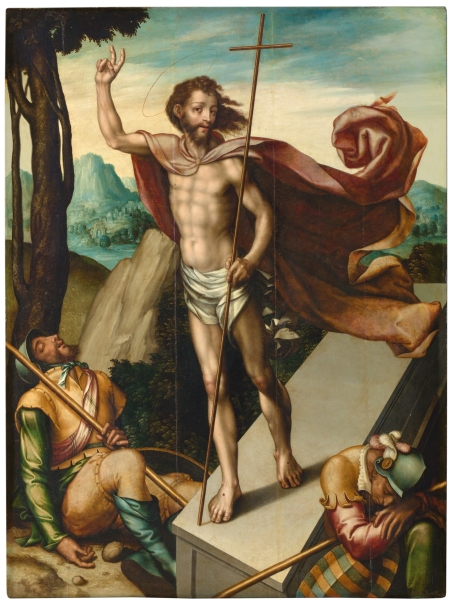
The Resurrection of Christ
Oil on panel. Ca. 1566
The dimensions, format, theme, support and pictorial style of these three works -The Crucifixion (P8211), Lamentation over the Dead Christ (Museo de Salamanca, CE 106) and The Resurrection (P8212)- all point towards a common provenance, an altarpiece with traditional subject matter linked to the Christological cycle, with special emphasis on the episodes related to the Passion, the death of Christ and the Resurrection. This was the type of iconography most often repeated on the altarpieces of th
ARTWORK
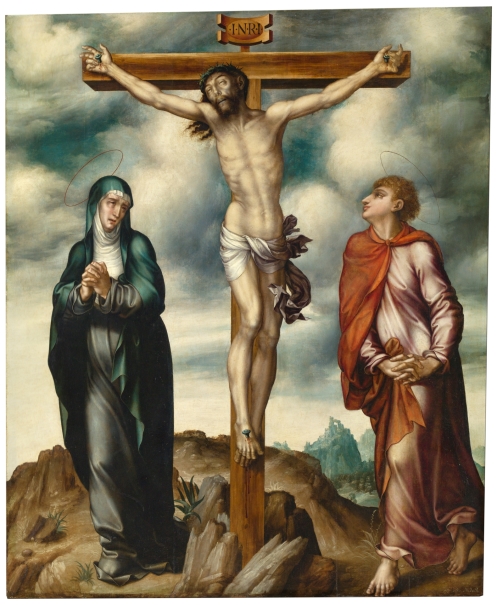
The Crucifixion
Oil on panel. Ca. 1566
The dimensions, format, theme, support and pictorial style of these three works -The Crucifixion (P8211), Lamentation over the Dead Christ (Museo de Salamanca, CE 106) and The Resurrection (P8212)- all point towards a common provenance, an altarpiece with traditional subject matter linked to the Christological cycle, with special emphasis on the episodes related to the Passion, the death of Christ and the Resurrection. This was the type of iconography most often repeated on the altarpieces of th
ARTWORK
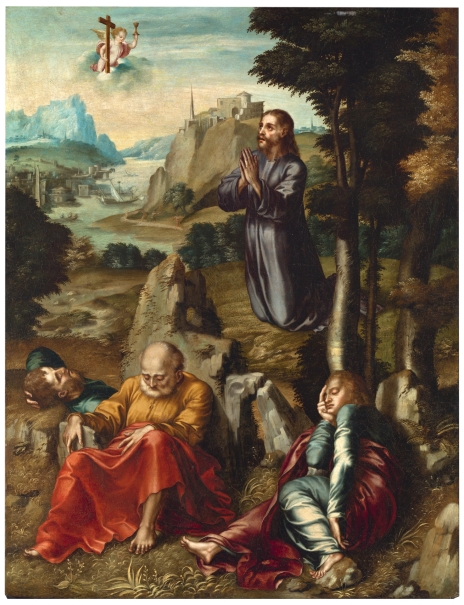
The Agony in the Garden
Oil on panel. Ca. 1545
Christ’s prayer on the Mount of Olives is the gospel episode that precedes his arrest and the beginning of his Passion and death on the cross. After the last supper with his disciples, Jesus withdraws with three of them, Peter and the two sons of Zebedee, James and John, to the nearby garden of Gethsemane. According to St Luke’s Gospel, he was withdrawn from them about a stone’s cast, and kneeled down, and prayed, saying: Father, if thou be willing, remove this cup from me; nevertheless, not my
ARTWORK
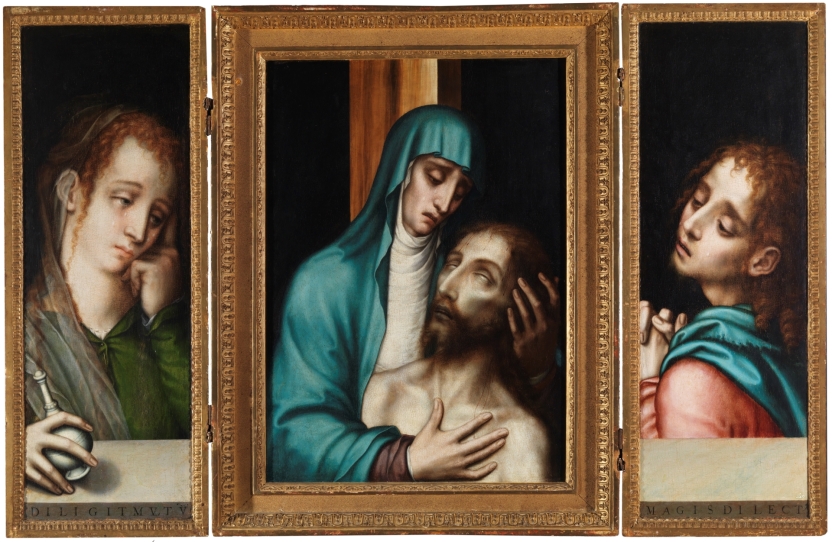
Triptych of the Pietà, St John and St Mary Magdalene
Oil on panel. Ca. 1570
Large-format versions of the Virgin holding the dead body of Christ, like those at Badajoz Cathedral and at the Real Academia de Bellas Artes de San Fernando, gave way in Morales’s oeuvre to smaller compositions on the same subject, with half-length figures shown on a striking background of rigorous black. Against this, the two figures and the upright of the cross are contrasted with strong lighting. The pentimenti revealed by technical studies of the numerous versions in this new format, with c
ARTWORK
Luis de Morales – (and workshop)
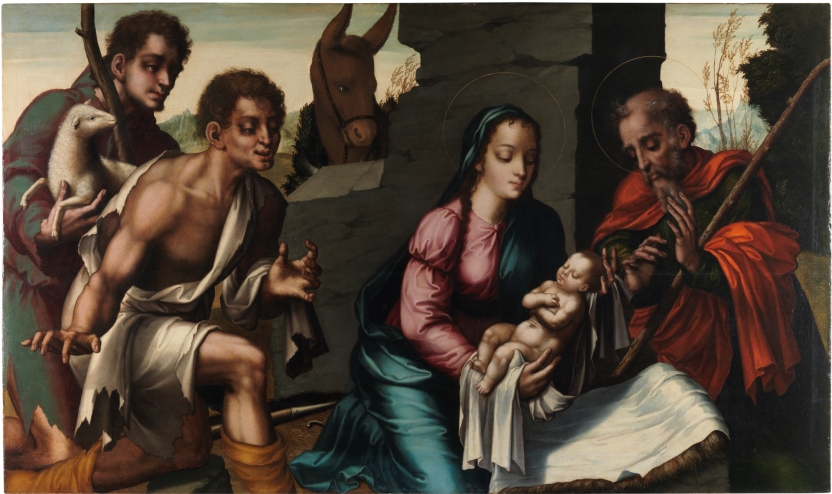
The Adoration of the Shepherds
Oil on panel. 1565 - 1570
It is extremely likely that these two panels, -The Adoration of the Shepherds and The Adoration of the Magi-, similar in format, measurements and style, belonged to the predella of the same altarpiece, since both have the usual configuration of paintings destined for this type of placement, and the compositional design in each case displays similarities in the size and arrangement of the figures as well as the background scenery. Further indications that their provenance is probably one and the
ARTWORK
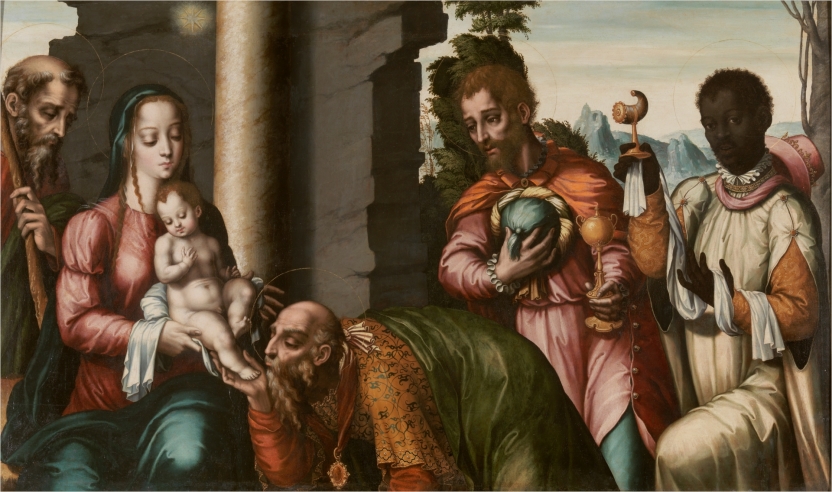
The Adoration of the Magi
Oil on panel. 1565 - 1570
It is extremely likely that these two panels, -The Adoration of the Magi and The Adoration of the Shepherds-, similar in format, measurements and style, belonged to the predella of the same altarpiece, since both have the usual configuration of paintings destined for this type of placement, and the compositional design in each case displays similarities in the size and arrangement of the figures as well as the background scenery. Further indications that their provenance is probably one and the
ARTWORK
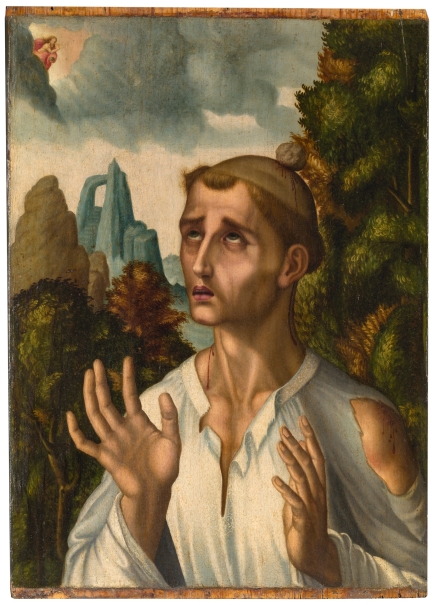
Saint Stephen
Oil on panel. Ca. 1575
The most frequent image of Saint Stephen shows his stoning after his condemnation for blasphemy by the Sanhedrin in Jerusalem. The account given in the Acts of the Apostles reads: And they stoned Stephen, calling upon God, and saying, Lord Jesus, receive my spirit. And he kneeled down, and cried with a loud voice, Lord, lay not this sin to their charge. (Acts, 7, 59-60). The death of the young deacon marked the start of the persecution of the Christians in Jerusalem and Palestine led by Saul, th
ARTWORK
Luis de Morales – (Workshop of)
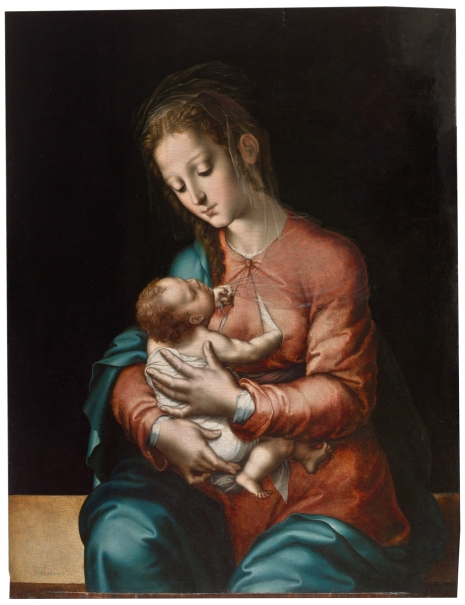
The Virgin and Child
Oil on panel. Ca. 1565
This is one of Morales’s most characteristic and best-known paintings, both because of its technical quality, its domestic format and its apparently tender and heartwarming subject, and also because it is one of the works by the painter that have been exhibited continuously ever since first entering the Prado. It joined the Museum’s holdings in 1916 after the Royal Board of Trustees had accepted the extraordinary artistic legacy of one of its most active and generous members, Pablo Bosch y Barra
ARTWORK
Pietà
Oil on panel. 1565 - 1570
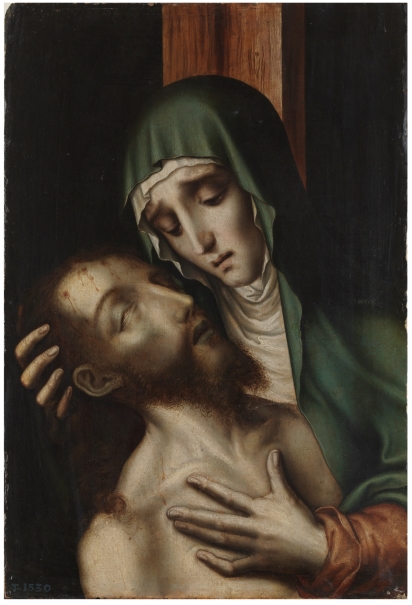
Large-format versions of the Virgin holding the dead body of Christ, like those at Badajoz Cathedral and at the Real Academia de Bellas Artes de San Fernando, gave way in Morales’s oeuvre to smaller compositions on the same subject, with half-length figures shown on a striking background of rigorous black. Against this, the two figures and the upright of the cross are contrasted with strong lighting. The pentimenti revealed by technical studies of the numerous versions in this new format, with c
ARTWORK
The Annuncation
Oil on panel. Ca. 1565
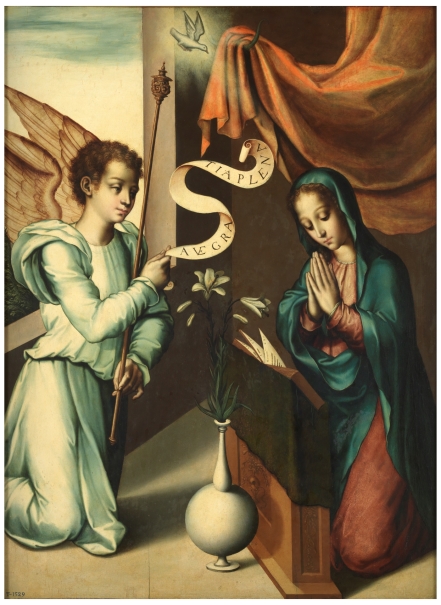
In a single sequence, the painting shows the Archangel Gabriel’s greeting to Mary, his announce ment to her that she has been designated as the mother of the son of God, and her acceptance of the divine will (Luke, 1, 26-38). St Gabriel appears on the viewer’s left, kneeling before the Virgin. He is covered in a white tunic constructed with a rich array of solidly drawn folds interspersed with a succession of clean bluish shadows. The outspread wings, golden in colour, stand out between the garm
ARTWORK
Saint John the Baptist
Oil on panel. Ca. 1566
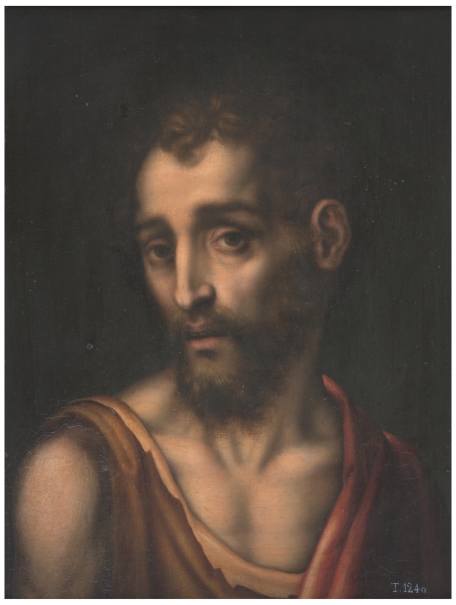
It is not known when or how these two paintings -Saint John the Baptist and Saint Juan de Ribera (P947)- came to be the property of Luisa Enríquez, but their common provenance has never been seen as an indication of a link with the same group of art works. However, the technical study that was recently carried out on the two panels shows that they are directly and unequivocally related in the oak wood used for them (which came from the same tree), their width without the lateral additions
ARTWORK
Christ Justifying his Passion
Oil on panel. Ca. 1565
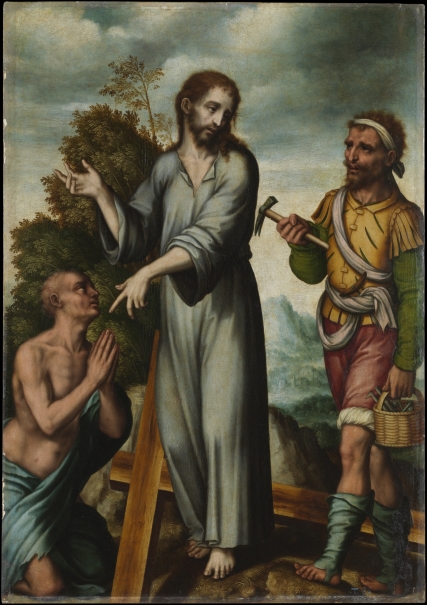
This work is an example of an exceptional iconography within the subject matter habitually dedicated to the Passion by the painter, and even within that of the European art of his time as a whole. Although his most frequent subjects were the traditional ones of the Ecce Homo (alone or accompanied by executioners, by Pontius Pilate and an executioner, or by the Virgin and St John), Christ at the Column and the Pietà, some of his works nevertheless dealt with scenes that did not appear in t
ARTWORK
Loading...

Loading...

Up