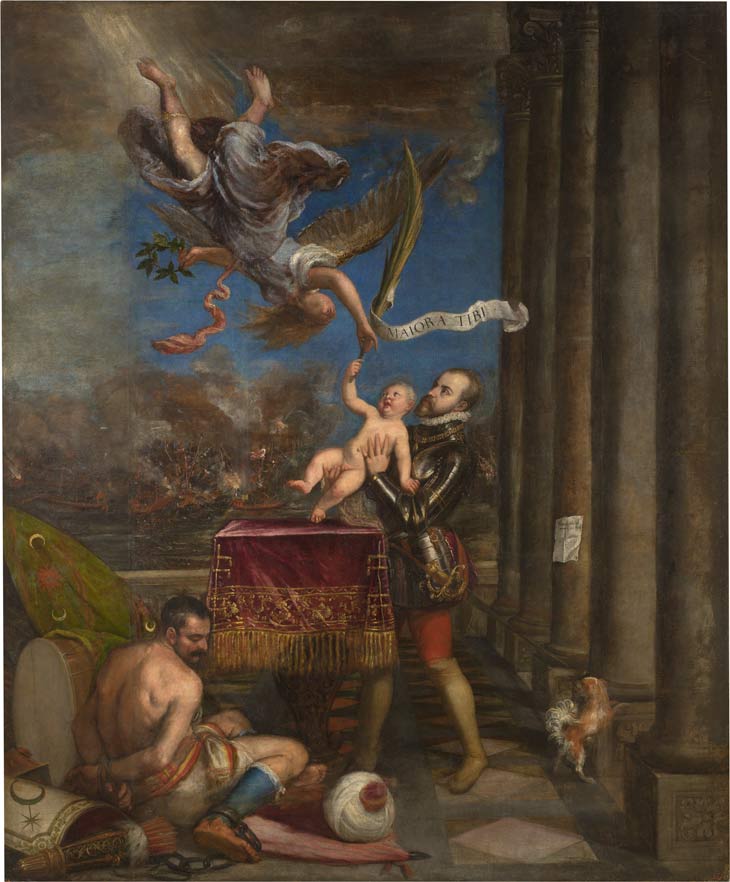
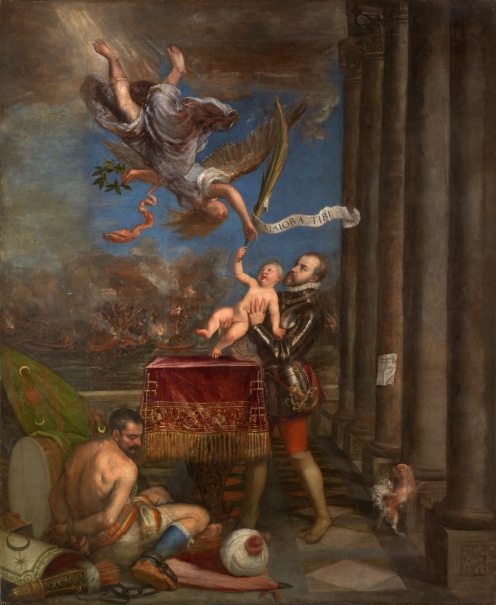
This canvas commemorates two events of enormous importance for Philip II which took place in 1571: the victory at Lepanto on 7 October, and the birth of his heir on 4 December.
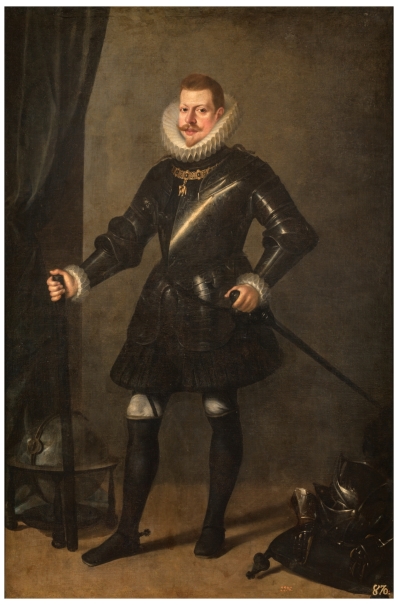
The King chose Titian’s work to represent his reign and paired it with the portrait of his father, Charles V at the Battle of Mühlberg, also by Titian. From then on they were always hung together and in order to display the depiction of Philip in the Salón Nuevo it was enlarged in 1625 to make it the same size as the portrait of the Emperor.
The recent restoration of Philip II offering the Infante don Ferdinand to Victory, undertaken by Elisa Mora and sponsored by Fundación Iberdrola España as a Benefactor Member of the Museum’s Restoration Programme, has recovered the qualities of Titian’s original but has also made Carducho’s enlargements more visible, particularly in the architectural elements. Following this presentation, the canvas will be shown with Carducho’s additions concealed.
The first known restoration of Titian’s painting took place in 1857 when it was possibly relined. Almost a century later, in 1953, the Museum’s records state that the restorers Martín Benito and Lópe Valdivieso worked on: “Titian Victory at Lepanto. Consolidate paint layer, restore, clean and check.”
The most recent restoration was initiated in 2016 and finished in May of this year. Given the particular characteristics of Titian’s painting with regard to both its size and state of conservation, it has been particularly complex.
Following analyses undertaken in the Museum’s technical documentation section and chemical laboratory, work began with the removal of surface dirt, oxidised varnishes and old areas of repainting from previous restorations.
This cleaning, which uncovered some old losses, cracks and infilling with gesso, was undertaken in three successive stages until Titian’s original could be revealed with all its characteristic pictorial technique. After cleaning, two large losses that had been repaired with inserts in the past became visible between the table and the King’s left arm.
The additions made by Carducho were found to be damaged and repainted, particularly in the left part of the sky. After eliminating these hard areas of repainting, significant losses and worn areas became visible. The blue pigments used by Carducho, which were different to those used by Titian and of inferior quality, had aged differently and altered, making his modifications visible, particularly in the Turk’s stockings.
Once cleaning had been completed, the pigment was fixed in the areas found to be fragile and or with irregularities along the seams of the added areas.
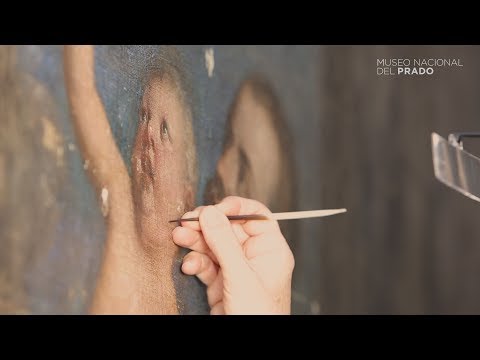
In order to restore the largest areas of paint loss, silicone moulds were made that reproduced the texture of the canvas and thus the characteristic vibration of Titian’s surfaces. Areas of paint loss and wear were first reintegrated with watercolour then, after the missing areas were filled in and the painting varnished with natural resin, a final adjustment was made to the colours.
During the restoration of the painting it was decided to restore the gilded wooden frame that has always accompanied it.