formularioRDF
The itinerary <em>TITULORECORRIDO</em> has been successfully created. Now you can add in works from the Collection browser
<em>TITULOOBRA</em> added to <em>TITULORECORRIDO</em> itinerary

Exhibition

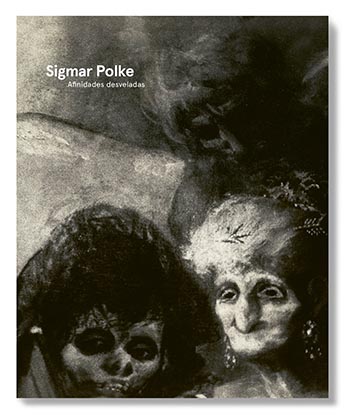
Sigmar Polke. Affinities Revealed

Museo Nacional del Prado. Madrid 11/26/2024 - 3/16/2025

Until 16 March 2025 in Rooms C and D of the Jerónimos Building, the Museo del Prado and the Fundación Amigos Museo del Prado, in collaboration with the Madrid City Council of Madrid, is presenting the first solo exhibition on Sigmar Polke in Madrid. 

Sigmar Polke. Affinities Revealed offers visitors the chance to learn about the work of one of the most influential names in contemporary European art and to discover the fascinating dialogue he established with the Spanish pictorial tradition, with Francisco de Goya as its maximum exponent. Two artists separated by almost two centuries, but connected by their disruptive and visionary approach. 

The exhibition, curated by Gloria Moure, brings together more than forty works by Sigmar Polke, including paintings, photographs and drawings, together with the magnificent painting Old Women or Time (1810-12) by Goya, from the collection of the Musée de Lille and presented here for the first time in Spain alongside its X-radiograph, an image that reveals compositions which particularly attracted Polke. This discovery encouraged him to experiment with new directions and offered him a source of inspiration to delve deeper into his own artistic concerns.

The route through the exhibition unites the legacies of two great masters, establishing a dialogue between Polke's formal experimentation and the symbolic charge of Goya's work.

Sigmar Polke. Affinities Revealed is the first solo exhibition to be devoted to the artist in Madrid, offering a stimulating dialogue between the creative career of this German painter and the indelible mark that Francisco de Goya left on his work and thought. Polke's encounter in 1982 with Goya’s painting Old Women or Time (1810-12) rapidly had figurative consequences which meant that his work was influenced from that point on with regard to both motifs and techniques and compositional criteria. In the X-radiograph analysis of Goya’s painting Polke discovered much more of what his intuition had led him to look for. This revelation of what is concealed reaffirmed his vision of painting as stratigraphic layers of time and memory. 

The effect of Goya on Polke and the affinity he felt with him particularly relates to three areas: the artist and the man, his artistic, political and social circumstances; the objectual and anthropomorphic iconography present in both Old Women and in its X-radiograph; and finally the painting’s specific pictorial technique.

The exhibition is not structured chronologically but rather through concepts that cross time, intersecting with the use of various techniques and revealing the creative complexity of one of the key artists of our time.

Curator:
Gloria Moure 

Access

Room C and D . Jerónimos Building

RDF

RDF

Sponsored by:
With the collaboration of:

Multimedia

Exhibition

The exhibition

The exhibition
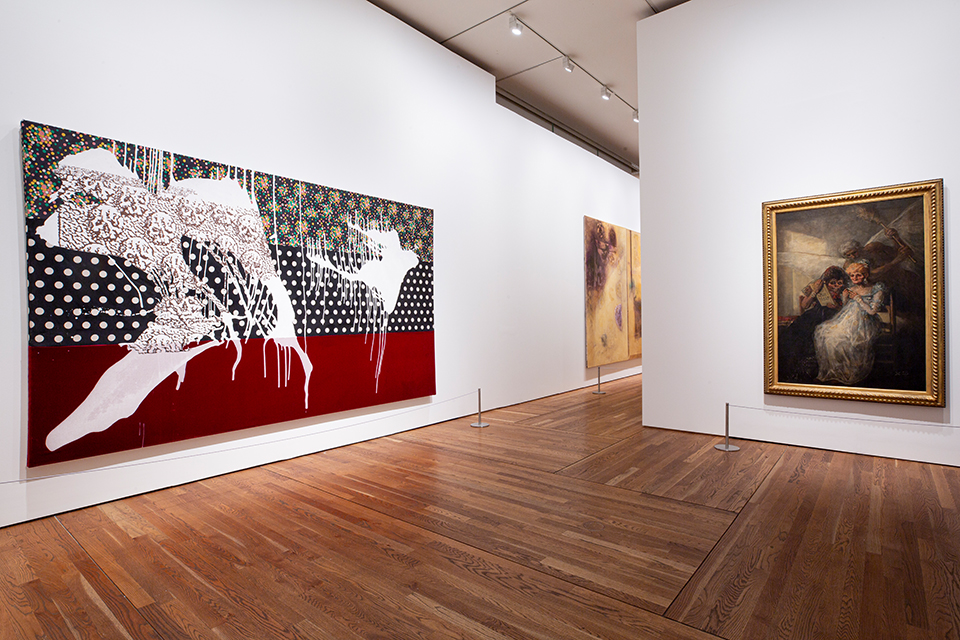
Image of the exhibition galleries “Sigmar Polke. Affinities Revealed”. Photo ©Museo Nacional del Prado

Curiosity lea d Polke to explore, by means of x-radiography what he sensed lay beneath the scene of The Old Women; this provided him with a wealth of themes which he would later address in his work. He was particularly struck by certain fragments of the canvas, which he photographed and then enlarged in photocopies that he altered by drawing over them. 

In the upper left part of the X-radiograph of The Old Women, we can quite clearly make out an earlier composition, a Resurrection of Christ surrounded by small fluffy clouds, within which faces or departed souls can be glimpsed. Polke found this composition especially appealing, as it chimed with his interest in the magical and the paranormal, and with his view of works of art more as phenomenological events than as closed, complete realities. 

Polke's iconographic exploration of the painting extended to the tiniest details, such as the jewellery adorning the lady in white, and especially the arrow so curiously lodged in her curls, as well as her disproportionately large earrings. Equally important are the wigs that conceal the ladies' baldness, which triggered Polke's later interest in headgear of all kinds. He also paid clase attention to the chair, and to the inquisitive mirror held up by the lady-in-waiting. 

Shades of Saturn (in his twin roles as mythological being and planet) - ruler of chance, time, feasting, criticism and the reversal of roles and attributes, lord of the daimons and guarantor of the utopian Golden Age- hover over Polke's vast exercise in the exploration of form and material, just as they dominate the scene in Goya's painting of the two old women. 

Goya's signature, enlarged in the photocopies, assumes particular importance, in that it reflects the incorporation of the artist's presence into the flow of creative formalisation, prompting a fertile collusion between chance or deliberate interactions and a formal association that inverts causes and effects. 

The late 1960s, when Polke was starting out on his career, were a time of cultural and political change. The determinist arguments espoused by the modernism whose birth had been witnessed by Goya were now being called into question. In both cases, an ancien régime had been overturned, but while the earlier cultural disruption had favoured an attempt to build a new, stable arder, the collapse that took place in the late 20th century called for more complex solutions, which had to include the concept of disequilibrium in all cultural spheres. 

Polke's creative drive springs from the search for communion with natural processes, from accident and error. When he provoques the flow of pigments concocted through daring chemistry, he is not describing; rather, he is immersed in the process, prompting concrete physical events. What matters here, though, is not the scientific underpinning, but the poetic substrate, which extends even to the artist's shaping outlook on the world with which he interferes while observing it. In that respect, Goya may well have sensed, in the early 19th century, that the Enlightenment would end up recreating an alienated world, far removed from experience, and for that reason he dispensed - somewhat urgently – with the idea of verisimilitude and instead enthusiastically embraced the uncertainty of the ambiguous and the changeable.

Artworks

1
Digital image of the X-radiograph of Francisco de Goya’s The Old Women / Time, 2020

C2RMF

2
The Old Women / Time

Francisco de Goya

Oil on canvas

1810–12

Lille, Palais des Beaux-Arts

3
Ashes to Ashes (Asche zu Asche)

Sigmar Polke

Dispersion paint and acrylic on printed fabrics and velour

1992

Chicago, Collection Museum of Contemporary Art Chicago, Gerald S. Elliott Collection

4
White Obelisk (Weißer Obelisk)

Sigmar Polke

Dispersion paint on printed fabric

1968

Siegen, The Lambrecht-Schadeberg Collection, Museum für Gegenwartskunst Siegen

5
Untitled (Triptych)

Sigmar Polke

Synthetic resin and pigment on canvas

1982

Potomac, Maryland, Glenstone Museum

6
Ghost (Geist)

Sigmar Polke

Gouache and watercolour on paper

1966

Stuttgart, Froehlich Collection

7
Ghost (Geist)

Sigmar Polke

Acrylic paint and watercolour on tracing paper

c.1967

Olbricht Collection

8
Untitled (Large Potato Head) (Ohne Titel [Großer Kartoffelkopf])

Sigmar Polke

Gouache on paper

1965

Stuttgart, Froehlich Collection

9
Ghost with Necktie (Das Krawatten-Phantom)

Sigmar Polke

Ballpoint pen on paper

1965

Munich, Staatliche Graphische Sammlung, on permanent loan from Wittelsbacher Ausgleichsfonds, Collection Herzog Franz von Bayern

10
Tartini’s Dream

Louis-Léopold Boilly

Lithograph

1824

Paris, Bibliothèque nationale de France

11
Paganini

Sigmar Polke

Dispersion paint, aluminium paint and graphite on printed fabric

1981–83

Private Collection

12
Untitled (Goya) (Ohne Titel [Goya])

Sigmar Polke

Gelatin silver print (unique prints)

c. 1984

Düsseldorf, Sies + Höke; Kicken Berlin

13
Interior (Interieur)

Sigmar Polke

Pintura de dispersión, gouache, témpera y pintura látex sobre lienzo

1965

Baden-Baden, Museum Frieder Burda

14
This is how you sit correctly (after Goya and Max Ernst) (So sitzen Sie richtig [nach Goya und Max Ernst])

Sigmar Polke

Silver, bronze, dispersion paint and acrylic on printed fabric

1982

Private Collection

15
Oil Slick (Olfleck)

Sigmar Polke

Oil and gold leaf on printed fabric

1983

Germany, Würth Collection

16
Nightcap I (Nachtkappe I)

Sigmar Polke

Indigo and alcohol varnish on canvas

1986

Paris, Fondation Louis Vuitton

17
Woman in the Mirror (Frau im Spiegel)

Sigmar Polke

Acrylic paint on printed fabric

1966

London, Private Collection

18
Seeing Things as They are (Die Dinge sehen wie sie sind)

Sigmar Polke

Synthetic resin and lacquer on polyester fabric

1992

Karlsruhe, Städtische Galerie, Garnatz Collection

19
Untitled (Ohne Titel)

Sigmar Polke

Dispersion paint, lacquer and graphite on nettle tracing paper

1981

Kunstmuseum Bonn

20
Lines of the Left Hand (Handlinien links) and Lines of the Right Hand (Handlinien rechts)

Sigmar Polke

Dispersion paint on lurex fabric

1968

Kunstmuseum Bonn

21
Expanding the Planetary System with a 10th Planet (Erweiterung des Planetensystems um einen 10. Planeten)

Sigmar Polke

Ballpoint pen, ink and watercolour on paper

1968

Berlin, London and New York, Galerie Michael Werner

22
Profile (Profil)

Sigmar Polke

Acrylic on printed fabric

1968

Stuttgart, Froehlich Collection

23
Velocitas-Firmitudo

Sigmar Polke

Graphite, silver oxide and Damar resin on canvas

1968

Private Collection

24
We’ve never done it like this before (Das haben wir noch nie so gemacht)

Sigmar Polke

Synthetic resin and pigment on canvas

1982

Rottterdam, Collection Museum Boijmans Van Beuningen

25
Untitled (Fly Agaric) (Ohne Titel [Fliegenpilz])

Sigmar Polke

Gelatin silver prints

1975

Otterlo, Kröller-Müller Museum, formerly in the Visser collection, acquired with support from the Mondriaan Foundation

26
Opium Smoker (Opiumraucher)

Sigmar Polke

Synthetic resin and lacquer on canvas

1983

Düsseldorf, Droege Art Collection

27
China Sea (Chinesisches Meer)

Sigmar Polke

Synthetic resin and pigment on canvas

1983

Private Collection

28
Lapis Lazuli II

Sigmar Polke

Lapis lazuli and resin on canvas

1994

Nimes, Carre d’Art, Musée d’art contemporain

29
Catastrophe Theory II (Katastrophentheorie II)

Sigmar Polke

Natural and synthetic resin, acrylic and pigment on canvas

1983

Vienna, Schauer Collection

30
Catastrophe Theory IV (Katastrophentheorie IV)

Sigmar Polke

Natural and synthetic resin, acrylic and pigment on canvas

1983

Vienna, Schauer Collection

31
Rainbow (Rainy Weather) (Regenbogen [Regenwetter])

Sigmar Polke

Synthetic resin and pigment on canvas

1983

Kunstmuseen Krefeld

32
Meteorite Fragments (Meteorenspane)

Sigmar Polke

Gelatin silver prints

1989

Karlsruhe, Städtische Galerie Karlsruhe, Garnatz Collection

33
Nostradamus

Sigmar Polke

Synthetic resin, mica enamel and gold leaf on printed fabric

1989

Colección Fundación ARCO. Depósito Museo CA2M

34
Topsy-Turvy World (Le Monde à l’envers)

Sigmar Polke

Synthetic resin and dispersion paint on fabric

1989

Madrid, Private Collection

35
Pikes

Sigmar Polke

Acrylic and synthetic resin on printed fabric

1988

Madrid, Private Collection

36
The Day of Glory has arrived (Le jour de gloire est arrivé)

Sigmar Polke

Synthetic resin, lacquer paint and pigment on polyester fabric

1988

Paris, Private Collection

37
Mephisto

Sigmar Polke

Dispersion paint, synthetic resin and pigment on fabric

1988

Colección de Arte Contemporáneo Fundación “la Caixa”

38
The Colossus

Attributed to Francisco de Goya y Lucientes

After 1808

Oil on canvas. 116 x 105 cm

Madrid, Museo Nacional del Prado

39
Black Man (Schwarzer Mann)

Sigmar Polke

Synthetic resin, shellac, pigments and beeswax on Dekostoff fabric

1982

Riehen/Basilea, Fondation Beyeler, Gift of Collection Renard

40
Large Man (Großer Mann)

Sigmar Polke

Acrylic on printed fabric

1986–92

Baden-Baden, Museum Frieder Burda

41
Fear, Black Man (Furcht [Schwarzer Mann])

Sigmar Polke

Synthetic resin on polyester fabric

1997

London, Private Collection

42
Max Ernst, Une semaine de bonté, Paris, Éditions Jeanne Bucher, 1934

Photogravure from a collage

Madrid, Museo Nacional Centro de Arte Reina Sofía. Biblioteca y Centro de Documentación

43
Eugène Ronjart, “She tiptoed out of the room to avoid waking her mother”, photogravure in Adolphe d’Ennery, Martyre!, Paris, Jules Rouff [1886]

Madrid, Museo Nacional del Prado, Biblioteca

44
Max Ernst, “And the butterflies start to sing”, in La Femme 100 têtes, Paris, Éditions du Carrefour, 1929

Photogravure from a collage

Madrid, Museo Nacional Centro de Arte Reina Sofía. Biblioteca y Centro de Documentación

45
Unknown artist, “Capuchin cemetery at Palermo”, in Le Magasin pittoresque, no. 1, January 1833

Madrid, Biblioteca del Ateneo

46
A.L. Clément, after an engraving by F. Méaville, “Moths of the genus Hybernia around a streetlamp in the Bois de Boulogne, Paris”, in La Nature, no. 969, vol. 1, Paris, 26 December 1891

Madrid, Biblioteca Nacional de España

47
Francisco de Goya, They already have a seat (Caprichos, n.º 26)

1797-99, print reproduced in Los Caprichos de Goya y sus dibujos preparatorios, with preliminary study and notes by Francisco Javier Sánchez Cantón, Barcelona, Instituto Amatller de Arte Hispánico, 1949.

Print on demand

Print artworks available in our catalogue in high quality and your preferred size and finish.

Image archive

Request artworks available in our catalogue in digital format.

Up