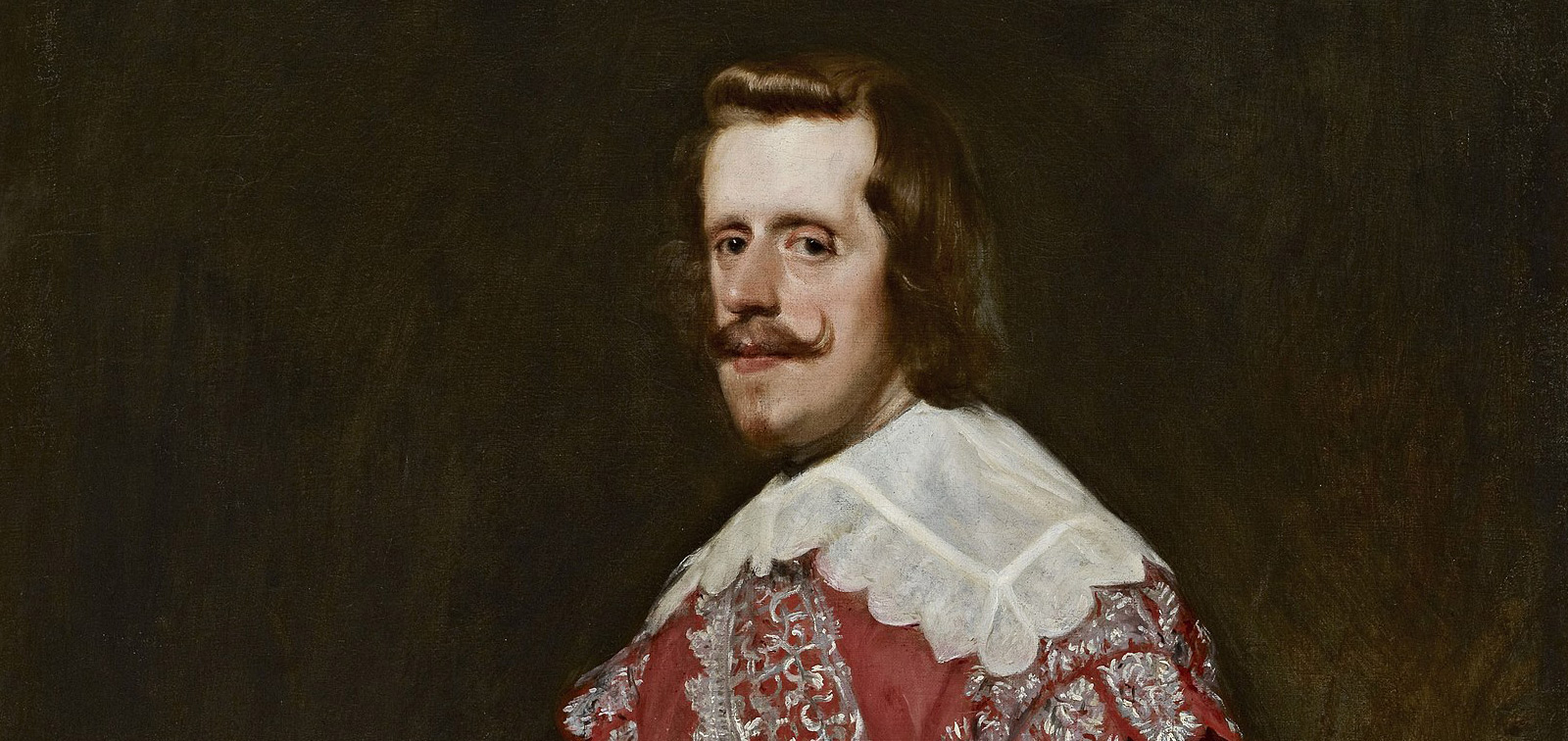
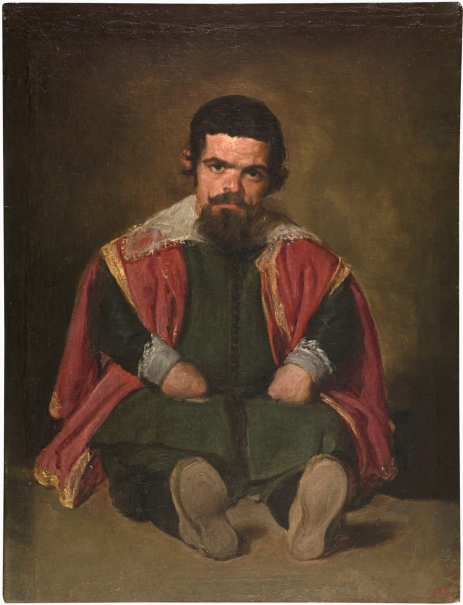
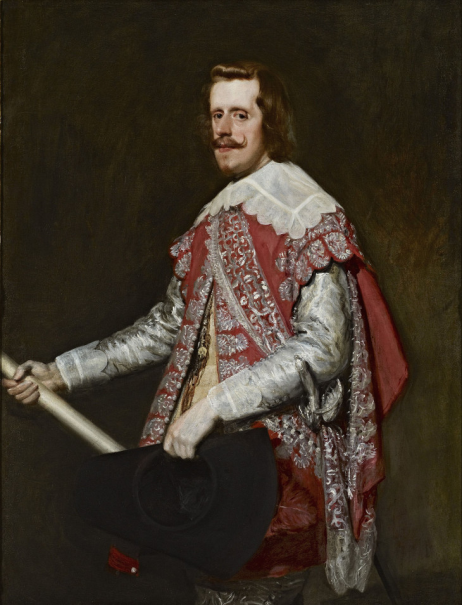
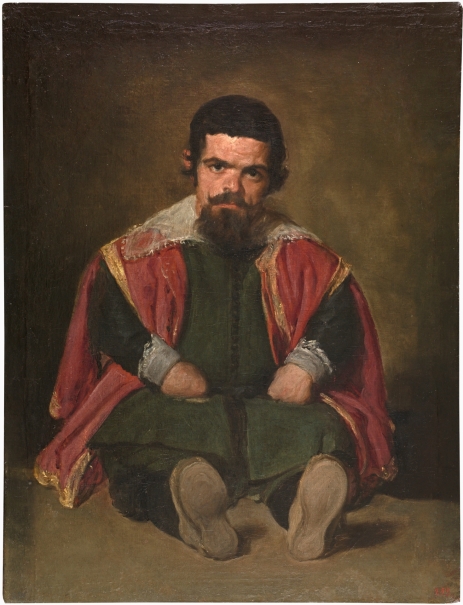
The financial accounts for Philip IV’s trip to Catalonia reveal that in addition to painting the king, Velázquez also executed a portrait of “El Primo”, a court buffoon who accompanied the monarch. For many years El Primo was thought to be a buffoon portrayed by Velázquez dressed in dark clothes, sitting on the ground and looking at a book, a work that is also in the Prado. At the same time, it was noticed that the portrait considered to be of Sebastián de Morra was painted on a type of canvas and with a preparatory layer unusual for Velázquez.
The issue was resolved in 2012 following a technical study of the portrait of the king. Pablo Pérez d’Ors, Richard Johnson and Don Johnson discovered that the canvas on which that work is painted is identical (and has the same preparation) to that used for the supposed portrait of Sebastián de Morra, which was as a consequence definitively retitled El Primo.
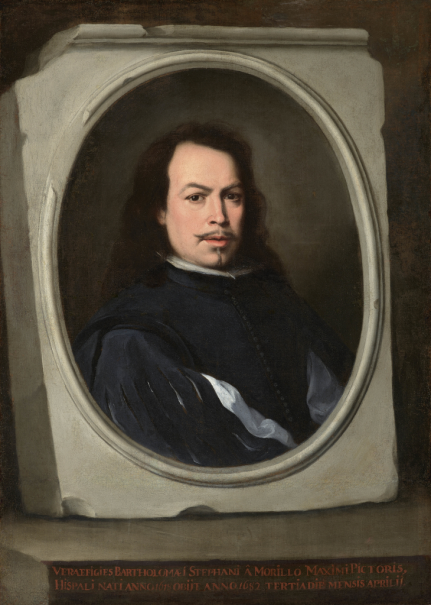
- Self-portrait
- Bartolomé Esteban Murillo
- Oil on canvas, 107 x 77.5 cm
- Ca. 1650-55
- The Frick Collection, New York. Gift of Dr and Mrs Henry Clay Frick II, 2014
Here Murillo constructs a sophisticated play of artifice based on his own image. His portrait is framed by an oval moulding set in a stone block. The upper part of his right arm seems to extend beyond the limits of the stone frame, forcing the limits between sculpture, painting and reality.
A notable element is the presence of chips in the block, which allude to the passing of time and hence to artistic fame, which survives it. In this sense the use of an oval format has connotations of prestige in terms of portraiture given its association with the medal, in turn allied to the concepts of fame and the endurance of memory.
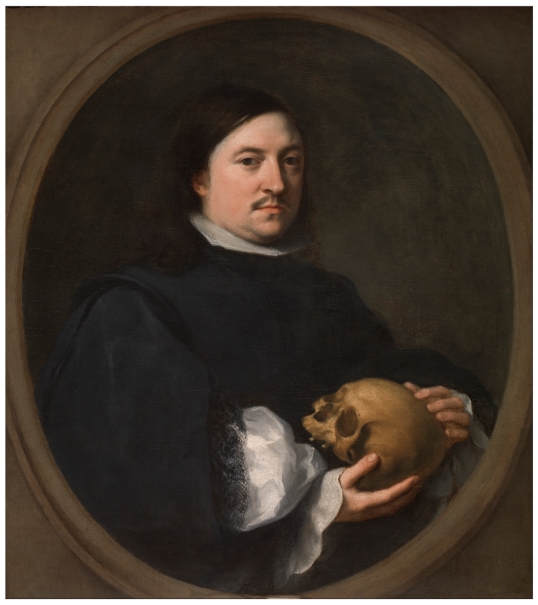
- Nicolás Omazur
- Bartolomé Esteban Murillo
- Oil on canvas, 83 x 73 cm
- Madrid, Museo Nacional del Prado
Murillo’s portraits not only introduce us to his own image to some degree but also to that of part of his circle of friends and clients. Nicolás Omazur (1641-1698), a Seville-based Flemish merchant who assembled a notable collection of the painter’s works, falls within both these groups.
The exhibition juxtaposes images of the artist and his friend in two works which have much in common; both form part of a small group of half-length portraits with the figures set in fictive circular or oval frames that seem to be made of stone. By using this device Murillo encourages the viewer to enter further into an illusionistic game through the way the sitters appear to project beyond the limits of their stone frames.
- Pedro de Alcántara Téllez-Girón, 9th Duke of Osuna
- Francisco de Goya y Lucientes
- Oil on canvas, 113 x 83.2 cm
- Ca. 1790s
- The Frick Collection, New York
The 9th Duke of Osuna (1755-1807) belonged to one of Spain’s most powerful families, increasing that influence through his marriage to the Duchess of Benavente. A socially dazzling and cultured couple, they shared many of the ideals of the Enlightenment with regard to public good and the need to encourage education and culture. They were also two of Goya’s most committed and intelligent clients and the artist painted more than 30 works for them. A number of them were portraits, such as this image of the duke which shows him aged around forty in a relaxed, spontaneous pose. His amiable features and lively eyes make his face one of the most appealing of any depicted by the artist.
- Portrait of a military Officer (the Count of Teba?)
- Francisco de Goya y Lucientes
- Oil on canvas, 63.2 x 48.9 cm
- Ca. 1804 (?)
- The Frick Collection, New York
This sitter is generally identified as Eugenio Guzmán de Palafox y Portocarrero, Count of Teba (1773-1834). As an army officer and aristocrat he played a notable role in both political and military affairs of the day. He was an enemy of Godoy, distinguished himself during the War of Independence and was made Captain General of the Kingdom of Granada in 1814. Guzmán de Palafox was imprisoned various times and veered between a moderate liberalism, which led him to translate Voltaire’s Brutus, and adherence to the absolutist cause after the failure of the Liberal Triennial.
The count’s adventurous life was matched by his dashing character, which is evident in this portrait: his dishevelled hair and large, dark eyes, suggesting the power to command, result in an intensely expressive image.
- The Forge
- Francisco de Goya y Lucientes
- Oil on canvas, 181.6 x 125.1 cm
- Ca. 1815-20
- The Frick Collection, New York
Goya locates the blacksmiths on a pictorial plane close to the viewer and creates a monumental viewpoint through the figures’ powerful bodies and concentrated expressions, their location in a empty setting and an expressive use of colour. The dirty white of the shirt and the glowing red of the metal create the focus for a composition in which blacks and greys prevail.
Like Velázquez with Vulcan’s Forge, this subject provided Goya with the opportunity to show the human body from various different viewpoints and display his mastery of corporeal expression. The spatial concept is also similar, with no pre-existing setting for the figures. Located around the anvil, it is they who create the spatial references through their volumes and movements.
- Portrait of a Woman
- Francisco de Goya y Lucientes
- Oil on canvas, 80 x 58.4 cm
- 1824
- The Frick Collection, New York
The year 1824 was one of important changes in Goya’s life. Having spent time in Madrid, he went first to Paris then settled in Bordeaux, the city in which he died four years later. This context makes it difficult to know where the present work was painted, nor is the sitter’s identity certain. Following the opinion of the painting’s first known owner, Aureliano de Beruete, she is generally considered to be María Martínez de Puga.
This is in any case an outstanding example of the way Goya was able to adapt his portraits to the new social context in which he moved at the end of his career. These new circumstances allowed him to work with an unprecedented technical freedom that justifies the frequent references to Édouard Manet in relation to this painting.
- Juan Bautista Muguiro
- Francisco de Goya y Lucientes
- Oil on canvas, 103 x 85 cm
- Madrid, Museo Nacional del Prado
Juan Bautista Muguiro (1786-1856) was a trader and financier based in Bordeaux where he was part of the Spanish colony who had moved to that city or taken refuge there, among whom Goya was very warmly welcomed. The two were distantly related but in the dedication on the painting the artist opted to refer to his model as “his friend”.
Taking the dark tones of the clothes habitually worn by his sitters as his starting point, Goya notably reduced the chromatic range, looking for neutral backgrounds that would harmonise with the muted shades of these fabrics and not distract attention from the principal motif. A year before his death he was able to individualise all the chromatic gradations and textures of the different garments while creating a remarkably lifelike sense of volume and presence.