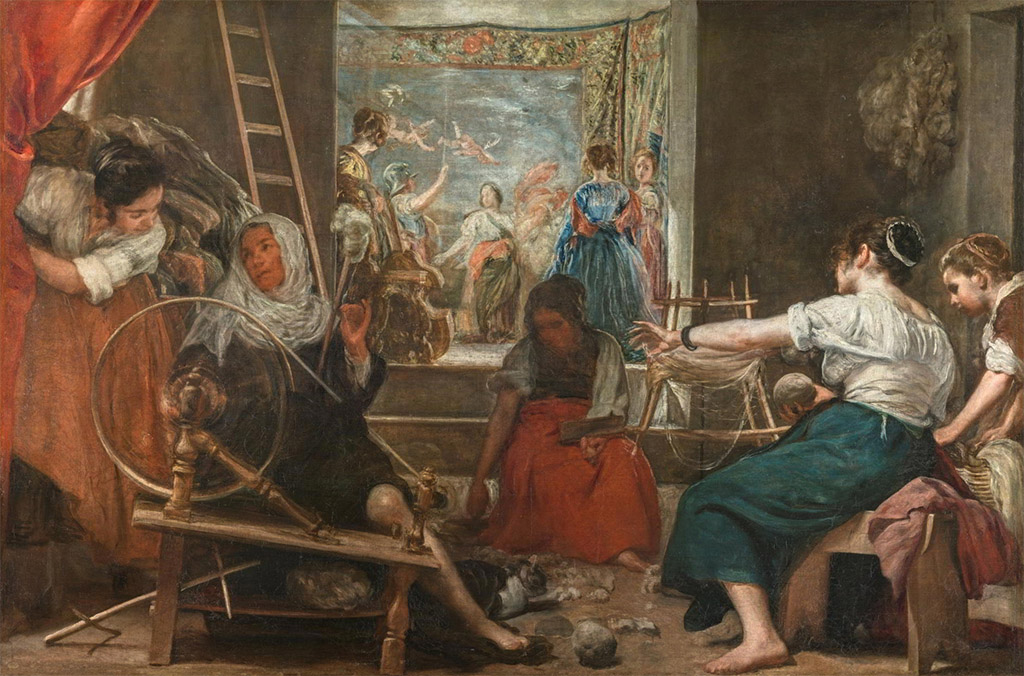
This painting depicts a mythological story.
Mythology is the collection of stories about the gods, heroes and traditions specific to nations or cultures.
This painting shows 2 moments of the same mythological story.
Arachne was a young woman who was highly skilled at weaving tapestries.
A tapestry was a large cloth of wool or silk.
In the past, paintings were replicated on tapestries and decorated the walls of palace halls.
Arachne challenged the Greek goddess of the arts, Athena, to see who was the best at spinning and making a tapestry.
The scene we can see in front of us is the competition between Athena and Arachne.
Athena is the elderly woman who works with the spinning wheel.
The spinning wheel is an ancient machine for spinning thread.
Velázquez portrays Athena as an elderly woman to show that older people have more wisdom.
Arachne is the young woman in a white blouse with her back turned.
She works with the winder.
The winder is a machine for winding thread.
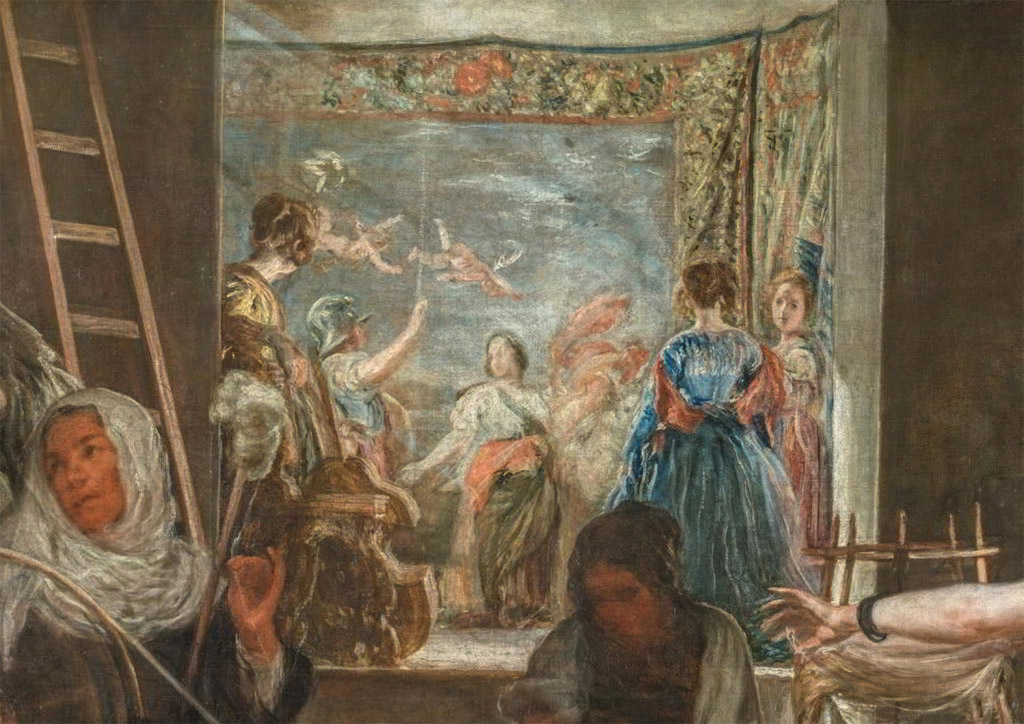
The scene in the background shows the result of the competition.
Arachne is the winner and stands in the centre.
Athena in armour is on the left.
Behind this scene, we can see the tapestry of the scene The Rape of Europa.
Arachne weaved this tapestry to provoke Athena.
In the scene of “The Rape of Europa”, god Zeus kidnaps a woman named Europa.
Zeus is the father of Athena.
Athena gets angry when she sees this scene of her father.
Arachne raises her arms, surprised by the punishment Athena imposes on her.
Arachne becomes a spider and must weave for the rest of her life.
In the background, 3 women accompany Arachne and Athena.