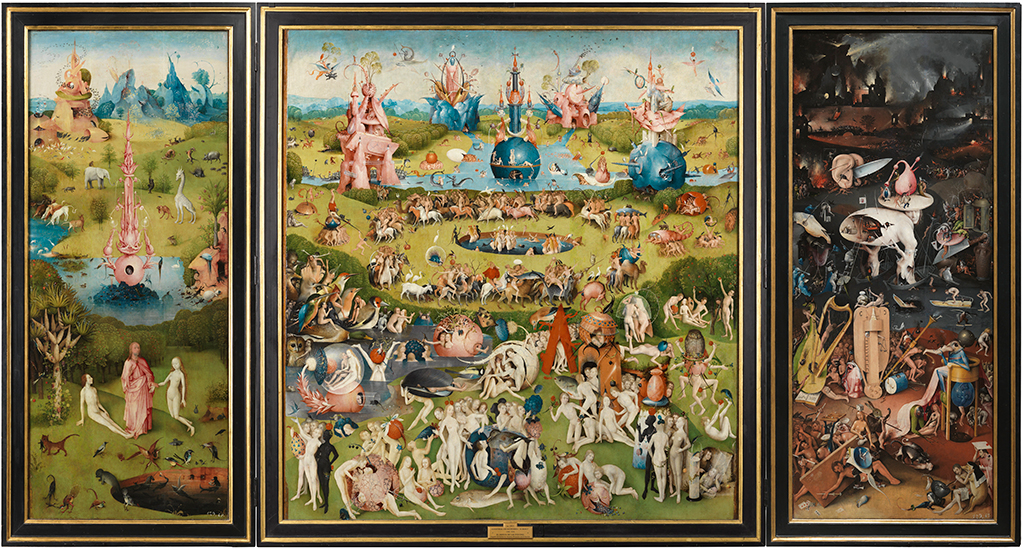
The left panel depicts the earthly Paradise.
Adam and Eve are with God the Father.
Next to Adam is the Tree of Life, and behind, on the right of the pond, is the Tree of the Knowledge of Good and Evil.
A snake coils around the tree.
This image represents the original sin when Adam and Eve ate the forbidden fruit from the Tree of Knowledge.
Because of that sin, God expelled them from Paradise.
In the central panel is the Garden of Delights.
Bosch paints a large number of naked men and women, many engaging in sexual relations.
The painter wants to show the sin of lust, which is when a person has excessive sexual desire.
Some animals, plants, and fruits are enormous, larger than people.
Among the scenes at the bottom is a couple in a cracked glass globe.
This globe symbolises that happiness is fragile and can break easily.
In another scene, a man carries a giant mussel.
In the mussel is his wife with her lover.
The man bears the infidelity of his wife.
In the centre, there is a pond full of naked women.
Next to the pond, a group of men on horseback spins around, representing different human vices.
In this painting, we can see various magnificent structures on the top, standing over the water.
In the centre is a structure with cracks, symbolising that it will not last long, just like the pleasures that humans enjoy.
On the right panel of the painting, we can see hell.
In hell, people receive punishments and torture for their sins.
Bosch portrayed a dark and terrible world with monsters.
In the centre, a man-shaped tree, possibly representing the devil, looks at the punishments without showing emotions.
Below, a monster devours people and throws them into a black pit.
In the pit, we can see more human faces.
The musical instruments people used for enjoyment in Paradise, and now the instruments are torture machines.
Bosch paints a picture and warns about the momentary nature of happiness and pleasures.
King Philip the Handsome, husband of Queen Joanna of Castile, admired the painting by Bosch.
His grandson, King Philip the Second, bought many of his paintings.


.jpg)