formularioRDF
The itinerary <em>TITULORECORRIDO</em> has been successfully created. Now you can add in works from the Collection browser
<em>TITULOOBRA</em> added to <em>TITULORECORRIDO</em> itinerary

The Spinners or The Fable of Arachne. Velázquez

The Spinners or the Fable of Arachne is a painting by Velázquez, a Spanish painter.

The painting is from 1660.

ETR (Easy to Read) icon
© Easy-to-read european logo: Inclusion Europe. More information at: Easy-to-read

¿What is the subject?

This painting depicts a mythological story.

Mythology is the collection of stories about the gods, heroes and traditions specific to nations or cultures. 

This painting shows 2 moments of the same mythological story.

Arachne was a young woman who was highly skilled at weaving tapestries.

A tapestry was a large cloth of wool or silk.

In the past, paintings were replicated on tapestries and decorated the walls of palace halls.

Arachne challenged the Greek goddess of the arts, Athena, to see who was the best at spinning and making a tapestry.

 The scene we can see in front of us is the competition between Athena and Arachne.

Athena is the elderly woman who works with the spinning wheel. 

The spinning wheel is an ancient machine for spinning thread.

Velázquez portrays Athena as an elderly woman to show that older people have more wisdom.

Arachne is the young woman in a white blouse with her back turned.

She works with the winder. 

The winder is a machine for winding thread.

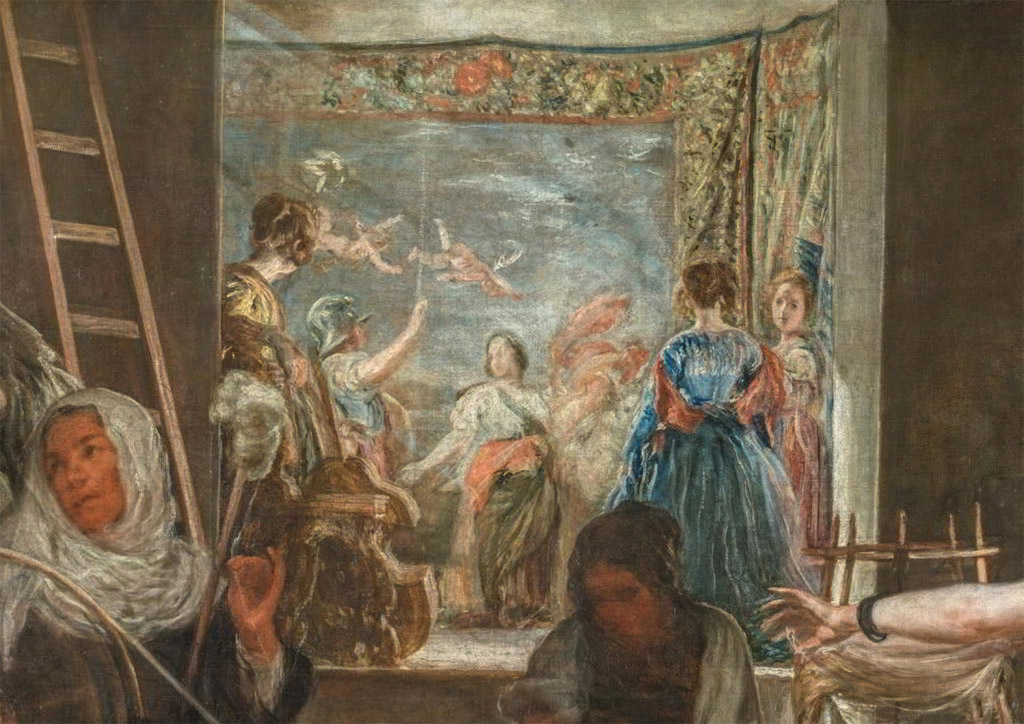
 The scene in the background shows the result of the competition.

Arachne is the winner and stands in the centre.

Athena in armour is on the left.

Behind this scene, we can see the tapestry of the scene The Rape of Europa.

Arachne weaved this tapestry to provoke Athena.

In the scene of “The Rape of Europa”, god Zeus kidnaps a woman named Europa. 

Zeus is the father of Athena.

Athena gets angry when she sees this scene of her father. 

Arachne raises her arms, surprised by the punishment Athena imposes on her.

Arachne becomes a spider and must weave for the rest of her life.

In the background, 3 women accompany Arachne and Athena.
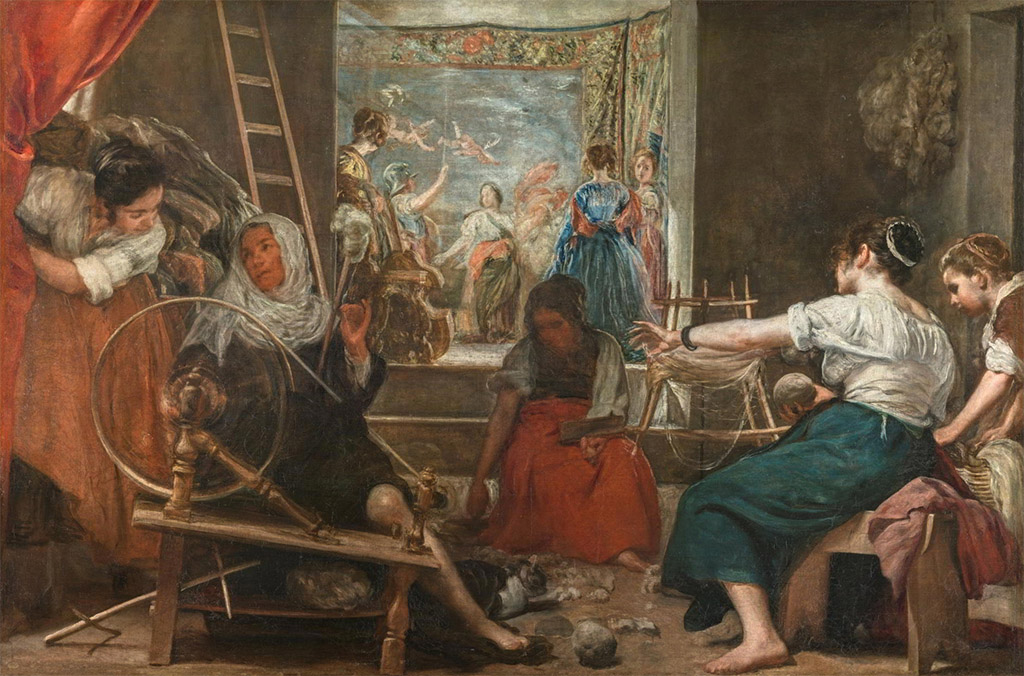
Picture of The Spinners by Velázquez

Why is this work relevant?

The painting is one of the most complex works by Velázquez.

In this painting, Velázquez combines figures and various scenes of the same story. 

This combination is one of the greatest achievements of Velazquez.

Another important achievement is the sensation of motion.

In this painting, Velazquez creates the illusion of movement in the spinning wheel. 

Another difficulty is that Velázquez paints a tapestry inside the painting.

The scene of “The Rape of Europa”, which Velázquez depicted in the background of the painting, is a work by the Italian painter Titian.

Titian painted The Rape of Europa about 100 years earlier.

Velázquez painted it as a tribute to Titian. 

Velázquez greatly admired Titian, who was a renowned artist.

Experts believed that, in this scene, Velázquez intended to recognise the importance of manual labour.

Later, experts discovered that it was a mythological story.

But today, experts still debate the meaning of the scene.

Some experts think that this painting warns against the arrogance of powerful people, while others see it as a way to support painting as a form of art.

Detail of the tapestry
Funded by the European Union - NextGenerationEU Government of Spain - Ministry of Culture Recovery, Transformation and Resiliency Plan Museo Nacional del Prado

Funded with the National Recovery and Resilience Plan (NRPP) , Spain’s Next Generation EU financing and according to the initiatives within the component C.24.I3 Digitization and valorization of major cultural services. The project is part of Campus Prado within Accessibility and Signage: Revitalization of the Urban Environment action line and as a universal accessibility activity.

Up