formularioRDF
The itinerary <em>TITULORECORRIDO</em> has been successfully created. Now you can add in works from the Collection browser
<em>TITULOOBRA</em> added to <em>TITULORECORRIDO</em> itinerary

Vulcan’s Forge. Velázquez

Vulcan’s Forge is a painting by Diego Velázquez, 

a Spanish painter.

The painting is from 1630.

ETR (Easy to Read) icon
© Easy-to-read european logo: Inclusion Europe. More information at: Easy-to-read

What is the subject?

This painting is a scene from the mythology of Ancient Greece and Rome.

Mythology is the collection of stories about the gods, heroes and traditions specific to nations or cultures. 

Apollo is the god of the sun and appears in the painting on the left with a light around his head.

Apollo visits Vulcan at his forge.

The forge is a shop where people make metal objects.

Vulcan is the god of fire who always worked at the forge.

Vulcan was married to Venus, the goddess of love.

Apollo tells Vulcan that Venus is unfaithful to him with Mars, the god of war.

Vulcan makes an angry face, and the workers at the forge look surprised.

They all stare at Apollo when he tells Vulcan of the infidelity of his wife.

Velázquez created paintings that told a story, for example, this visit of Apollo to Vulcan.

The scene is lively and reflects the surprise that comes with the news.

For this reason, Velázquez portrays the figures with diverse gestures and reactions.

Vulcan’s Forge by Velázquez

What makes this painting relevant?

The human figures of Velázquez are realistic, which means that they look very close to reality.

In this painting, Velázquez wanted to show the impact of jealousy and deception on people. 

The bodies of the figures are full-length and life-size, which means that they are the same size as real people.

Velázquez painted the bodies in great detail as he painted the muscles of the figures.  

The objects also look very real.

For example, the red-hot metal piece looks like it can really burn.

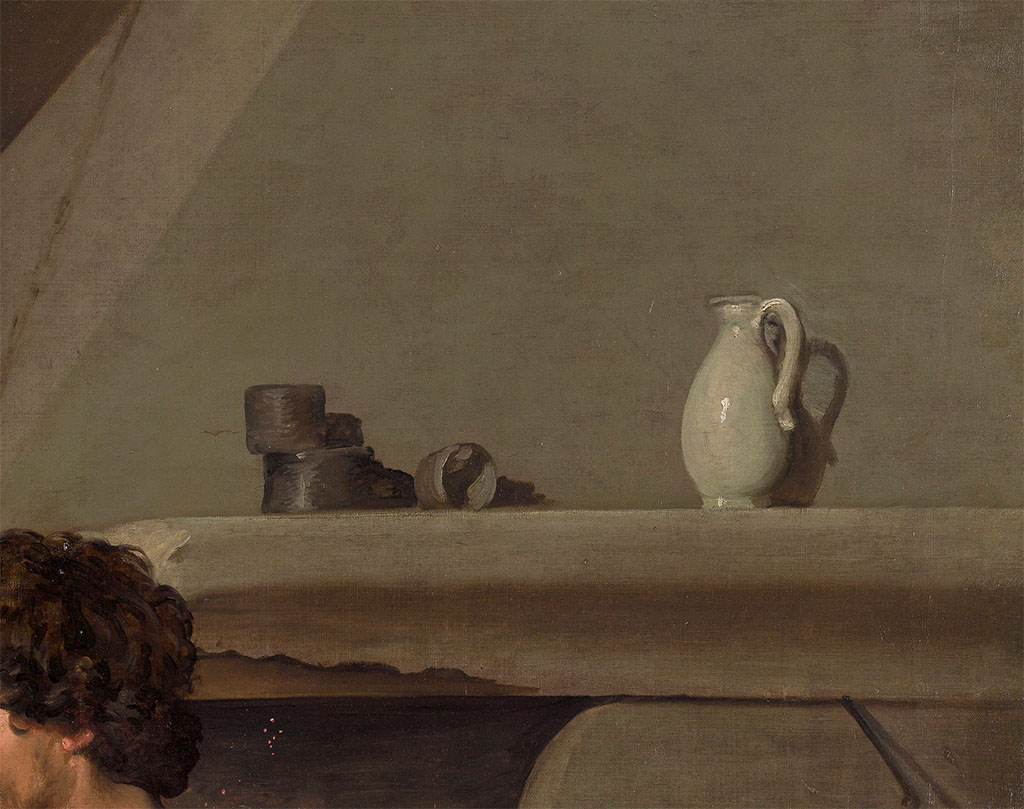
Also, the armour or the jug on the chimney in the background glow.

Velázquez created this painting when he lived in Italy.

The painter Rubens encouraged him to make this trip, and Velázquez obtained permission for the journey.

On this trip, Velázquez studied how Italian painters portrayed the nude and the emotions of the figures.

Detail of the objects on the fireplace of Vulcan’s forge

Where was the painting before arriving to the Museo del Prado?

The painting was first in the Buen Retiro Palace, near the Retiro Park in Madrid. 

This palace no longer exists. 

Later, the painting was in the Royal Palace.

Funded by the European Union - NextGenerationEU Government of Spain - Ministry of Culture Recovery, Transformation and Resiliency Plan Museo Nacional del Prado

Funded with the National Recovery and Resilience Plan (NRPP) , Spain’s Next Generation EU financing and according to the initiatives within the component C.24.I3 Digitization and valorization of major cultural services. The project is part of Campus Prado within Accessibility and Signage: Revitalization of the Urban Environment action line and as a universal accessibility activity.

Up