Effigies amicorum. Portraits of Artists by Federico de MadrazoTuesday, September 22, 2015
The Museo del Prado is celebrating the publication of the general catalogue of its collection of nineteenth-century painting edited by José Luis Díez and Ana Gutiérrez and the bicentenary of the birth of Federico de Madrazo with a monographic exhibition on this painter. Madrazo was one of the most influential men on the Spanish art scene of the time owing to both the quality of his painting and his status as director of the Museo del Prado and the San Fernando Academy of Fine Arts and master to many of the most significant Spanish painters of the following generations.
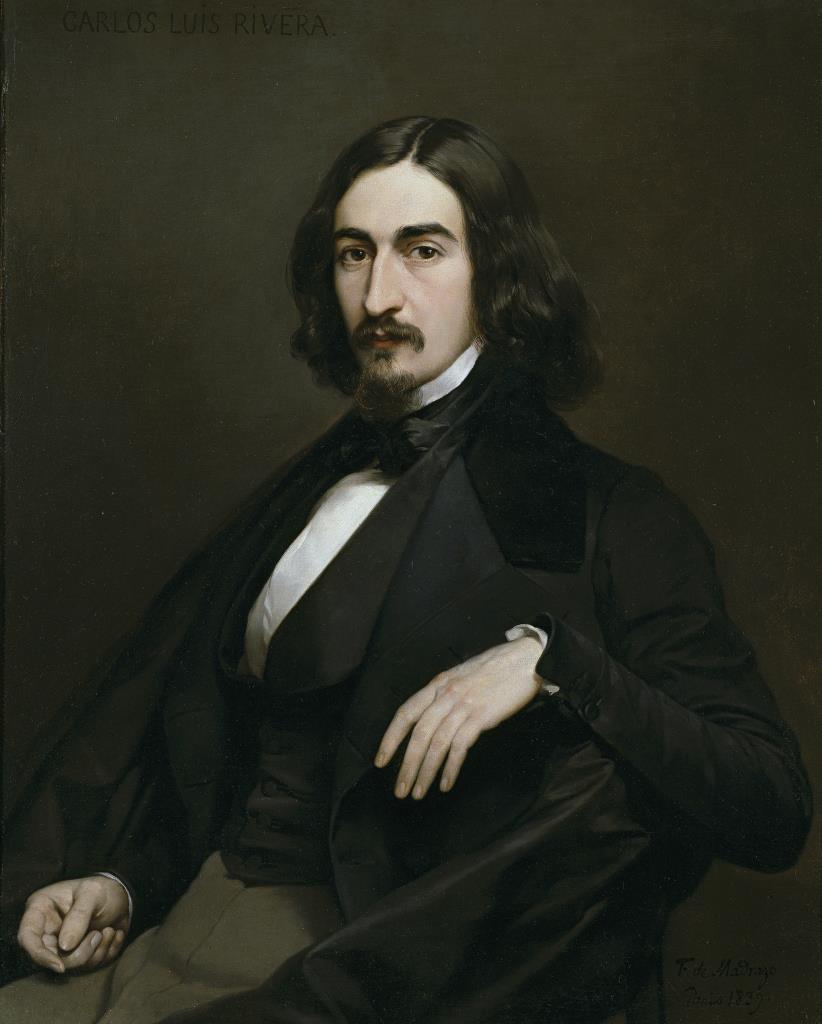
The Painter Carlos Luis de Ribera , 1839. Federico de Madrazo. Oil on canvas.
Federico de Madrazo was the Spanish painter of his day who produced the largest number of artists’ portraits, of which the Prado houses a superb collection including oil paintings, drawings and lithographs. Conscious of their value, the artist bequeathed to the museum a large group of drawn portraits of artists and writers, in the manner of a sort of Album amicorum.
‘Effigies amicorum. Portraits of Artists by Federico de Madrazo’
Federico de Madrazo (Rome, 1815 – Madrid, 1894) was the Spanish painter who produced the largest number of portraits of artists. These works – of considerable interest, as befits the most significant specialist of his generation – attest to his great professional merit and status. They are not merely heads but long bust-length portraits or, in the case of the drawings and lithographs, half-length.
He generously gave the oil portraits to the sitters. They were friends, such as Carlos Luis de Ribera, whom he painted in Paris in one of his earliest masterpieces, Benito Soriano Murillo, a close collaborator as deputy director of the Prado, and Perugino Sensi, a lithographer who had worked at the Royal Lithographic Establishment founded by Madrazo’s father; colleagues, such as Carlos de Haes and Cosme Algarra; and prominent pupils, such as Eduardo Rosales and Federico’s own son Raimundo.
The drawn portraits are part of a large group that are similar in size, technique and style. Keenly aware of their artistic and also documentary interest, the artist kept and bequeathed them in their entirety to the Prado. The treatment of these works, most of which were executed in Paris, Rome and Madrid between 1839 and the early years of the following decade, attests to the intention to form a sort of iconographic album of artist and writer friends in the tradition established by German artists of the sixteenth century. The most important group was produced in Rome, where portraiture was a common practice among fellow pupils and friends. He coincided there with Jean-Auguste-Dominique Ingres, whom he had portrayed years earlier and whose influence is notable in a few likenesses such as those of Ponzano and Zanetti.
The lithographed portraits denote an outstanding mastery of this new technique encouraged by his father José, of whom Federico made a portrait to illustrate the biographical sketch published in 1835 by El Artista, the most important Spanish Romantic review. The other great Spanish painter of the time, Vicente López, was also lithographed by Federico for the same publication, even though he differed greatly from Federico’s father in his artistic orientation. Both likenesses bear witness to Federico’s devotion to art through these careful images of its most significant figures, disseminated in the form of prints.
Pintura del siglo XIX en el Museo del Prado. Catálogo General
This general catalogue is the result of a research project carried out by the department of conservation of nineteenth-century painting at the Museo Nacional del Prado for more than fifteen years, during which countless documentary and bibliographic sources of very different nature and provenance were combed through, examined and verified.
It is the first publication to feature the museum’s entire collection of nineteenth-century paintings – 2,690 works – including those belonging to the permanent collection and those on permanent loan to other institutions. It also provides a detailed record of all the paintings, listing the institutions to which they belonged at various times, as well as documentary, technical, iconographic and exhibition details and photographic or engraved reproductions of the works. In some cases this information is accompanied by historical descriptions, which are particularly useful when works are unlocated. This data, exhaustively compiled in the book, can provide an incalculable aid not only to the museum but also to specialists and to anyone interested in nineteenth-century painting.
The catalogue includes a detailed list of the exhibitions in which the works have been shown and various appendices and comparative tables aimed at clarifying matches between the various inventories and documentary records of the institutions where they have been housed, as well as several indices to help readers carry out all kinds of specific searches.
Two introductory texts complete the publication. The first, written by José Luis Díez, director of the research project, describes the time limits and characteristics of the catalogue and analyses the collection’s two centuries of history. The second, by Ana Gutiérrez, curator and author of the catalogue entries, thoroughly analyses the documentary sources used to compile them.
As well as being important for the museum, this publication also has repercussions for the rearrangement of the state holdings of the permanent collections of the Prado and the Museo Nacional Centro de Arte Reina Sofía, as for the first time it lists all the nineteenth-century paintings housed in the Museo del Prado.