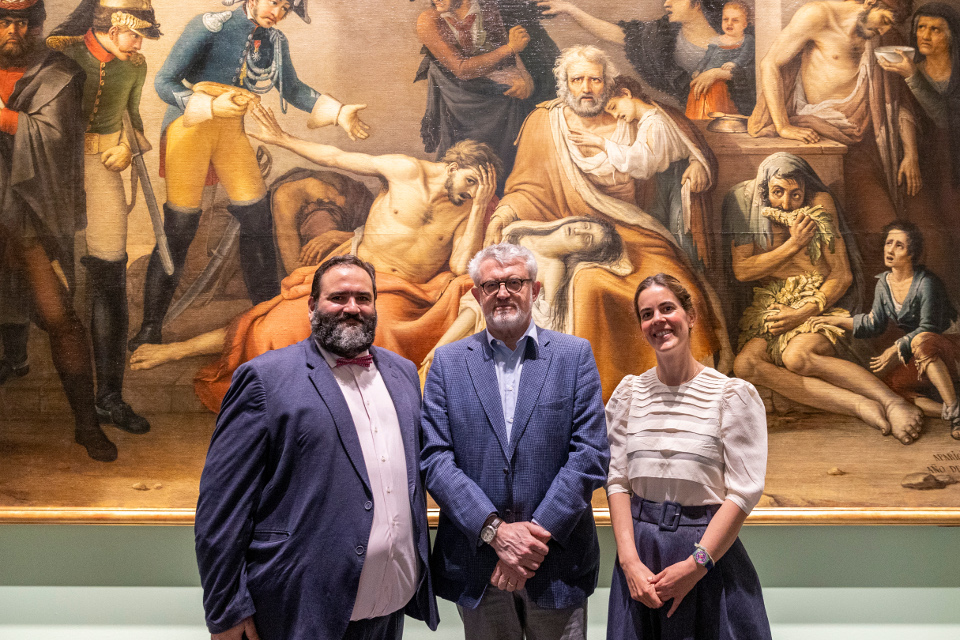
The most popular painting of its day and the one most appreciated by Ferdinand VII
The Museo del Prado is launching its new exhibition format “A work, a story” with The Year of Hunger in Madrid by José AparicioMonday, April 27, 2026
“Our aim is to encourage the viewer to look at a work which, aside from its aesthetic merits, helps us to reflect on aspects of art history that often go unnoticed,” in the words of Miguel Falomir, director of the Prado.
Hailed as a major artistic milestone of its day, lauded in the press, reproduced in prints and celebrated in songs and poems, Aparicio’s history painting also served as a political tool. The reconstruction of its original location at the Museo del Prado in 1819, where it became one of the institution’s principal icons, ahead even of works now considered indisputable such as LasMeninas, reveals the ideological toll imposed by Ferdinand VII’s absolutism.
The exhibition analyses the rise and fall of a national icon, from its status as the most powerful visual metaphor for 19th-century Spain to that of a depiction of a merely local anecdote. By displaying the painting in this way, the Prado is encouraging a reflection on the vicissitudes of art and criticism, propaganda, the invention of taste and the role of museums.
The Year of Famine in Madrid byJosé Aparicio. Madrid, Museo Nacional del Prado, on deposit in the Museo de Historia in Madrid
The writer Umberto Eco imagined an ideal museum dedicated to a single work of art: a space where stories would accumulate around it, culminating, as the ultimate exercise, in the public's contemplation and understanding. This vision resonates powerfully in the Museo del Prado's new exhibition format "A work, a story", a concept ideally suited to The Year of Hunger inMadrid by José Aparicio (1818). In the words of Miguel Falomir, director of the Museo del Prado, the aim of the exhibition is “to encourage the viewer to look at a work which, aside from its aesthetic merits, helps us to reflect on aspects of art history that often go unnoticed."
This canvas, one of the most acclaimed and controversial in the collection of the Museo del Prado since it first opened in 1819, is filled with events and figures that demonstrate how a single work can reconstruct the complexity of a past world without losing its contemporary relevance. The return to the Museum, albeit on a temporary basis, of what was known in its day as the “hunger painting” offers the opportunity to contemplate with today’s eyes what was once one of the most celebrated works in Ferdinand VII’s Spain; no other painting generated more discussion in the decades following the museum's inauguration in 1819.
The Year of Hunger in Madrid returns to the Prado charged with the full weight of its significations: the memory of a catastrophe, the political ambition with which it was conceived, the misunderstandings surrounding its reception, and the erosion of its prestige. In addition, on this occasion its critical reassessment has been accompanied by an ambitious restoration programme which has improved the work’s stability and legibility.