formularioRDF
The itinerary <em>TITULORECORRIDO</em> has been successfully created. Now you can add in works from the Collection browser
<em>TITULOOBRA</em> added to <em>TITULORECORRIDO</em> itinerary

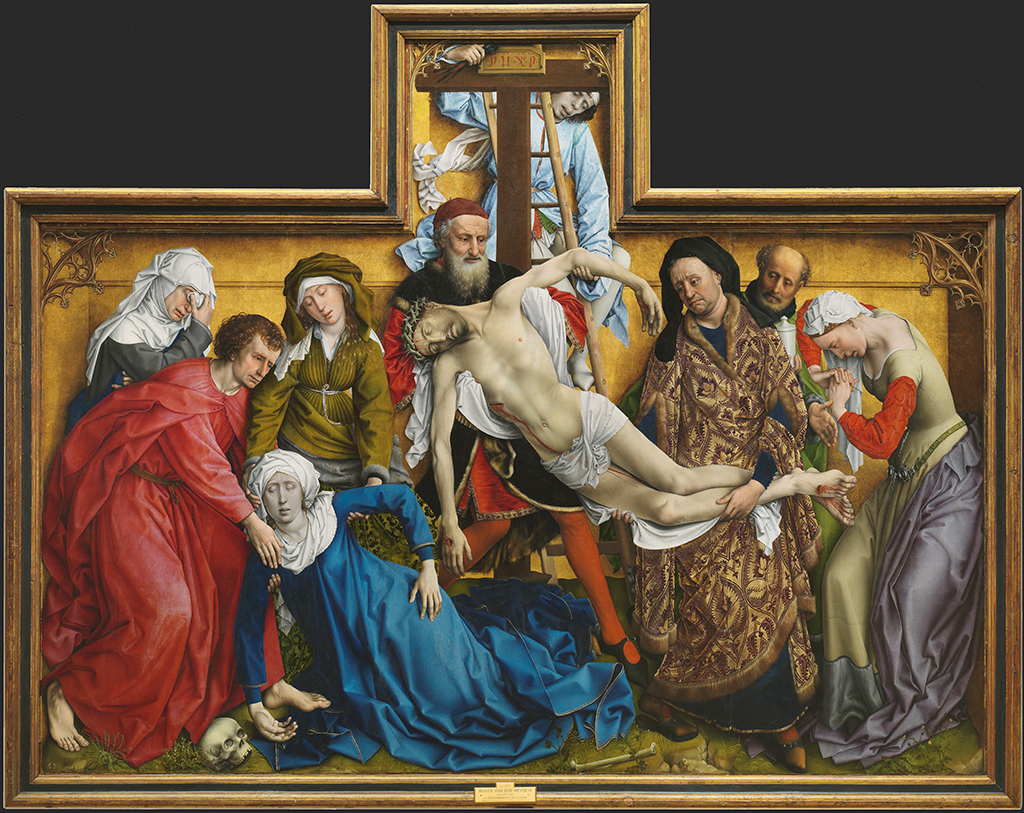
The Descent from the Cross. Rogier van der Weyden

The author of this painting is Rogier van der Weyden, a Flemish painter. 

Flanders is a region of Belgium.

The painting is from 1435.

ETR (Easy to Read) icon
© Easy-to-read european logo: Inclusion Europe. More information at: Easy-to-read

What is the artist depicting?

The descent is the moment when they take Jesus down from the cross after he dies to take him to his tomb.

The lifeless body of Jesus is in the centre, held by 3 men.

A young servant in a long blue jacket stands on a ladder.

He holds the 2 nails that were removed from the hands of Jesus.

Below him are 2 men holding the arms and legs of Jesus.

The man holding the arms is Nicodemus, a Jewish leader.

The man holding the legs is Joseph of Arimathea, the wealthy man who buried Jesus.

Jesus still wears the crown of thorns.

We can see a beard on his face, and one of his eyes is slightly open.

Blood from the wound on his side drips down to his leg.

The cloth covering him is a very transparent veil.

The painter depicted the blood so that we can see it under the veil.

In the painting, we see the Virgin Mary lying unconscious in a posture similar to that of Jesus.

Saint John the Evangelist and her sister Mary Salome support her.

Mary Cleophas, another sister of the Virgin Mary, weeps behind Saint John.

On the right side of the painting, Mary Magdalene stands with her hands intertwined and her back bent as she expresses her grief.
El descendimiento
The Descent from the Cross by Rogier van der Weyden

Why is the painting relevant?

Rogier van der Weyden demonstrates his skills in portraying the gestures of the figures.

Each figure expresses their pain differently.

The painting represents the descent from the cross and the suffering of the Virgin because her son is dead.

Van der Weyden also successfully depicts the contrast of the grey colour of the skin of the deceased Jesus with the white colour of the fainting Virgin.

The drawing is very precise, and the colours are diverse.

For example, the transparency of the skin, the details of the clothes, and the way he depicts the folds of the fabrics are impressive.

Van der Weyden painted the scene on a wooden panel.

The painting represents the figures almost life-size, which was uncommon in Flemish painting at that time.

The lack of depth in the space makes the figures appear almost like painted sculptures.

Detail of Jesus

The history of the painting

This painting adorned the Chapel of Our Lady Outside the Walls in the city of Leuven, which is now in Belgium.

The crossbowmen of the city commissioned the painting from Van der Weyden.

In the corner ornaments, called traceries, there are small crossbows to indicate that the crossbowmen were the ones who paid for the painting.

Even the shape of the body of Jesus with his arms outstretched resembles that of a crossbow.

About 100 years after Van der Weyden painted the picture, Mary of Hungary bought it.

She was the aunt of King Philip the Second.

Later, Mary of Hungary gave it to Philip the Second, who ordered it to be hung in the Monastery of El Escorial.

Detail of the Virgin Mary

This work belongs to the following tours:

Easy-to-read content of Museo del Prado
Funded by the European Union - NextGenerationEU Government of Spain - Ministry of Culture Recovery, Transformation and Resiliency Plan Museo Nacional del Prado

Funded with the National Recovery and Resilience Plan (NRPP) , Spain’s Next Generation EU financing and according to the initiatives within the component C.24.I3 Digitization and valorization of major cultural services. The project is part of Campus Prado within Accessibility and Signage: Revitalization of the Urban Environment action line and as a universal accessibility activity.

Up