Loading...
Back to itineraries
Beauty and Something More
Religious-themed Masterpieces at the Museo del Prado START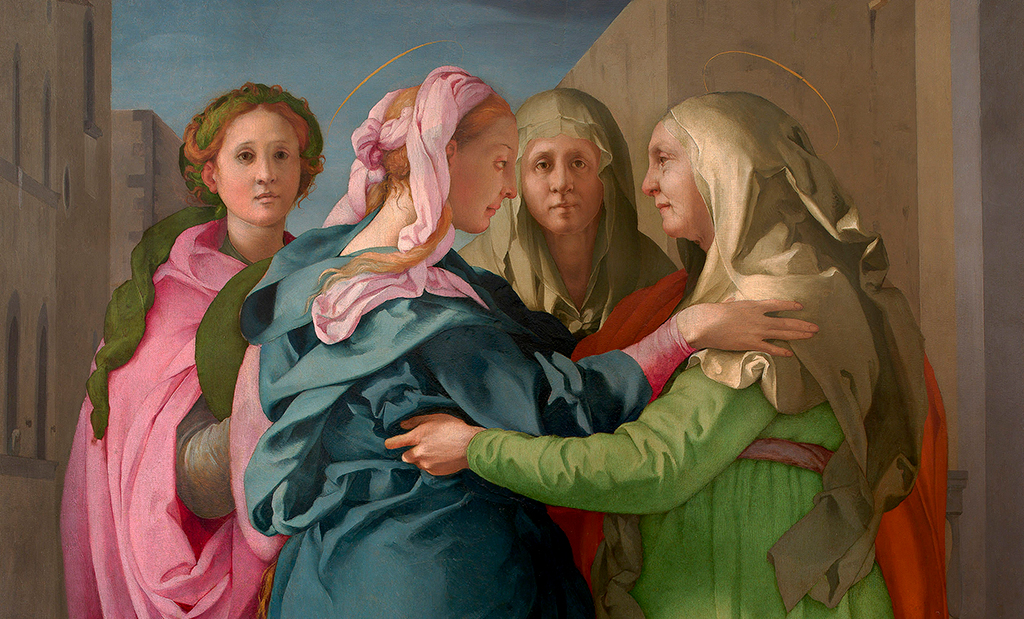
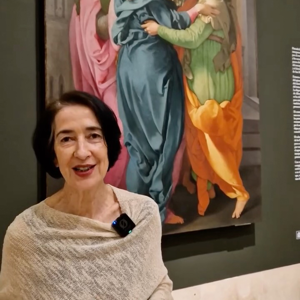
Pope Leo XIV’s visit to Madrid in 2026 is an exceptional occasion to rediscover magnificent pieces in the Prado’s collection that are considered among the finest religious paintings in the history of art. Well-known masterpieces by Velázquez, Murillo, El Greco and Zurbarán have now been joined by a painting of remarkable power and beauty, The Visitation by Jacopo Pontormo. In another extraordinary coincidence, this work is currently visiting Spain for the first time thanks to a loan agreement with the parish church in Carmignano, Italy, where it usually hangs.
This route, called “Beauty and Something More”, is an invitation to delight in art, loveliness, the artist’s sensibility and, for those who feel it, a spirituality that has shaped the history of Western civilization.
Detail of The Visitation by Jacopo Pontormo. The Invited Work
Beauty and Something More


"The Word became flesh" (John 1:14)
In keeping with Saint Luke's account of this event (1:26-38), the archangel Gabriel has appeared to the Virgin Mary in her home in Nazareth and has announced that she has been chosen to be the mother of God. In this scene the dove of the Holy Spirit leaves the hands of God the Father and flies along a beam of light towards Mary. On the left we see Adam and Eve being expelled from Paradise -the lush garden that can be seen behind them. The symbolism is clear: the Incarnation of Christ signifies the beginning of redemption from Original Sin, with Mary as the 'new Eve'.
Room 056B
Beauty and Something More
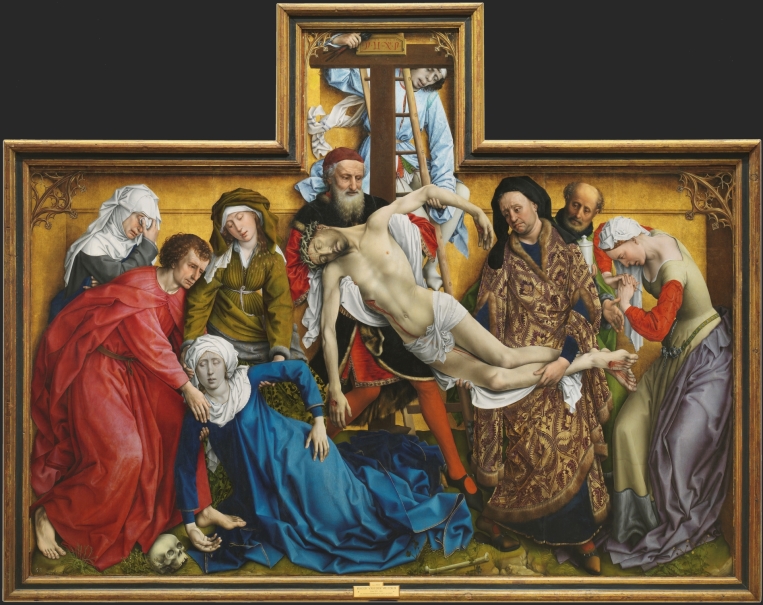

"Love consists in this" (1 John 4:10)
Nicodemus and Joseph of Arimathaea, with the help of a servant, lower Christ's lifeless body from the cross after he has given his life for the redemption of humanity. As Saint John writes in his Gospel: "No one can have greater love than to lay clown his life for his friends" (Jn 15:13). The painter highlights the Virgin's pain at the sight of her son's Passion and death. Christ's body recalls the shape of a crossbow and may be an allusion to the Guild of Crossbowmen of Leuven, in modern Belgium, who commissioned the painting, as are the small crossbow pendants hanging in the tracery in the upper corners of the picture.
Room 058
Beauty and Something More
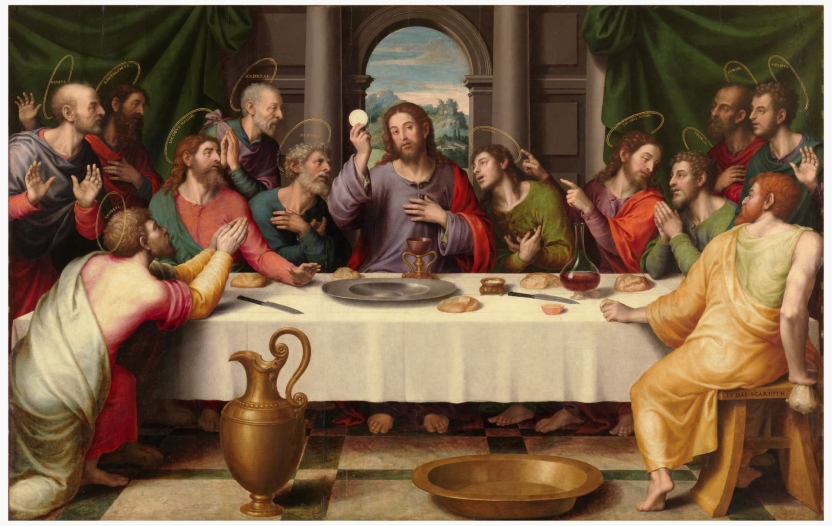

"I am the Bread of Life" (John 6:35)
Christ raises the Host and institutes the sacrament of the Eucharist: "This is my body given for you". The painting does not represent Christ's announcement of the betrayal of Judas, although the apostle's position in the picture gives him a marked prominence in the group: he is seated on the far right of the table, his red hair and yellow robes symbolising envy and betrayal. On the table is the chalice, also known as the Holy Grail. According to tradition, the chalcedony cup that King Alfonso V of Aragon donated to the Cathedral of Valencia and that is preserved there, is the one used by Jesus at the Last Supper. Juanes reproduces it faithfully.
Room 051
Beauty and Something More
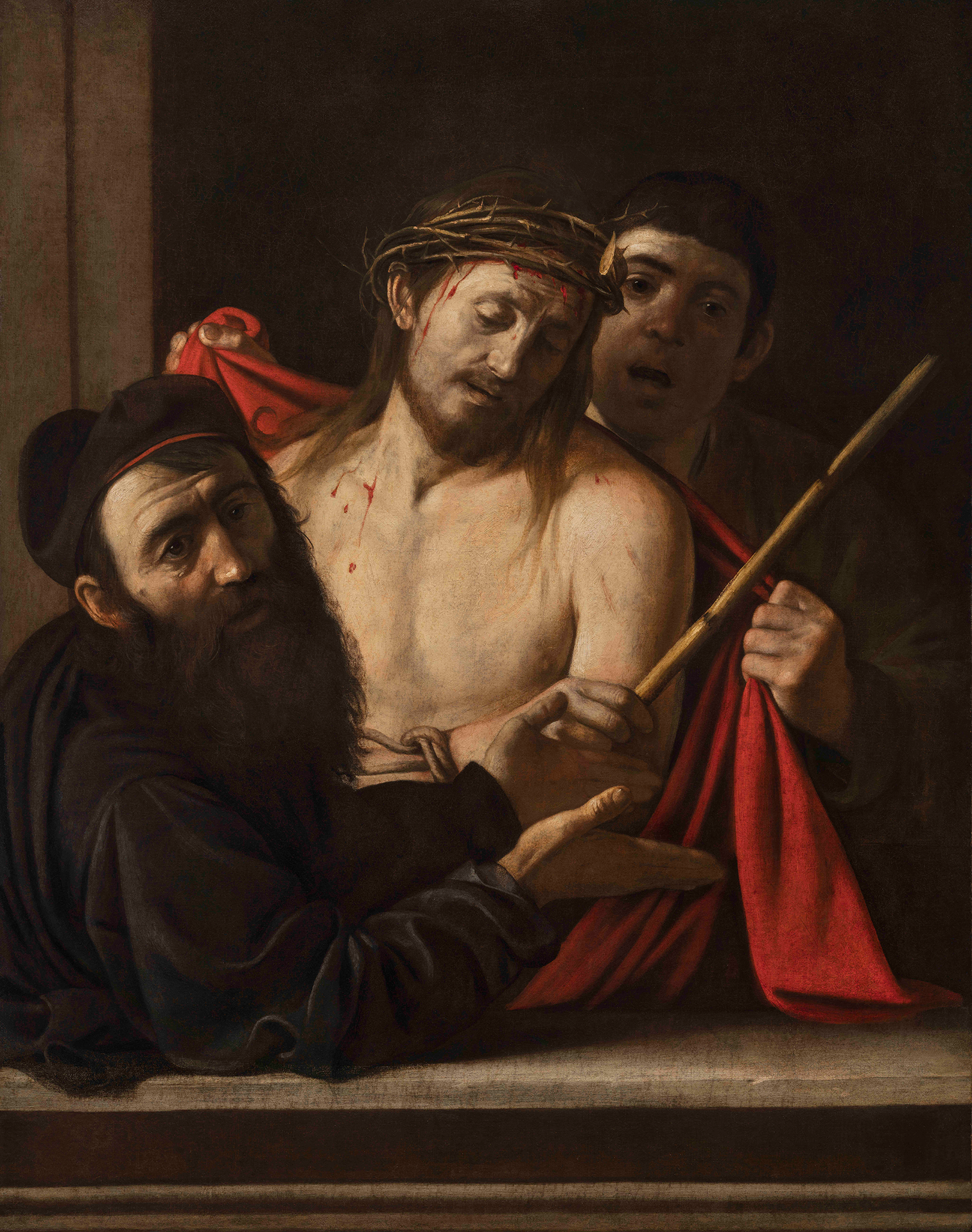

Ecce Homo
Oil on canvas. Private collection, on deposit
1606-1609
1606-1609
Caravaggio
“Behold the man” (John 19:5)
As narrated in the Gospel of John (19:5), Pontius Pilate, the Roman governor of Judea, depicted here with a thick beard and leaning on a windowsill, presents Jesus Christ to the people of Jerusalem with an eloquent hand gesture: “Behold the man” (Ecce Homo).
With bowed head and downcast eyes, Christ shows signs of the flogging and cruel mockery of the soldiers, who had given him a crown of thorns, a reed for a sceptre and a purple cloak to ridicule the claim that he was “King of the Jews”.
Caravaggio used bright lighting to draw attention to Christ’s naked form and heighten the dramatic intensity of this moment in the gospel account, shortly before his death on the cross.
Room 007
Beauty and Something More
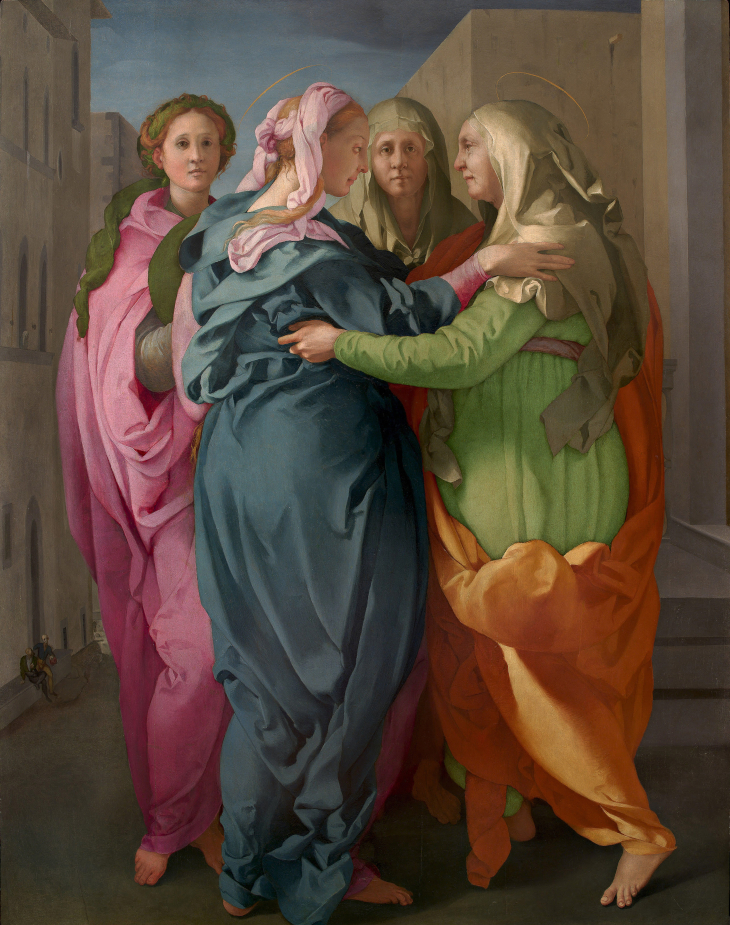

The Visitation
Oil on canvas. Parish of San Michele Arcangelo in Carmignano. The Invited work
Ca. 1528
Ca. 1528
Jacopo Pontormo
“I know that Messiah is coming, he who is called Christ” (John 4:25)
Shortly after the Archangel Gabriel came to her home in Nazareth to announce that she would conceive the Son of God, the Virgin Mary went to visit her cousin Elizabeth who, despite her advanced age, was six months pregnant at the time (Luke 1:39–56). Although the gospel says that the two women met inside Elizabeth and Zechariah’s house, Pontormo decided to follow the iconographic convention for this scene and portray them in an urban outdoor setting.
Unusually, the painter also chose to prominently feature two other women—perhaps Mary and Elizabeth’s servants—who have a surprisingly powerful presence. The peculiar colours of the figures’ heavy robes, common in Pontormo’s work, are also quite striking.
Room 049
Beauty and Something More
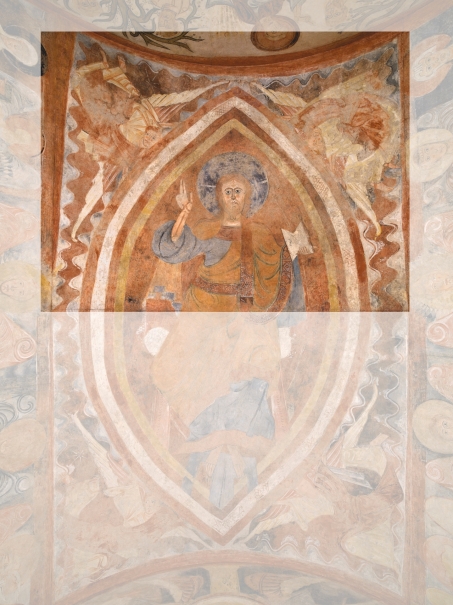

Christ Pantocrator held by four Angels, Hermitage of Vera Cruz, Maderuelo (Segovia)
Fresco painting on mural transferred to canvas.
XII century
XII century
"It is you who say that I am King" (John 18:37)
The image of Christ as Pantocrator -Lord of all creation- derives from Roman Imperial art. It is because of this that he appears wearing luxurious robes and seated on a throne, holding a book in his left hand and giving a blessing with his right. Christ is enclosed in a mystical mandorla, which is guarded by four angels who represent the supernatural character of the Kingdom of God. These angels are sometimes replaced in other representations by the Tetramorph, the four winged creatures who symbolise the four evangelists. The murals from the chapel of Santa Cruz de Maderuelo (Segovia) were painted by an unknown artist whose style is close to the Master of Santa Maria de Taüll.
Room 051C
Beauty and Something More
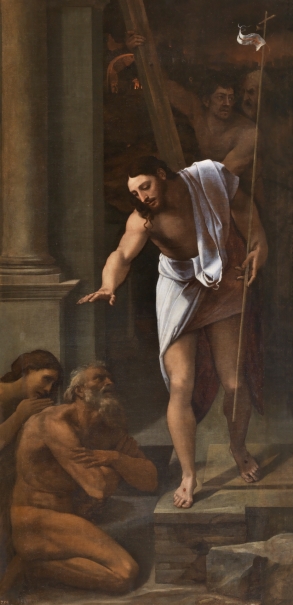
"I am Life" (John I4:6; John 11:25)
Based on various texts from the New Testament, the Apostles' Creed says that "Jesus Christ [...] descended to the dead. On the third day he rose again". This episode, which is also reflected in the apocryphal gospel of Nicodemus, is known as the Anastasis, and is a typical subject of icons in Byzantine art and in the art of the Orthodox Church, although it is less common in Western art. Here Christ is carrying the banner of victory, and leans towards Adam and Eve who are naked and waiting to be rescued from Limbo and taken to the Kingdom of Heaven. Behind Christ we can see the figure of Dimas, the good thief, who is carrying his cross.
Room 049
Beauty and Something More
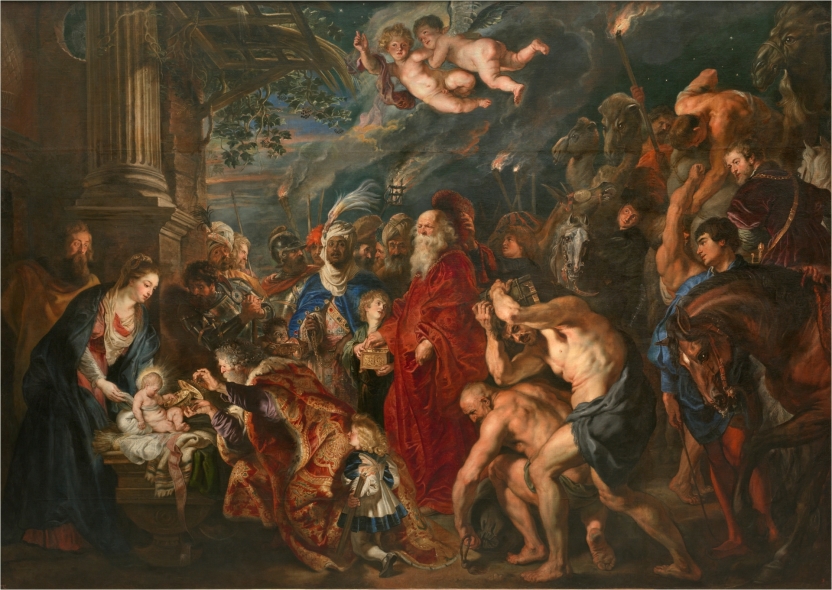

"I am the Light of the world" (John 8:12)
The Gospel of Saint Matthew (2:1-12) notes that Magi came to adore the Child Jesus and offered him gifts of gold, frankincense and myrrh, which over time were associated with his royalty, divinity and humanity. For this reason, the number of Magi was assumed to be three, and they are represented of different ages andas coming from the three parts of the then-known world: Europe, Asia and Africa, symbolising in this way the redemption of all of humanity. In Rubens's interpretation of the episode, the source of light is the Christ Child, who first illuminates the Virgin and then the rest of the figures.
Room 028
Beauty and Something More
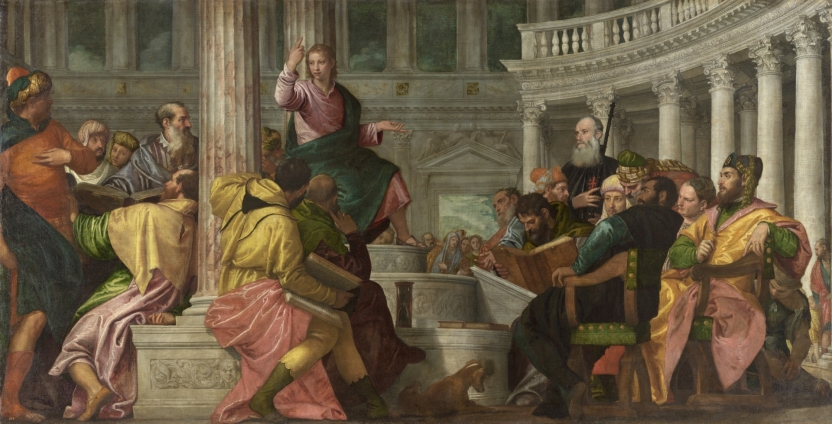

"I am Truth" (John 14:6)
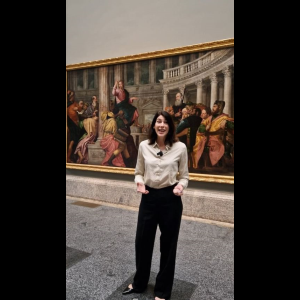
Christ's childhood concludes with the episode of Jesus debating among the doctors in the Temple. Mary and Joseph lost their son, who was just twelve years old, when they went to Jerusalem to celebrate the Passover, and they found him three days later among the Jewish doctors who were surprised by his intelligence and the clarity of his answers (Lk 2:46-47). In this very theatrical scene, Veronese places Jesus in the centre of the composition, in an elevated place to mark his moral and theological superiority.
Room 026
Beauty and Something More
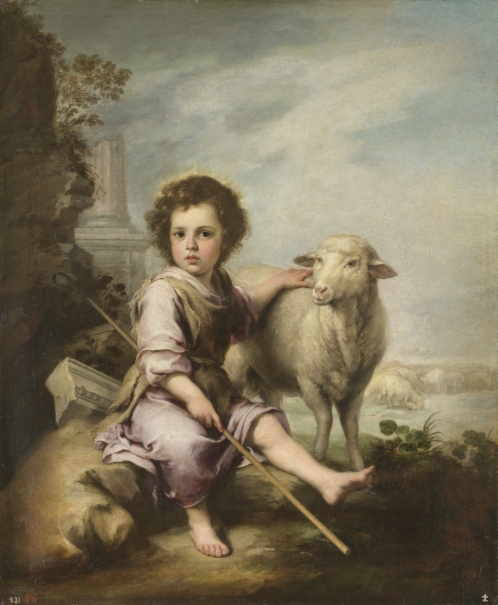

"I am the Good Shepherd" (John 10:11)
The good shepherd lays clown his life for his sheep. Early Christians used this image, derived from the moscophoros or kriophoros (a male figure who carries on his shoulders a calf or a ram), to represent Jesus Christ. From the Greco-Roman period it was regarded as a symbol of philanthropy, of love and dedication to others. Murillo, who had a special sensitivity to the world of children, shows us the child Jesus stroking a lamb before a background of classical ruins that allude to the downfall of paganism.
Room 017
Beauty and Something More
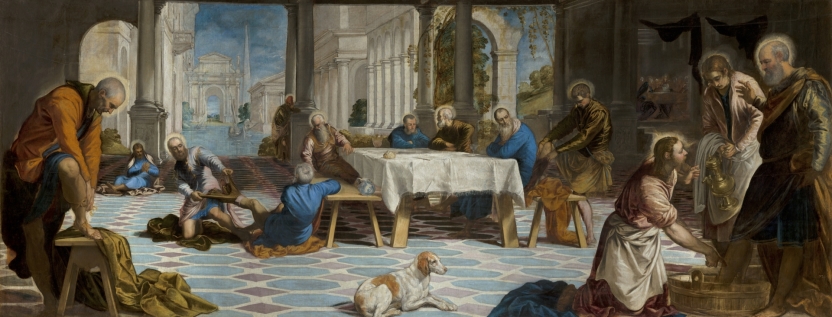

"I am the Way. No one can come to the Father except through me" (John 14:6)
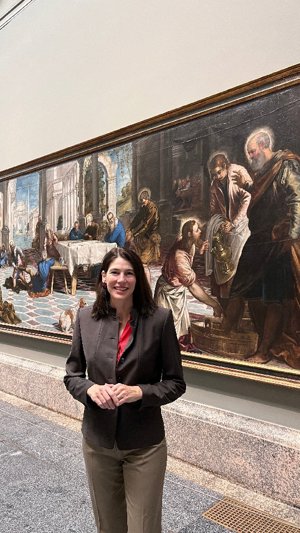
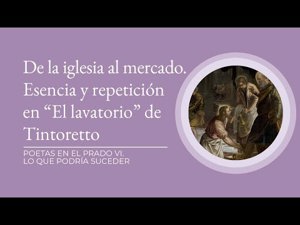
Shortly before the Last Supper, Jesus prepared to wash the feet of his disciples as an example of humility and service to others, a message which he transmitted to his apostles several times: "If anyone wants to be first, he must make himself last of all and servant of all" (Mk 9:33-37; Lk 9:46-48; Mt 18:1-5). Tintoretto painted this picture of great theatrical richness for the church of San Marcuola in Venice, for the chapel in which the Confraternity of the Blessed Sacrament was based -one of the many scuole, or brotherhoods, in the city that encouraged devotion to the Eucharist among its members.
Room 025
Beauty and Something More
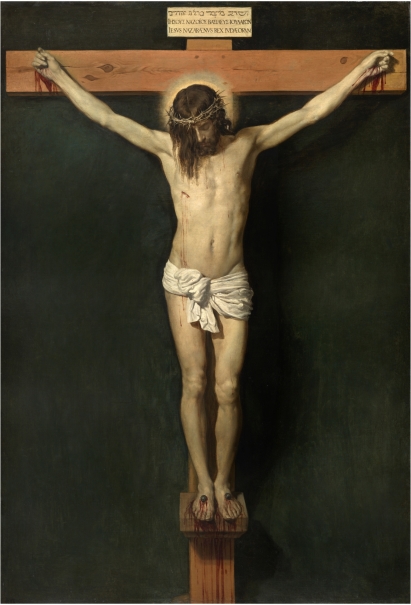

"I am the Way; I am Truth and Life" (John 14:6)
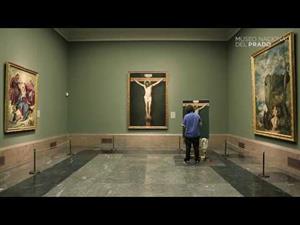
In this painting, Velázquez depicts Christ crucified with four nails instead of the three used in the Gothic period, which forced the body to twist in pain and so increases the drama of the image. Here, however, Christ appears to rest on the cross adopting a gentle contraposto, which eliminates any sign of stiffness in his body. The painting has become one of the greatest devotional icons in Spanish culture. The light focuses on his body in such a way as to make it emerge powerfully from the dark background, giving the impression that we are looking at a sculpture rather than a painting.
Room 014
Beauty and Something More
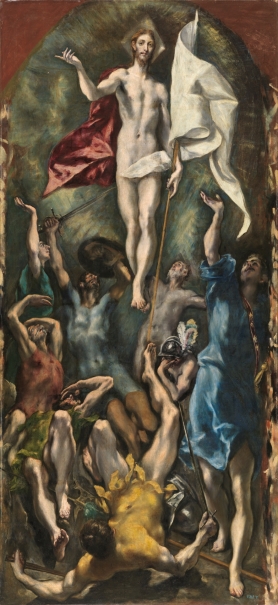

"I am the Resurrection and the Life" (John 2:25)
Christ rises, naked and triumphant, above the soldiers who guarded his tomb. All except one show surprise and fear at the miraculous resurrection of one who was dead but is now alive. Possibly due to his Byzantine inheritance, El Greco seems to have combined Christ's rising from the tomb with his subsequent ascension into Heaven, omitting any spatial reference and representing the Resurrection as the total triumph over death. This painting was part of the altarpiece in the church of the Colegio de Doña María de Aragón in Madrid, the most important commission that El Greco ever received.
Room 009B
Beauty and Something More
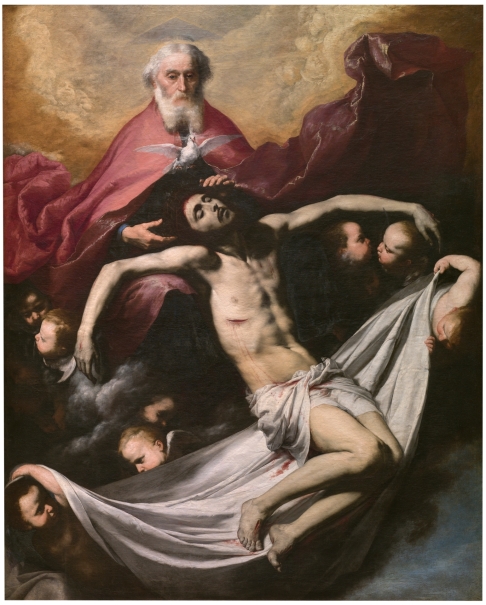

"I am Son of God" (John 10:36)
God the Father gently removes the crown of thorns from the head of his Son, whose lifeless body lies across his knees. His outstretched arms, held up by angels, evoke the death on the cross. Between the heads of God the Father and God the Son is the dove of the Holy Spirit, thereby composing an image of the Holy Trinity that emphasizes both surrender and sacrifice: God surrendered his only son to redeem humanity, and accepts his sacrifice for the forgiveness of sins. Ribera moves from the tenebrism of his early work towards richer Venetian-inspired colours, never abandoning his characteristic naturalism.
Room 008
Beauty and Something More
Artworks (14)
The Annunciation
Tempera on poplar panel.
1425 - 1426. Room 056B
1425 - 1426. Room 056B
The Descent from the Cross
Oil on panel.
Before 1443. Room 058
Before 1443. Room 058
The Last Supper
Oil on panel.
1555 - 1562. Room 051
1555 - 1562. Room 051
Ecce Homo
Oil on canvas. Private collection, on deposit
1606-1609. Room 007
1606-1609. Room 007
Caravaggio
The Visitation
Oil on canvas. Parish of San Michele Arcangelo in Carmignano. The Invited work
Ca. 1528. Room 049
Ca. 1528. Room 049
Jacopo Pontormo
Christ Pantocrator held by four Angels, Hermitage of Vera Cruz, Maderuelo (Segovia)
Fresco painting on mural transferred to canvas.
XII century. Room 051C
XII century. Room 051C
Christ’s Descent into Limbo
Oil on canvas.
1516. Room 049
1516. Room 049
The Adoration of the Magi
Oil on canvas.
1609. Room 028
1609. Room 028
Christ among the Doctors in the Temple
Oil on canvas.
1550 - 1556. Room 026
1550 - 1556. Room 026
The Good Shepherd
Oil on canvas.
Ca. 1660. Room 017
Ca. 1660. Room 017
The Washing of the Feet
Oil on canvas.
1548 - 1549. Room 025
1548 - 1549. Room 025
Crucified Christ
Oil on canvas.
Ca. 1632. Room 014
Ca. 1632. Room 014
The Resurrection
Oil on canvas.
1597 - 1600. Room 009B
1597 - 1600. Room 009B
The Trinity
Oil on canvas.
Ca. 1635. Room 008
Ca. 1635. Room 008
Floor 0 and -1
Floor 1
Related content