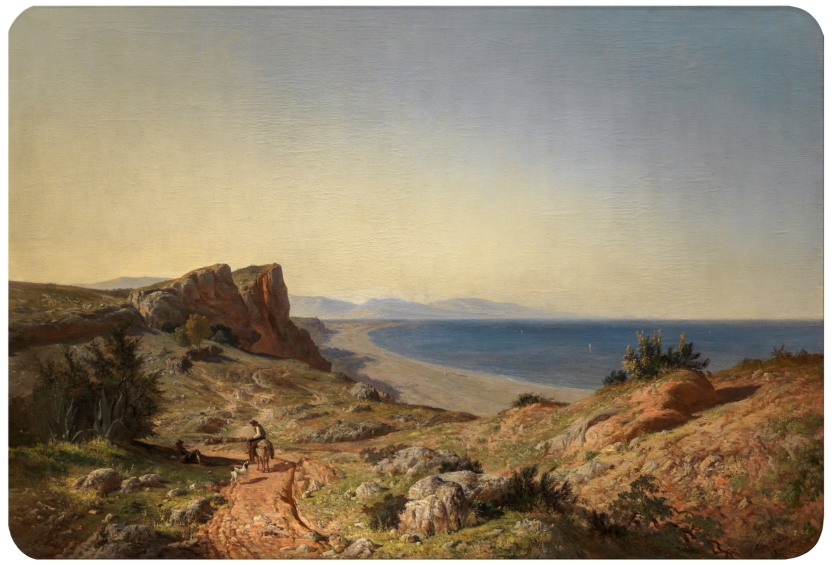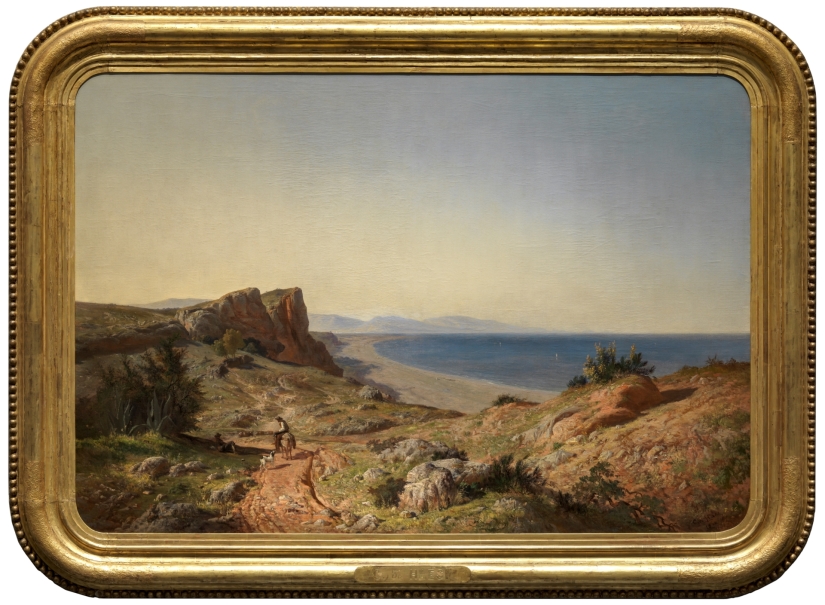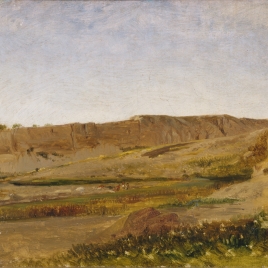
A Landscape. Recollections of Andalusia: The Mediterranean Coast near Torremolinos
1860. Oil on canvas.Not on display
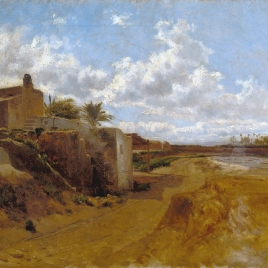
Throughout the second half of the nineteenth century, Carlos de Haes was the leading landscape artist in Spain, not only because of his continuous activity as a painter in that genre but also because of his role as a teacher, for he held the chair of Landscape Painting in Madrid´s Higher School of Painting, Sculpture and Printmaking (Escuela Superior de Pintura, Escultura y Grabado). There he trained the majority of landscape artists from 1857 until his retirement in 1894. Haes´s contact with other landscape artists from his native country of Belgium, such as his teacher Joseph Quineaux (1822-95), provided an important influence on his painting; others sources of inspiration were French and Dutch realist painting, as well as his own personal interest in the accurate representation of the land, its geological features and its flora. He would begin with studies executed en plein air, of which the Prado houses the best and largest surviving collection.Haes also executed larger-dimension paintings in his workshop, as the present work reveals. At the 1860 National Exhibition of Fine Arts, this painting was displayed together with three of his other landscapes and was awarded first prize. The persistence of a fundamentally romantic outlook in landscape painting is evident in various elements of this work: the wide, panoramic view, articulated around a road that indicates the vanishing point of the image; the prominence of large crags that serve as a nucleus of monumentality and drama in the composition; the liveliness of the small figures of peasants with animals, from which we can measure the work´s grandiose dimensions; as well as the marked contrasts between the clearly defined shadows in the foreground and the diffuse luminosity of the sky.The inclusion in the work´s title of the word recuerdos (recollections) is also characteristic of a romantic outlook, which the artist would surpass in successive years in favour of a more immediate and direct vision of reality, no longer the product of remembrances or composed of elements from different aspects of that reality. A foretaste of this realist sensibility is perceptible in the attention he has given to the clayey quality of the rutted road, flanked by sparse, meagre vegetation. Furthermore, by avoiding the moment of a sunrise or sunset, the painter sidesteps the rhetorical emphasis that is typical of Romanticism. A critic reviewing this canvas for La Época on 30 October 1860 accurately perceived the modernity of the landscape: It seems as if he chose such a subject so as to display all of his strengths and powerful resources in a place where ... there are no projecting shadows from trees or clouds, no accidents of the sort that, by only copying them onto the canvas one has completed the landscape. He has managed to bring together so many objects under the same warm atmosphere, each preserving its corresponding individual colour and contour, such that the viewer cannot but react with pleasant surprise. In the distance we see the haze that on very hot days blends the land with the blue of the sea, which loses its transparency, and with a mastery as great as the difficulty he has overcome, he has made the line of the horizon seem to disappear, the same horizon that on cool days is so sharply defined on that coastline.Haes avoided, it is true, the representation of trees in this canvas, a motif that is otherwise common in his paintings and, indeed, in the tradition of landscape painting from northern Europe that was fundamental in his training. In contrast, this southern landscape resembles the sort that was being produced at that time in Italy. In addition, the unique luminosity of the horizon in this canvas reminded an anonymous critic for El Museo Universal of paintings by Claude Lorrain, an artist who is well represented in the Prado (Barón, J.: Portrait of Spain. Masterpieces from the Prado, Queensland Art Gallery-Art Exhibitions Australia, 2012, p. 238).