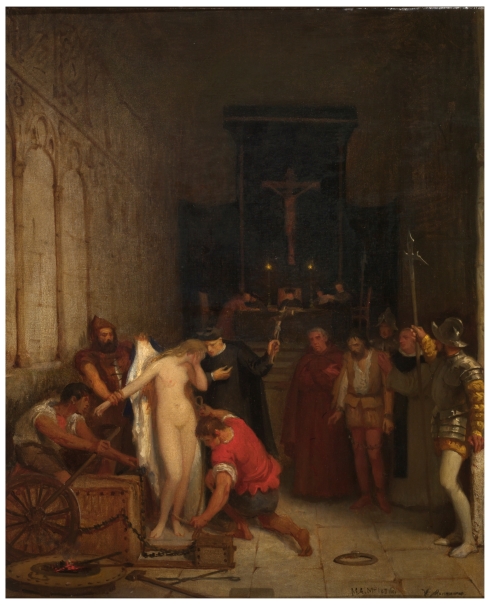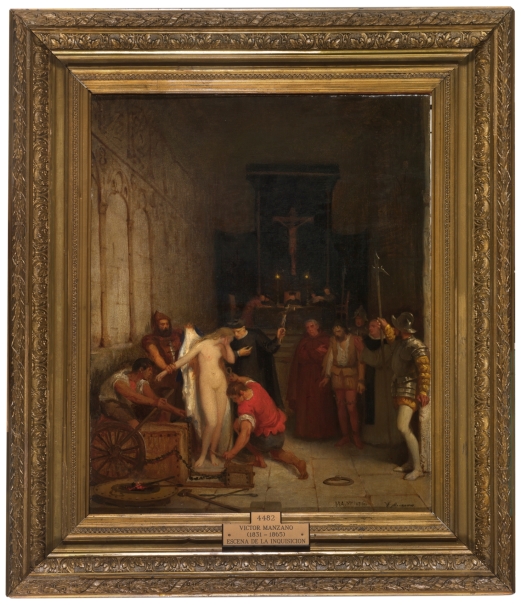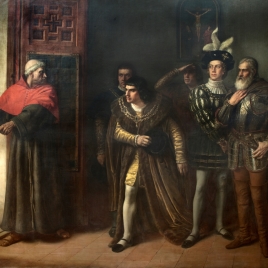
A scene of the Inquisition
1859. Oil on canvas.Not on display
This is a preparatory sketch for a larger painting that remained in the painter’s family in 1866.
Upon his return to Madrid after his stay in Rome and later in Paris, Víctor Manzano had already begun experimenting with a new way of representing space in his historical paintings. Here, he captures the dense atmosphere in an enclosed room in semi-darkness, as he demonstrates in this sketched canvas drawn in 1859. In the scene, the figures appear in the shadows of a lugubrious chapel. The interior architecture is conceived as a real stage with a pronounced play of perspective, the deep gloom in which it is submerged is bathed by the candles of the altar in the background, which envelop the figures in dimly graduated illumination. Among them, the naked body of the young victim of the impending torture stands out clearly. The white cloak that uncovers her and in which the light is concentrated emphasises her flesh. This chromatic resource unmistakably highlights the protagonist of the scene. This is a reflection of the conquests that had for years been preoccupying some Spanish painters who had trained in Rome. Their focus was mainly on the veristic interpretation of the air interposed in an interior space, as achieved through the handling of light in compositions with a plot filled with figures.
Díez, José Luis, 'Eduardo Rosales y la conquista del realismo por los pintores españoles en Roma (1855-1875)' En: Del realismo al impresionismo, Madrid, Fundación Amigos Museo del Prado - Galaxia Gutenberg, 2014, p.87