Cervantes' last moments
1856. Oil on canvas.On display elsewhere
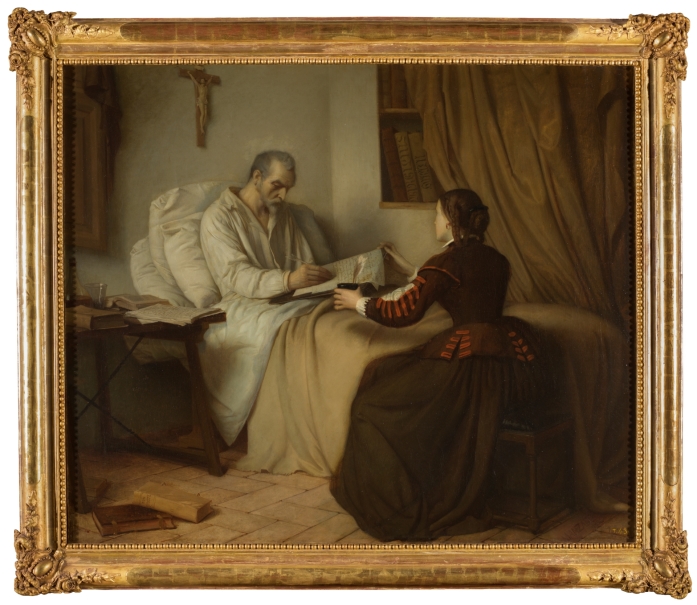
This work was painted by Manzano at the age of 27 and presented at the 1858 National Exhibition. It represents one of the best known episodes in Cervantes´ life, when, ‘after receiving the last rites, the author wrote the dedication of his novel The travails of Persiles and Sigismunda to the Count of Lemos’, as the exhibition catalogue states. Indeed, after completing his last novel, The travails of Persiles and Sigismunda, on 2 April 1616, the illustrious writer fell ill with dropsy. After a brief trip to Esquivias, taking advantage of a temporary improvement, he was definitively bedridden at his home in Madrid, from where he expressed his desire to kiss the hand of the man who had long been his protector. On his return to the Court after being relieved of his post as governor of Naples, the Count of Lemos ignored the writer’s request. Cervantes, who was already at death’s door, wrote a dedication of his last work to the nobleman on 19 April, in the form of a letter. The author of Don Quixote died on 23 April 1616, after having written his will in that same period, in which he ordered two masses to be said for the repose of his soul.
In his painting, Manzano depicts this passage from Cervantes´s final days in an austere room with bare, whitewashed walls. There, the author lies on his bed on several cushions, writing the famous dedication on a parchment held by the lady who looks after him and who is also holding the inkwell in her other hand. A crucifix can be seen above the headboard of the palliasse. On the opposite side, a bookcase with books, half-hidden behind a partially drawn curtain, can be glimpsed. Next to the bed is a table on which a bottle and a glass tumbler rest. Other parchments and several books are visible, some of which are lying on the floor, among them, the second part of Don Quixote.
In this painting, Manzano once again displays his excellent pictorial skills, a talent cut short by his untimely death. He always used a sober palette, with subtly harmonised, earthy colours, and chose delicate transparencies and a soft chiaroscuro, which here, are especially visible in areas such as the folds of the bed linen, the lady´s dress, and the curtain. The artist splendidly combines these qualities with his absolute mastery of a clean and precise drawing, as can be seen in certain details of the lady´s earring and the very soft modelling of her hands. These qualities are particularly noteworthy in the working of the head of Cervantes, with the grave and transcendent nobility in his expression and his strong, sharp-featured face accentuated by his approaching death. Moreover, the balanced sense of clear and serene composition –which this painter displayed throughout his entire output– results in a work of evident artistic beauty. In this work, Manzano manages to convey all the solemn intimacy that the scene requires.
This passage from Cervantes´s biography was one of the most attractive for nineteenth-century Spanish painters. Furthermore, in Museo del Prado is another large canvas depicting the same scene. It is entitled Cervantes in his last days writing the dedication to the Count of Lemos (P007529) and was painted by Eugenio Oliva Rodrigo (1857–1925) in 1852.
El mundo literario en la pintura del siglo XIX del Museo del, Madrid, Centro Nacional de Exposiciones y Promoción Artística, 1994, p.130-131, nº4