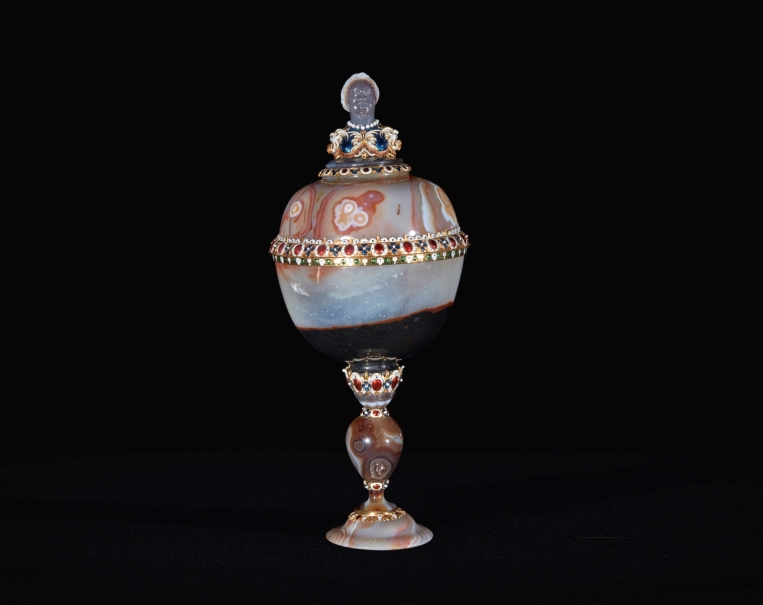
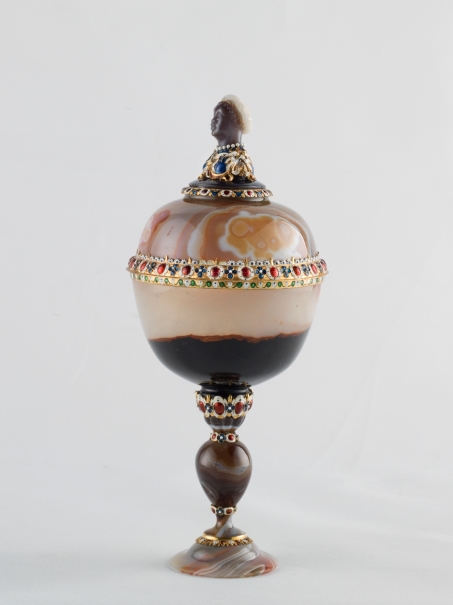
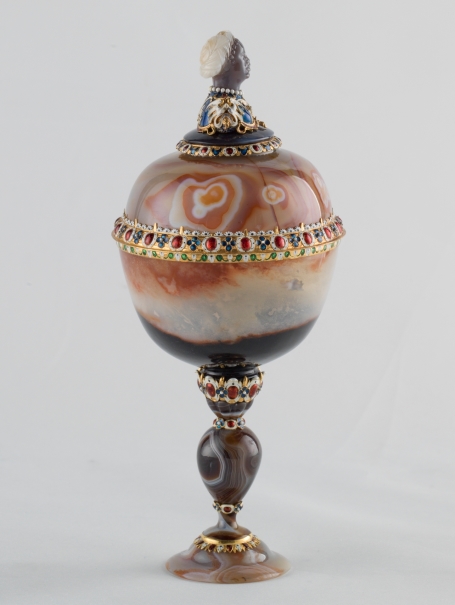
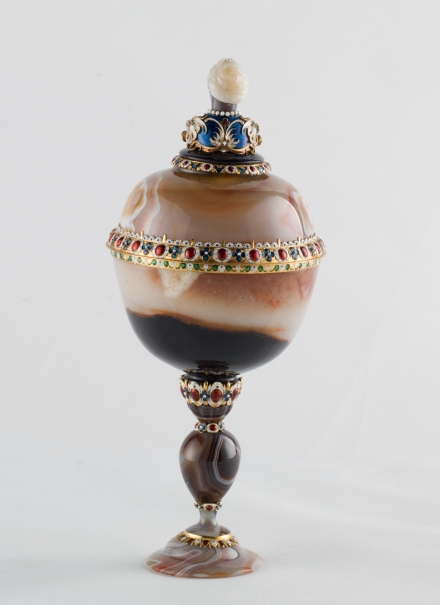
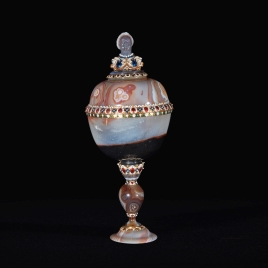
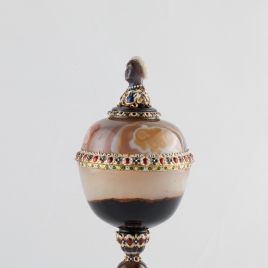
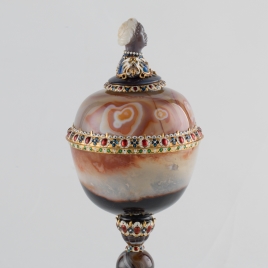
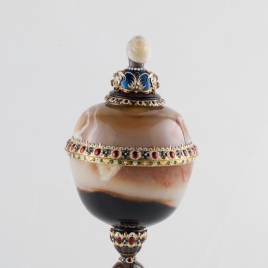
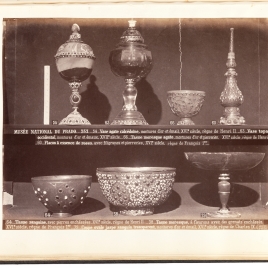
Agate goblet crowned by a bust
1590 - 1630. Agate, Enamel, Gold.Room 079B
Vessel comprising pieces of agate with different patterns of veining, some possibly ancient, linked by adornments in different designs, in enamelled gold. The body is semi-spherical and is joined to the lid through an adornment consisting of two decorated bands, the first with small motifs, enamelled in white and green, and the second with ovolos in translucent red enamelling, imitating ruby cabochons, between white scrolled designs and small blue flowers, all framed by an edging of white leaflets enamelled with black. A similar adornment supports the bust of a figure wearing an enamelled necklace and a translucent blue garment overlaid with white leaves and with two mascarons on the shoulders. The stem, held by an adornment of false cabochons, is darker in tone, and is joined to a bell-shaped base, lacking the bottom trim, with two lesser adornments and a short agate neck.
The Schatzkammer der Residenz in Munich boasts a chalcedony goblet with winged handles, in enamelled gold, crowned by a bust with armour of enamelled gold and a lion skin, inv. 377. The head, as in the Prado goblet, is of agate, and the contrasting colour of the banding serves to highlight the headdress. The use of a range of different materials to lend volume and colouring to a stone carved in the round or a cameo, preferably with anthropomorphic motifs, is particularly characteristic of Ottavio Miseroni, to whom a large number of works of this kind, featuring different coloured stones, have been attributed.
The adornment, using of translucent red enamelling to imitate ruby cabochons and blue flowerets, displays variations -as Arbeteta points out- on the habitual designs derived from the cosses de pois or pea pod style and lobed leaves, with their centres somewhat raised, decorated with small drawings in black enamel as in the designs of Gédeón and Gilles Légaré. However, the leaflets on the borders link the goblet to others in the Prado, such as O10, O11 and to goblets attributed, as far as the adornments are concerned, to the Paris school. The reddish veining gives the body an appearance for which this vessel was greatly prized.
The state of the work in the 19th century can be seen through the photography of Juan Laurent Minier, "Vase agate calcédoine, montures d’or et émail, XVIe siècle, règne de Henri II", ca. 1879, Museo del Prado, HF0835/23.