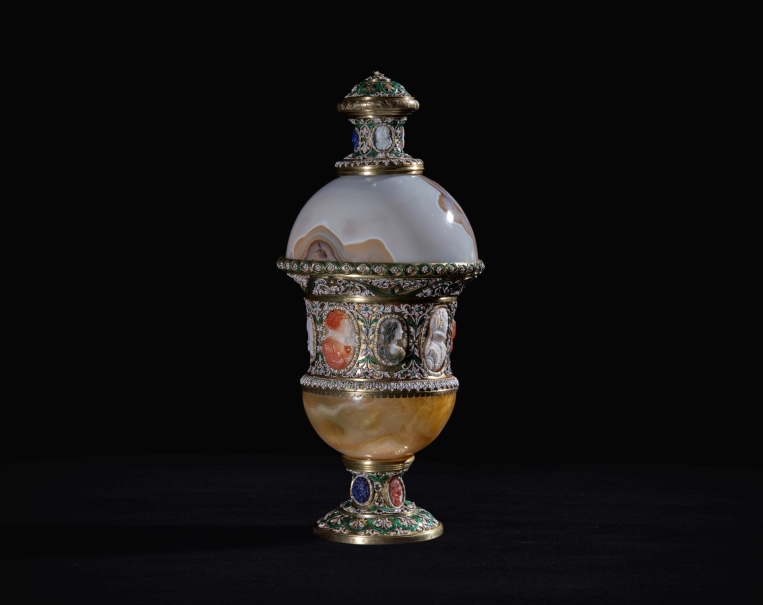
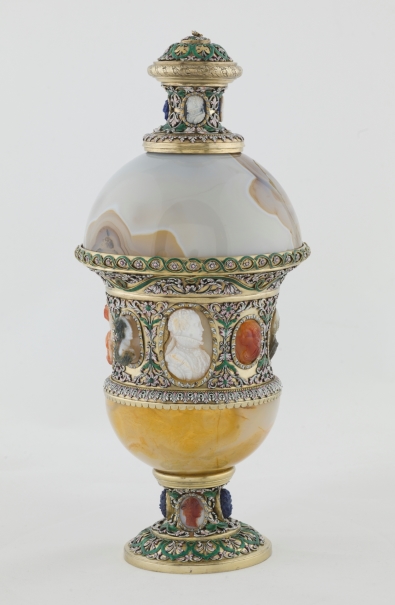
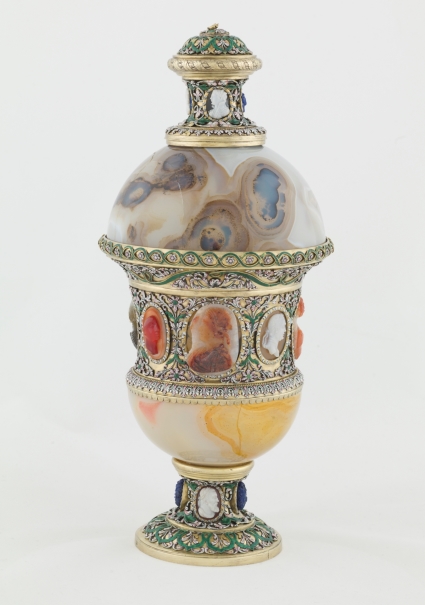
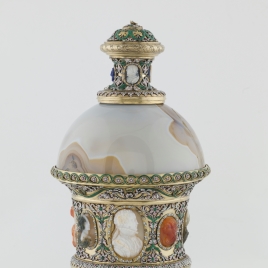
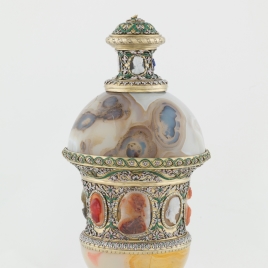
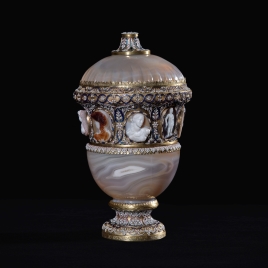
Agate vessel with three bands of cameos
XVII century. Agate, Silver gilt, Lapis lazuli, Cowry, Chalcedony, Gold, Enamel.Room 079B
The pair of a vessel stolen in 1918, this is one of the few pieces which still preserve work by Pierre Ladoyreau or Ladoireau, one of the great master craftsmen of the 17th century in France, who designed furnishing and bronzes for the palace and gardens of Versailles. It is made up of two pieces of stone, sixteen cameos and three large enamelled gold mounts. The decoration of the mounts, similar to that of numerous vessels at the Prado, is typical of the Paris school in the late 1680s. It is characterised by enamelled overlays that follow designs by Bérain and others, formed by undulating ribbons and translucent green leaves combined with small flowers and white stalks marked in purple and black, which alternate all over the smooth surface with a pointillé that provides a matte background.
The vessel is adorned with three orders of cameos made in different types of stone, nearly all dating from the last third of the 16th century, though one or two are later. Most represent figures in court dress, several of them in the Spanish style. Some profiles recall historical personages like Anna of Austria, Louis XIII or the young Louis XIV. Placed alongside them are cameos with the effigies of Roman emperors crowned with laurel. There are also other figures and divinities from the classical world, such as Bacchus.
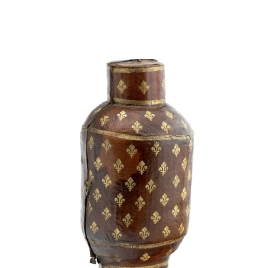
Here, as on other pieces in the Dauphin’s Treasure, it is the work of the silversmith that predominates, and the stone elements are very much secondary to the mounts. It was made by the Parisian Pierre Ladoireau (active 1679-1716), whose mark appears on the interior of the base, with the initials “PL” separated by a cross and star and surmounted by a fleur-de-lys beneath a crown. The silversmith and metal founder to the King’s Wardrobe of Louis XIV, he made several of the opulent silver furnishings for the Hall of Mirrors at Versailles. He also created pieces for the decoration of Marly, the Dauphin’s residence, and had his own retail business and workshop, maintaining commercial contacts with China and the East Indies. Very few works of his are currently preserved, since most were eventually melted down after different vicissitudes. The vessel also bears the mark of the assay master or fermier Jacques Léger (active between 1687 and 1691), an “A” crowned by a fleur-de-lys.
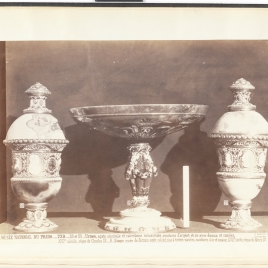
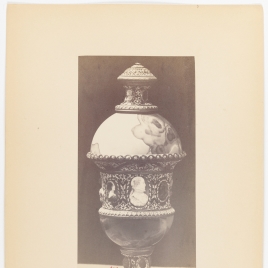
The state of the work in the 19th century can be seen through the photography of Juan Laurent y Minier, "Vase agate sardoine, montures d’or avec émaux et pierreries, XVIe siècle, règne de Henri II", c. 1879, Museo del Prado, HF0835/04.