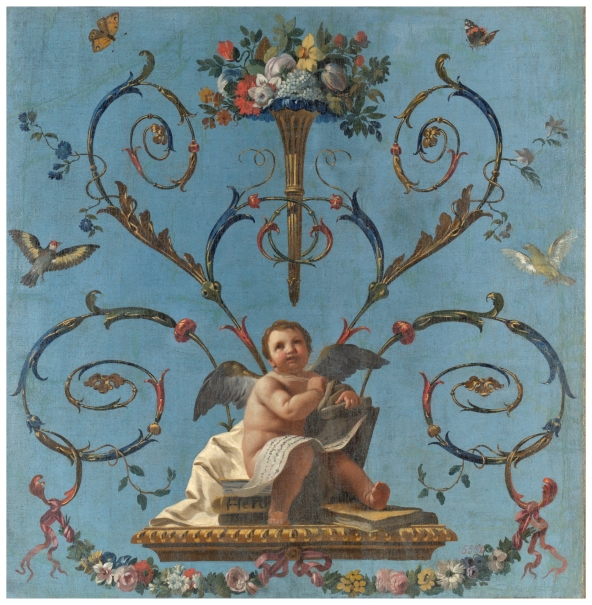
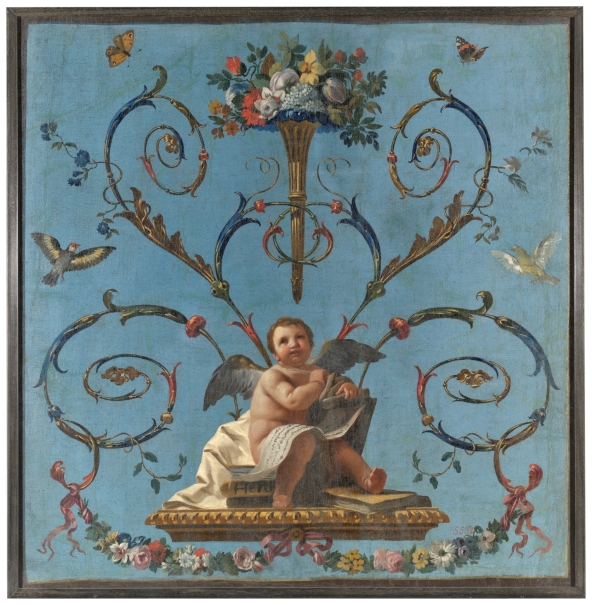
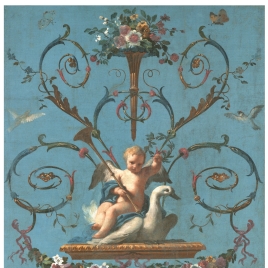
Allegory of Arithmetic
Ca. 1775. Oil on canvas.Not on display
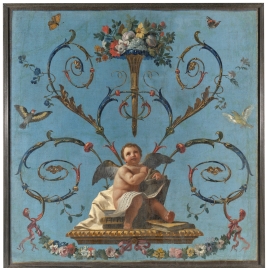
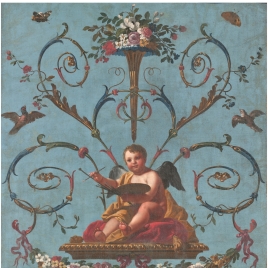
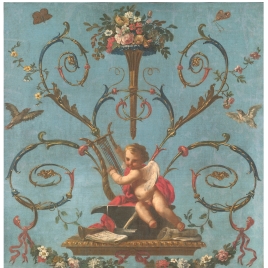
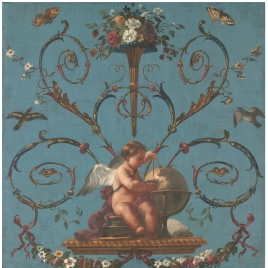
This work belongs to a set of six canvases painted as tapestry cartoons for the decoration of the cabinet of the Princess of Asturias in the Royal Palace of El Pardo. The little children or cupids represent several allegories: Painting, Architecture, Fame, Music, Astronomy and Arithmetic (P007347 to P007352). Dated between 1770 and 1780, this unique composition belongs to the height of the 18th century, even though it was already experiencing, aesthetically, the decline of the Baroque, which was becoming more diluted in its final phase. Its decorative conception shows the refined echoes of rococo even though it draws many of its formulations from the anaglyphic repertoire of the High Renaissance, suitably polished, when many of the motifs recovered from the Roman ornamental tradition were reworked. Thus, in this work, multiple references can be perceived as appearing in the varied world of tapestry, either in its finest trimmings or in the central areas of the draperies, depending on the schools and periods. The compositional scheme evinces Castillo’s ability to imagine ornaments, adornments and titivations, with a light and pleasing effect, in order to achieve a decorative, coherent, harmonious and well-adorned result.
Luna, Juan J., El bodegón español en el Prado: de Van der Hamen a Goya, Madrid, Museo Nacional del Prado, 2008, p.130-131