formularioRDF
The itinerary <em>TITULORECORRIDO</em> has been successfully created. Now you can add in works from the Collection browser
<em>TITULOOBRA</em> added to <em>TITULORECORRIDO</em> itinerary

Close Continuar a ficha de la obra Continuar a ficha de la obra
02-06-2026
José del Castillo

Madrid (Spain), 1737 - Madrid (Spain), 1793

See author's file

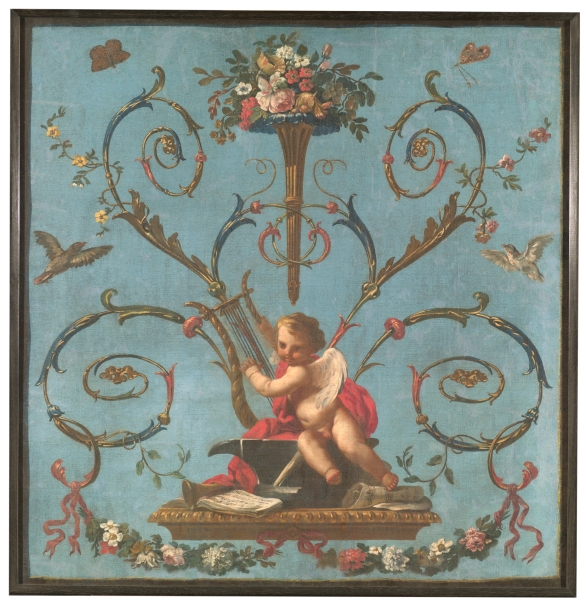
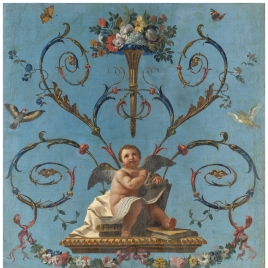
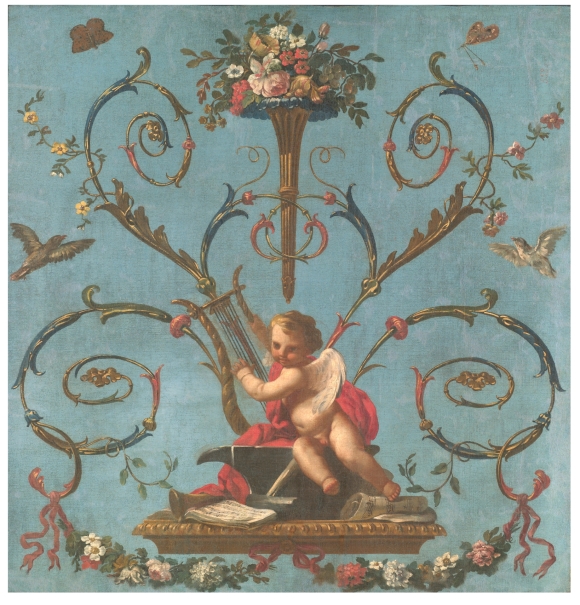
Allegory of Music

Ca. 1775. Oil on canvas.
On display elsewhere

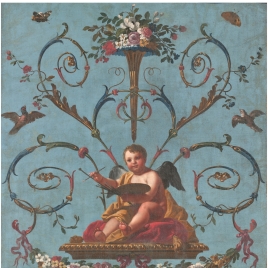
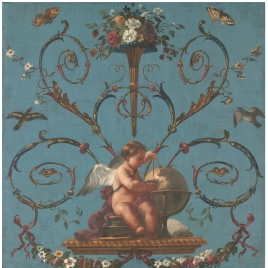
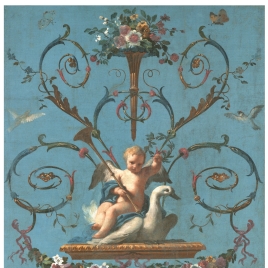
This work belongs to a set of six canvases painted as tapestry cartoons for the decoration of the cabinet of the Princess of Asturias in the Royal Palace of El Pardo. The little children or cupids represent several allegories: Painting, Architecture, Fame, Music, Astronomy and Arithmetic (P007347 to P007352). Dated between 1770 and 1780, this unique composition belongs to the height of the 18th century, even though it was already experiencing, aesthetically, the decline of the Baroque, which was becoming more diluted in its final phase. Its decorative conception shows the refined echoes of rococo even though it draws many of its formulations from the anaglyphic repertoire of the High Renaissance, suitably polished, when many of the motifs recovered from the Roman ornamental tradition were reworked. Thus, in this work, multiple references can be perceived as appearing in the varied world of tapestry, either in its finest trimmings or in the central areas of the draperies, depending on the schools and periods. The compositional scheme evinces Castillo’s ability to imagine ornaments, adornments and titivations, with a light and pleasing effect, in order to achieve a decorative, coherent, harmonious and well-adorned result.

Luna, Juan J., El bodegón español en el Prado: de Van der Hamen a Goya, Madrid, Museo Nacional del Prado, 2008, p.130-131
Multimedia

Technical data

Imagen del carrusel
Imagen del carrusel

Related artworks

Allegory of Fame
Oil on canvas, Ca. 1775
José del Castillo
Inventory number
P007350
Author
José del Castillo
Title
Allegory of Music
Date
Ca. 1775
Technique
Oil
Support
Canvas
Dimension
Height: 117 cm; Width: 113 cm
Series
Gabinete de la Princesa de Asturias, Palacio Real de El Pardo
Provenance
Real Fábrica de Tapices de Santa Bárbara (Royal Tapestry Factory), Madrid; transferred to the Royal Palace, Madrid, in the mid-19th century
Entry date
1870

Bibliography +

Museo Nacional del Prado, Museo del Prado. Inventario general de pinturas (III). Nuevas Adquisiciones. Museo Iconográfico. Tapices., Museo del Prado, Espasa Calpe, Madrid, 1996, pp. nº 5580 (Inv. cart. tapices).

Luna, Juan J., El bodegón español en el Prado: de Van der Hamen a Goya, Museo Nacional del Prado, Madrid, 2008, pp. 130-131.

Other inventories +

Inv. Cartones para Tapices. Núm. 5580.
[José del Castillo] 5580 [nº del inventario moderno] 41 [id. Antiguo] / id id id Música

Location +

Madrid - Tribunal Supremo de Justicia (Deposit)

Displayed objects +

Lyre, Classical: Ángel con lira de caja en forma de herradura con extremos de forma torneada y seis cuerdas tendidas. El ángel está vuelto hacia el espectador y con la mano izquierda parece que toca las cuerdas. La lira aparece en el siglo VII a. de C. Su invención es atribuida por la mitología griega al Dios Hermes, que se la ofreció a Apolo y a Orfeo simbolizando la expresión poética. La lira clásica tiene generalmente siete cuerdas (Proyecto Iconografía Musical, U.C.M.).
El instrumento solía ser de madera y su sonoridad era siempre débil, moviéndose en el registro medio de la voz humana a la que acompaña.

Shawm: Sobre la mesa y detrás del libro, asoma la campana de un aerófono, posiblemente de madera, aunque tiene un color dorado. Podría ser el final de una chirimía, aunque faltan detalles para la identificación del instrumento ya que está cubierto con el manto rojo. La chirimía es un aerófono con embocadura de lengüeta doble, antecedente del oboe y muy usado en Europa en el siglo XVII, especialmente en la música al aire libre y en danzas (Proyecto Iconografía Musical, U.C.M.).
Se puede tocar indistintamente con la mano derecha arriba y la izquierda abajo y viceversa, apoyando los labios en un tudel.

Music, Illegible: En el soporte del ángel hay dos partituras; una enrollada donde apoya su pie izqu¡erdo y otra en forma de cuaderno manuscrito, de varias páginas, apaisado, abierto y doblado por una de ellas. La música de las partituras no resulta legible (Proyecto Iconografía Musical, U.C.M.).

Update date: 02-06-2026 | Registry created on 28-04-2015

Visor 360

Drag with the cursor to rotate the piece

Other works by José del Castillo

Print on demand

Print artworks available in our catalogue in high quality and your preferred size and finish.

Image archive

Request artworks available in our catalogue in digital format.

Up