An altar boy practices his singing
1891. Oil on canvas.Not on display
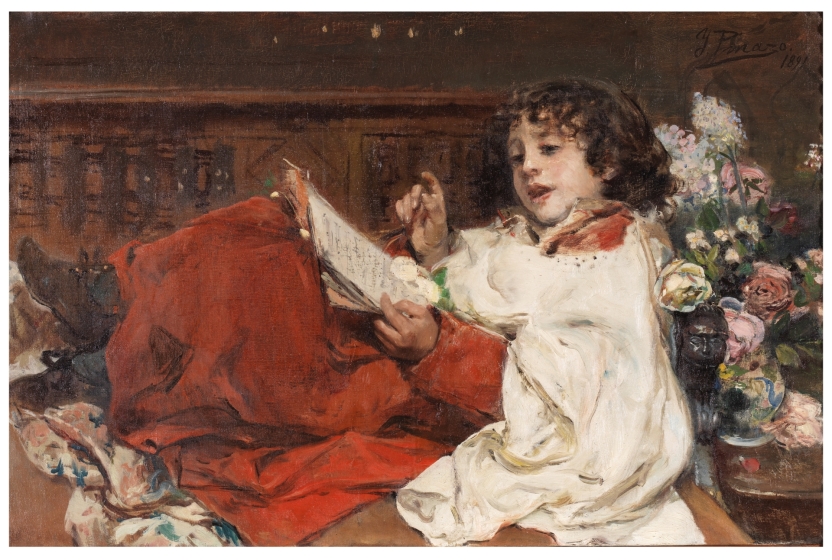
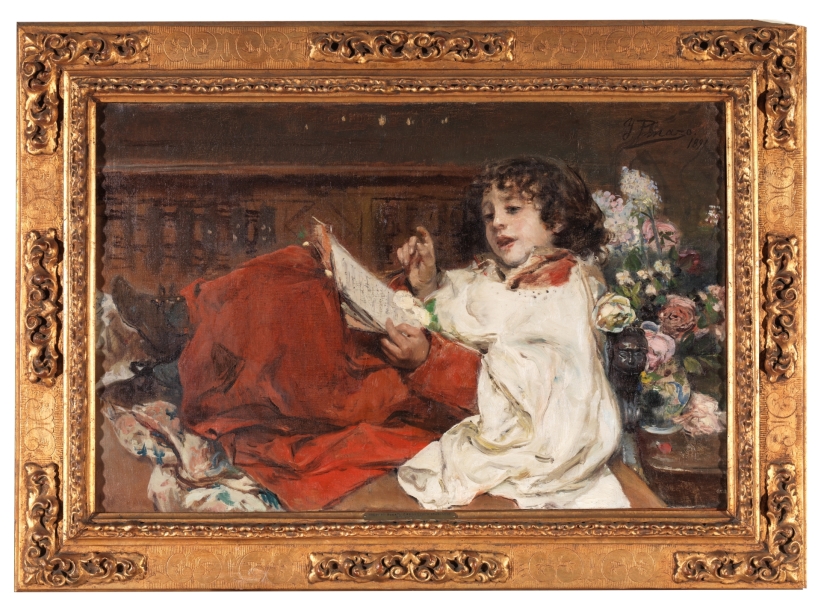
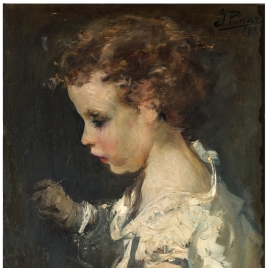
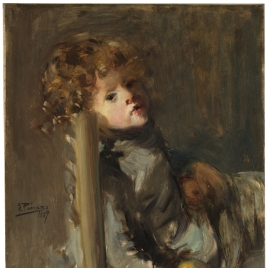
Lying quietly in a church pew, an altar boy hums the notes of a score in his lap. Beside him is a colourful bouquet of flowers, and in the background, behind a balustrade, the candles of an altar glow in the half-light. This painting, surprisingly unknown to those who have studied Pinazo’s work, is nevertheless an important piece among the many paintings of children by this painter over the course of his career.
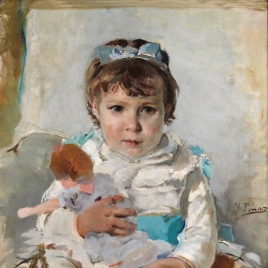
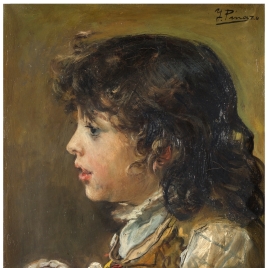
Indeed, this work combines the artist’s preference for children, whom he portrayed on countless occasions. There was a widespread fashion in Europe throughout the second half of the 19th century for painting altar boys and church acolytes, usually depicted in their most anecdotal and humorous guise, and almost always neglecting their parish duties, as in this case. Pinazo himself painted other pictures with similar themes, such as Altar boy playing the zambomba, in the Museo de Valencia. The fact that Pinazo often used his own children as models for his figures of children provides them all with a ‘familiar air’. In this case, the altar boy’s features correspond to those of his son Ignacio, his favourite model.
It is a painting with an eminently decorative aim, reinforced by the inclusion of the colourful touch of the flowers. Pinazo captures with his remarkable mastery the freshness and spontaneity of the child model, who occupies almost the entire canvas. He traces his design with long, very marked dark brushstrokes and absolute freedom and speed of execution, leaving large areas of the composition barely outlined – such as the folds of the clothing – and thus focusing on the child’s face and hands.
Museo Nacional del Prado, Pintura española del siglo XIX: del neoclasicismo al modernismo, Madrid, Ministerio de Cultura, 1992, p.172 nº45