And They Still Say Fish Is Expensive!
1894. Oil on canvas.Room 061A
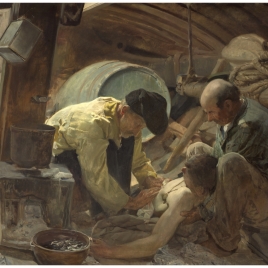
This emblematic painting—undoubtedly the most famous among those Sorolla produced in his youth with a social theme—stands as a key example of the artist’s engagement with a genre that was then fully in vogue within the official artistic circles of Madrid, where Sorolla sought to earn his first public recognition. Moreover, it is arguably the most emotionally resonant of these early works, due to the depth of its subject matter, which touches on experiences familiar to the people of his native region. With this canvas, Sorolla achieved one of the most moving scenes in Spanish social realist painting of the late 19th century. Following the success of “¡Otra Margarita!” (1892, Mildred Lane Kemper Art Museum, Washington University in St. Louis), Sorolla once again garnered a First Medal at the 1895 National Exhibition with this work, which he presented alongside thirteen other paintings, most of them portraits.
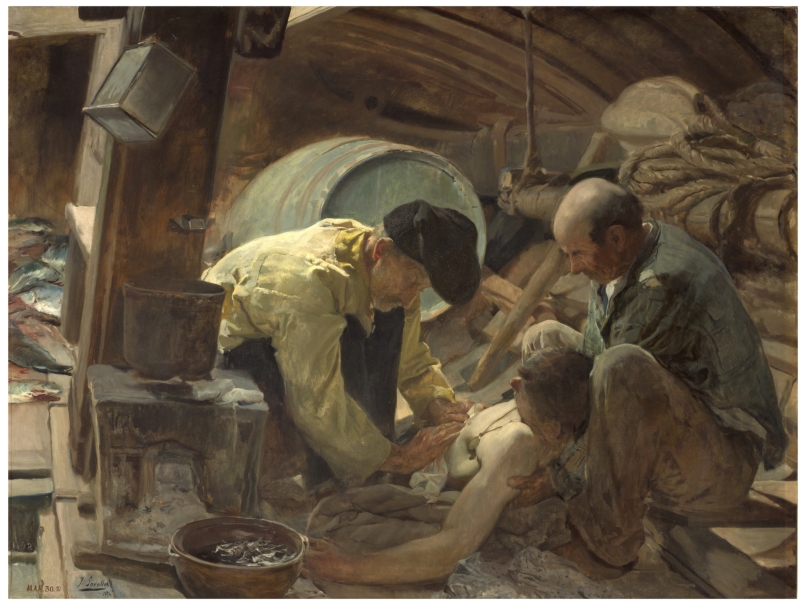
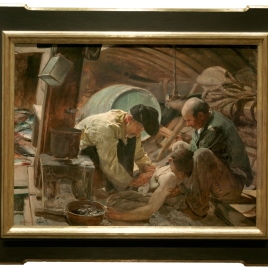
The painting depicts the interior hold of a fishing boat, where a young fisherman—little more than a boy—lies on the floor after suffering an accident while at sea. Bare-chested, wearing a devotional medallion common among fishermen as a talisman against misfortune, the boy is being carefully tended by two older sailors. Their faces convey a serious, concentrated demeanor. One supports the youth’s shoulders, while the other—wearing a traditional barretina—applies a compress to his wound, having just moistened it in a basin of water seen in the foreground. Surrounding them are various fishing tools, and in the background lies a heap of freshly caught fish from the ill-fated day’s labor.
Still adhering to the formal rigors of strict naturalism that characterize Sorolla’s early socially engaged works, with their firm, descriptive drawing—particularly in the figures—and only slightly freer treatment of the surrounding setting, Sorolla nonetheless achieves in this painting a notable compositional harmony and a daring spatial design. The canvas already incorporates some of the innovations in painterly language that would define his later oeuvre.
Indeed, the first thing that moves the viewer is the quiet, stoic composure of the elderly seamen as they care for the fragile, wounded body of the boy—an image rendered with the dramatic solemnity of a secular pietà, imbued with a noble gravity that only Sorolla was able to evoke from the soul of the fishermen of his homeland.
Furthermore, the treatment of light—streaming in through the boat’s hatch and softly illuminating the hold and its contents—demonstrates Sorolla’s evolving mastery of luminosity in this genre, a clear advancement over his earlier efforts. The modern, daring framing shifts the perspective sharply to one side, emphasizing the spatial tension of the enclosed setting and revealing the stairs down which the injured boy was carried, thereby deepening the composition. It culminates in the silvery reflections of the piled fish in the background.
The restrained yet deeply felt pathos with which Sorolla approaches this maritime subject stands in sharp contrast to other major works with similar themes, such as “Comiendo en la barca” painted four years later. While similar in scale, that work adopts a radically different approach, already rooted in the naturalist costumbrismo that would come to typify Sorolla’s depictions of seafaring life.
Although Pantorba states that the painting was executed during the summer of 1894 in Valencia, Sorolla appears to have begun it several months earlier. In a letter to his friend Pedro Gil dated early that year, he wrote: “I’m already finishing my painting for the Salon; it’s a large one—though it’s not more than two meters—it’s a scene with fishermen, and it takes place inside a fishing boat.” Here, Sorolla likely refers to the monumental scale of the figures relative to the canvas, which indeed contributes to the solemnity and powerful presence of the composition.
The subject and title of the painting were inspired by the final scene of the novel “Flor de mayo” by Vicente Blasco Ibáñez, written simultaneously as Sorolla painted this work and published in 1895. In that novel, Blasco Ibáñez describes the harsh life of fishermen, concluding with a dramatic accident at sea and the retrieval of a lifeless body in the hold of a wrecked boat, followed by an impassioned denunciation. In the preface to the 1923 edition of the novel, Blasco Ibáñez recalled his friendship with Sorolla and their shared fascination with the sea as a source of artistic inspiration.
This celebrated canvas, which in its time inspired fervent poetic tributes, has earned near-universal critical acclaim throughout its history. In the same year of its public debut in Madrid, Reparaz praised the painting’s luminous qualities, while Pérez Nieva focused on the dramatic subject and the sobriety of its color palette. In the mid-20th century, critic Pompey lauded the work, perceiving the influence of Velázquez in its execution.
The Museo Sorolla holds two oil sketches believed to be preparatory studies for the final painting. One, “Bodega de una embarcación. Valencia”, depicts various objects in the hold of a boat, while the other, “Interior de una barca”, establishes the general layout of the composition, including the base of the central mast and the beam of light entering through the hatch—both elements carried over into the final work. The finished painting can also be seen mounted on an easel, unframed, in a photograph taken in Sorolla’s studio on Plaza del Progreso in Madrid, likely still in 1894, before the work was awarded the National Exhibition prize and purchased by the Spanish State.
From Paris, Sorolla wrote to his wife on June 15, 1895, to share the news: “I suppose you already know I was awarded first prize in Madrid for the painting They Still Say the Fish Is Expensive.”
Díez, José Luis, 'Joaquín Sorolla. ¿Aún dicen que el pescado es caro!'. Arte y transformaciones sociales en España (1885-1910), Madrid, Museo Nacional del Prado, 2024, p.266-268 nº.166