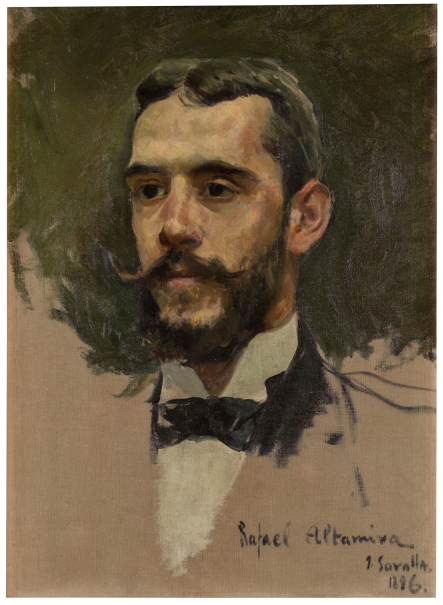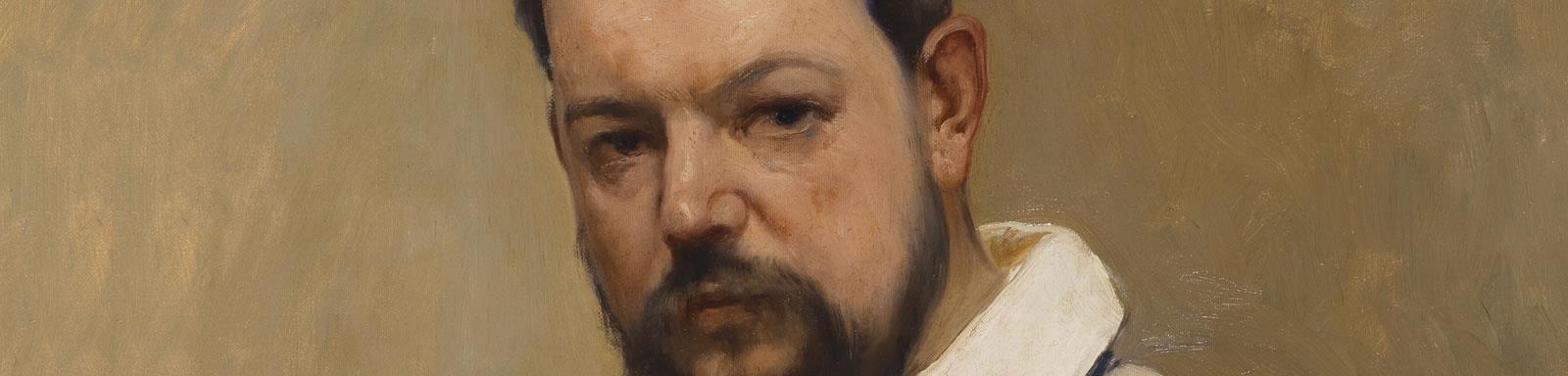
Rafael Altamira y Crevea
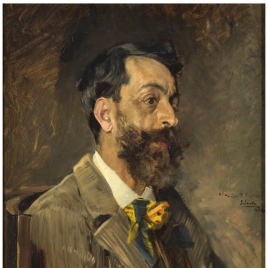
1886. Oil on canvas.On display elsewhere
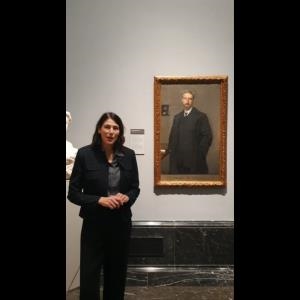
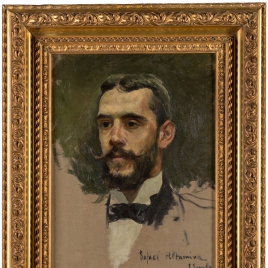
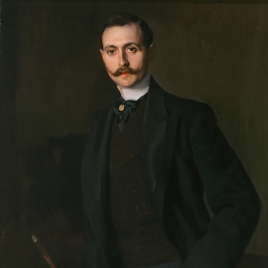
This portrait of Rafael Altamira y Crevea (Alicante, 10 February 1866–Mexico, 1 June 1951) was painted the year he graduated in Law from the Universidad de Valencia, where he had developed a close friendship with Sorolla. The head is well defined above his shirt and bow tie, which, like the background, are barely sketched out, leaving the rest of the canvas uncovered by paint (even though the artist did sign the work). This intimate portrait features a sobriety of colour that used to be very common in the artist’s early portraits, which years later, in 1901, seemed to Emilia Pardo Bazán, ‘as if they had been painted in tempera, pale and dry’. Indeed, they lack the luminous vibrancy in those done after 1900. Nevertheless, he manages to capture Altamira’s character with immediate truthfulness, treated with a certain idea of a head that is at once ancient and noble. Nonetheless, the detail of the raised tips of the moustache – which he would later replace with a long beard – reveals a youthful concern for his appearance. It was also a gift to a friend whose hobby was painting and who, in his twenties, was embarking on a fruitful career as a jurisconsult and historian.
Altamira became one of the most prominent professors of the Institución Libre de Enseñanza from his chair in Oviedo. He promoted relationships with America through a trip in 1909-10, which strengthened relationships between Latin American and Spanish universities, and through his chair as Americanist, which he occupied in 1914, at the Universidad Central de Madrid. He was director general of Primary Education (1911–13), a member of the International Tribunal at The Hague and a convinced pacifist. He went into exile in Mexico in 1945. In addition to having met Sorolla in Valencia, they also met in Madrid and even in Asturias, where Altamira lived between 1897 and 1908. He owned a house in San Esteban de Pravia, and he coincided there with Sorolla during his stay in La Arena during the summer of 1902, which was to be repeated the following years. During the calmness of that first summer, they both shared many hours of work as well as observations of the landscape, to which Altamira devoted several articles. An indication of the relevance of those conversations is a letter that Sorolla wrote to Altamira shortly after his return to Valencia, in which he made interesting aesthetic remarks concerning the legitimacy of depicting nature without any expressive additions whatsoever and regarding the self-value of pictorial notes and sketches. As per Sorolla, painting should be stripped of all the useless things we do, leaving only what it should be: a state of mind that has no other philosophy than the feeling that painting from life strongly exerts at the time. Written in 1902, these words also apply to the portrait, which was painted much earlier. On a second occasion the painter would portray Altamira, but then, in 1913, he did it more conventionally, for the Iconographic Gallery of Illustrious Spanish Gentlemen that Archer M. Huntington was putting together for the New York Hispanic Society. As a matter of fact, Altamira was one of the guests at the exclusive meal that Sorolla would share at his home on 19 June of the previous year, honouring Huntington. The writer from Alicante – a polygraph of wide-ranging interests who, from his naturalist position, understood Sorolla very well – was attracted to painting and assembled a small collection of works by his artist friends. Upon Sorolla’s death in 1923, he dedicated an article to him in his Estudios de crítica literaria y artística [Critical studies of literature and art] (1929).
Barón, Javier, Rafael Altamira y Crevea (1886). En Barón, J.: El retrato español en el Prado. De Goya a Sorolla, Madrid, Museo Nacional del Prado, 2007, p.180, n. 63