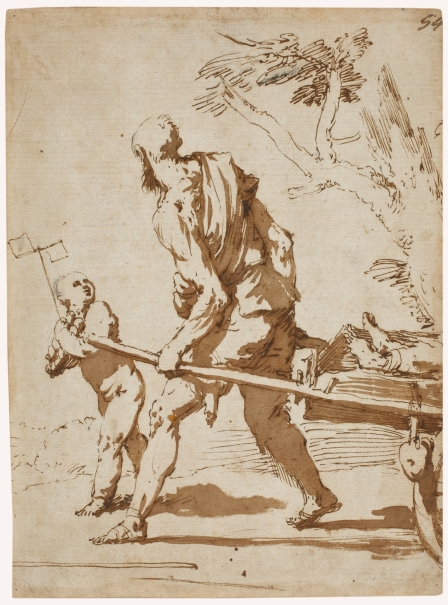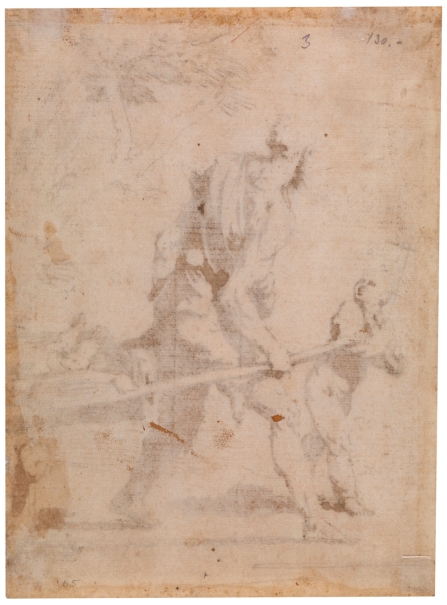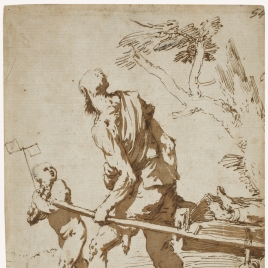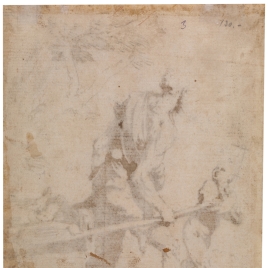
Boy with a Pinwheel and Man pulling a Cart with a body
Ca. 1640. Wash, Pencil strokes, Pencil, Grey-brown ink on laid paper.Room C
Until now, this drawing has been dated in the 1630s, fundamentally because its subject matter can be related to the epidemics of cholera and leprosy that struck the city of Naples in those years. Stylistically, however, this drawing more closely resembles the artist’s late works. While his drawings from the 1630s are characterized by very precise pencil or pen lines and a very nuanced use of washes, those from the following decade are more like the present work, with broken lines, much less precise and thus more nervous contours and a denser use of less-transparent and less-nuanced washes, resulting in more dramatic light and shadows. In its form and composition, this drawing is closely related to Woman holding a Child, followed by another Child and a Dog (private collection), including a similar way of drawing the child’s legs. The fact that the figures occupy almost the entire surface of the paper links this work to some of the drawings from that period, such as The Martyrdom of Saint Bartholomew (New York, The Pierpont Morgan Library), with which it also shares some stylistic aspects. Some of its characteristics are habitual in Ribera’s drawings, including figures with elongated proportions and dislocated, extremely foreshortened bodies. This approach sometimes leads to formal errors that can be further accentuated by an extreme use of washes, resulting in powerful shading that interferes with a correct representation of the perspective or anatomies. This is visible here in the distortion of the old man’s figure to heighten the composition’s dramatic character. Ribera’s creative freedom is clearest in his drawings and it draws his works into different territories, from the observation of reality that leads him to depict scenes from everyday life or studies of human characters to more imaginative compositions in which the bodies are distorted or deformed to achieve a certain sense of the grotesque. This sometimes makes it difficult to determine the final meaning of some of his compositions. On one hand, the presence of realistic elements, such as the old man pulling a cart, reflects an observation and representation of daily life, where death is an everyday event. On the other, the inclusion of a child holding a pinwheel and some vaguely rendered objects in his arms—could they be logs?—may possibly allude to something more than mere child’s play. According to Ripa’s traditional iconography, the pinwheel is associated with unawareness and madness. From that perspective, the drawing could be interpreted as an allegory of death and madness, symbolized by the nude child walking along with a pinwheel, unable to make any sort of sound that would warn of the proximity of the cadaver being transported by the old man for interment outside the city walls. Death is eloquently represented by the figure of the ragged old man pulling a cart with a cadaver whose feet are the only visible part of his body. But this drawing might also refer to the mutability of life by contrasting the innocence of childhood with the harsh reality of death. Finally, it may simply be a depiction of an everyday event, with no allegorical intent at all (Text drawn from Matilla, J. M. en: Memoria de Actividades, Museo Nacional del Prado, 2009, pp. 40-41).