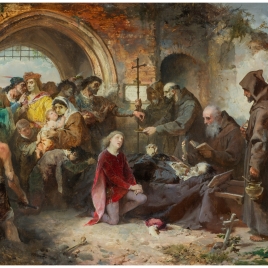
Cervantes and John of Austria
1860. Oil on panel.Not on display
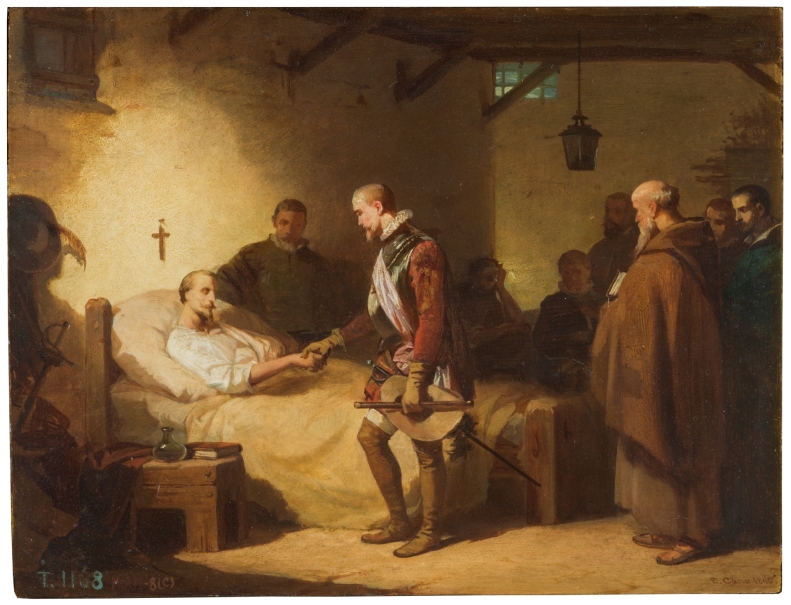
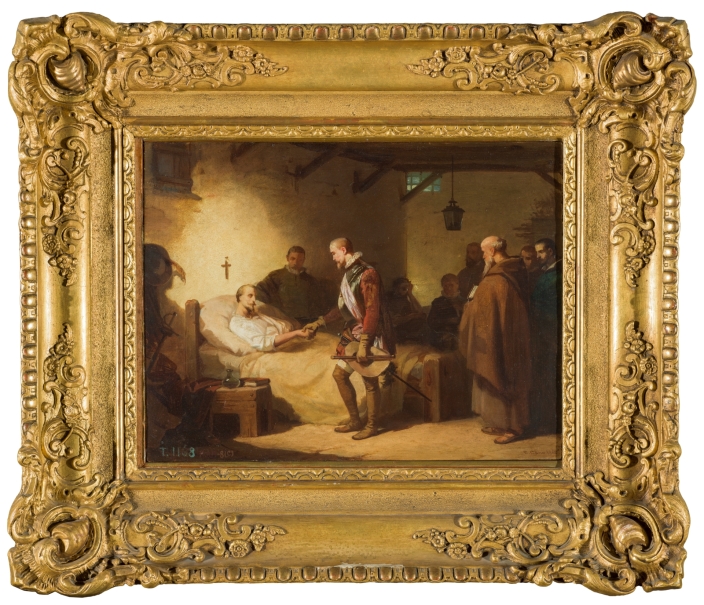
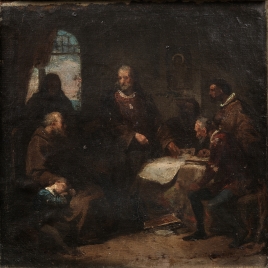
Inside a sober room –perhaps a hospital– Cervantes, bedridden after losing his left arm during the Battle of Lepanto, is visited by John of Austria, the halfbrother of King Philip II the Prudent and admiral of the Holy Alliance fleet, victorious against the Turkish Empire in that famous battle, which took place on 7 October 1571. The distinguished visitor, wearing a general´s breastplate, sash and flare, shakes the writer´s right hand, whose left arm is bandaged in a sling. In the semi-darkness of the room, they are surrounded by various figures, including an elderly, bearded friar on the right of the composition, with another wounded man with a bandaged head in the background in the darkness.
Despite its small size, this small panel – previously classified as a canvas and titled on the reverse side by the artist himself – is good proof of Cano´s special qualities for small–format works which, while appearing to be sketches, are in fact mere pictorial whims of an intimate and unpretentious nature. These are works in which the artist demonstrates precisely his freest and most sincere technique, with the juicy brushstrokes and delicate play of light for which he was always particularly skilled, with results quite different from the extreme academic purism to which he is accustomed in the large historical compositions for which he is best known. In fact, the arbitrary use of the lighting effects that set the mood of the room, highlighting the two main characters in the scene, plunges the rest of the room into almost absolute darkness, with only the austere couch on which the "Manco de Lepanto" lies, the cross hanging from his headboard, the flask and the book visible on his rustic bedside table, next to which can also be seen hanging the writer´s hat, cloak and sword, and the unlit lantern hanging from the beam of the coffered ceiling.
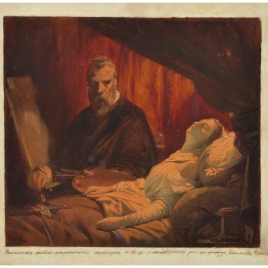
Along with this small panel owned by the Prado, Cano made other versions of the same subject, always in small dimensions; one of them kept in Museo de Cádiz and another in a private collection in Seville, as well as a lithograph that appeared in the magazine El Arte en España in 1862 (Pérez Calero, 1979, n. 76, 74 and 116, respectively).
El mundo literario en la pintura del siglo XIX del Museo del, Madrid, Centro Nacional de Exposiciones y Promoción Artística, 1994, p.128