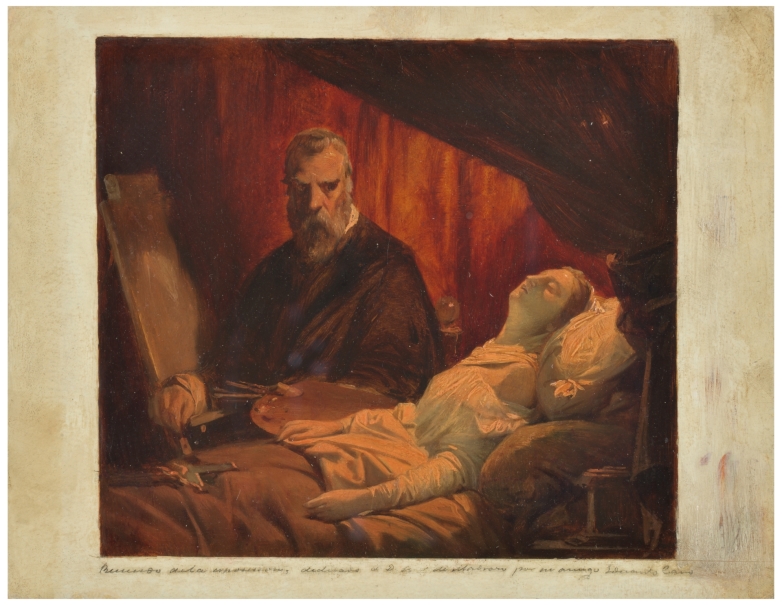
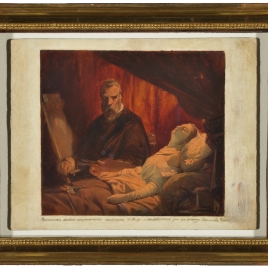
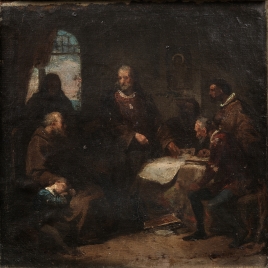
Tintoretto painting his dead daughter (copy)
Ca. 1856. Oil on cardboard.Not on display
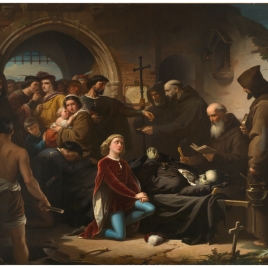
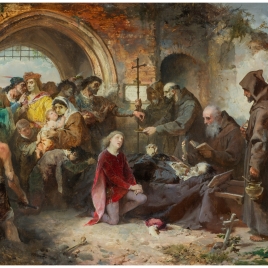
Marietta (1560–1590), the eldest daughter of the painter Jacopo Robusti ‘il Tintoretto’ (1518–1594), was a painter and a musician. According to lore, her father painted her while she lay dead in her deathbed. This painting, a copy of the original by León Cogniet, demonstrates how he was inspired by Luis de Madrazo, to whom Cano de la Peña dedicates his work. The influence of The Funeral of Saint Cecilia in the Roman Catacombs (P006555) – one of his most remarkable works – on this work is clear and is especially evident in the figure of the Saint’s corpse.
León Cogniet’s painting Le Tintoret peignant sa fille morte (Musée de Beaux Arts in Bordeaux), had a huge impact among the critics and the public since its public exhibition in 1848 in the Paris Salon, and soon after, in 1853, it would enter the Museum where it is currently held. There are many unmistakeable connections between the Frenchman’s work with the aforementioned canvas by Madrazo. The position of the young woman’s head, leaning backwards as a clear gesture of her last breath; the girl’s own appearance, with snow-white skin and blonde hair; her body, wrapped in a thin white nightgown hitched up to her waist, with her arms fallen alongside her body. In Madrazo’s painting, Tintoretto is substituted by Pope Urban, whose features – and particularly the shape of his beard – are reminiscent of the Venetian master’s presence as depicted in the French canvas, which moreover alludes to Tintoretto’s self-portrait in Museée du Louvre.
It is worth recalling that Cogniet’s painting enjoyed a special recognition in the Madrazo sphere of influence: Leopoldo Sánchez del Bierzo, one of Federico de Madrazo’s closest collaborators, made a copy of the painting (Museo de la Real Academia de Bellas Artes in Madrid); Vicente Palmaroli would make another copy (private collection). Nevertheless, it is widely known how Eduardo Rosales gazed upon it on his way to Rome, praising it in his pocket diary in such a way that Salas even took it as one of the original sources for Queen Isabella the Catholic dictating her Will (P004625). Luis de Madrazo would keep this copy, painted by the Andalusian artist and his brother Federico’s disciple Eduardo Cano de la Peña, throughout his entire lifetime.
Navarro, Carlos G., Luis de Madrazo pensionado en Italia: El Entierro de Santa Cecilia y sus dibujos preparatorios en el Museo del Prado. Boletín del Museo del Prado, Madrid, Museo del Prado, 2007, p.130