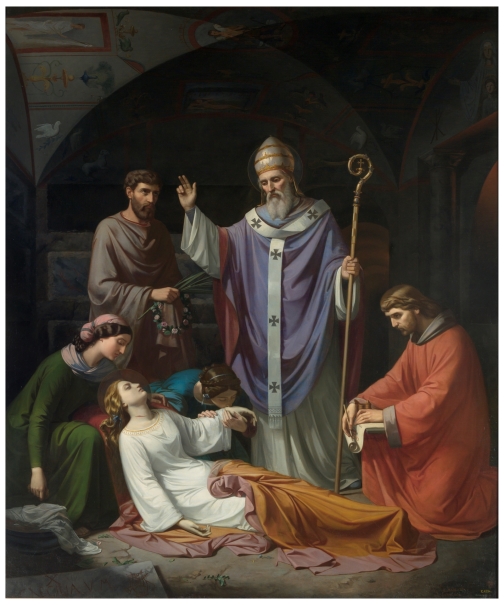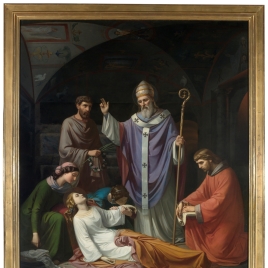
Burial of Saint Cecilia in the Catacombs of Rome
1852. Oil on canvas.Not on display
Following the early successes that marked the career of the young Federico de Madrazo in Rome, especially with Las Marías en el sepulcro preserved in los Reales Alcázares in Seville, his brother Luis de Madrazo also travelled to Rome in 1848 to complete his artistic training thanks to a grant by the Academia de San Fernando, with the same objectives of erudite and cosmopolitan training that had encouraged his father and brother in the past.
It was precisely during his years in Rome that Luis de Madrazo painted what can be considered the undisputed masterpiece of his entire career as well as one of the most outstanding works of Spanish religious painting of the time: The Burial of Saint Cecilia in the Catacombs of Rome.
Luis both lived through and felt the personal impact of a massive upheaval in the religious life of the city of the popes and swept into the feverish artistic activity which followed the scholar Giovanni Battista Rossi’s 1850 discovery of the catacombs of Saint Callixtus. It was a discovery which made real, made tangible, the historical suffering and persecution of Christians in ancient Rome. This archaeological site would automatically become a place of pilgrimage of great importance in the holy city as well as an endless resource for artistic depictions of the tortures and burials of the most venerable martyrs buried there. It became a cataract of new plot sources for young artists eager to forge a future for themselves in the Eternal City.
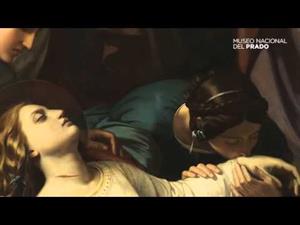
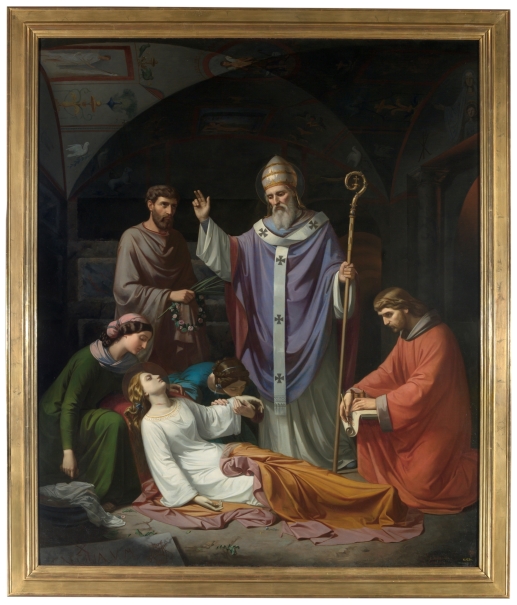
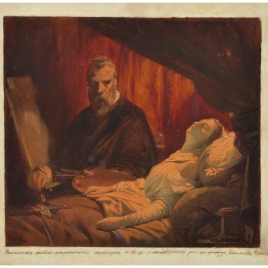
It was in this climate of renewed religious enthusiasm that Luis de Madrazo gave created this work. The ambitious and beautiful canvas portrays the burial of the young Christian martyr in the underground crypt in the presence of Pope Urban himself. It is a solemn, transcendent painting of severe, restrained drama. Its elaborate composition, with several figures attending the burial, does not distract the viewer´s attention, which Madrazo manages to focus on the delicate beauty of the saint´s recumbent body. Madrazo studied the figure of Saint Cecilia in several drawings of enormous formal beauty and exquisite cleanness of line, by using his most attentive and delicate technique in his pictorial rendering, both in her face and hair as well as in the modelling of the cloak and tunic that serves as a shroud, whose whiteness powerfully accentuates her inert body within the darkness of the catacomb. It was a great success among the community of Spanish artists living in Rome at the time, and its fame was subsequently confirmed after its public exhibition in Madrid (Díez, J.L. in: El arte de la era romántica [Art in the Romantic Era]. Galaxia Gutenberg - Círculo de Lectores, 2012, pp. 296–298).