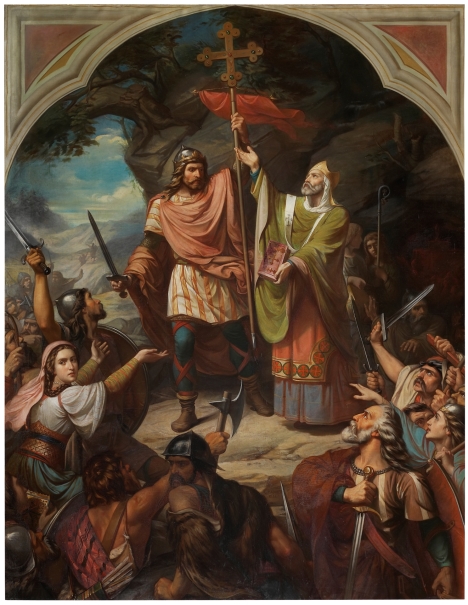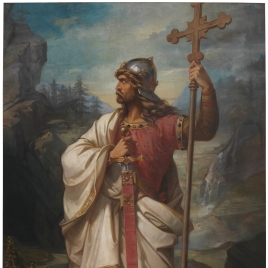
Pelagius of Asturias in Covadonga
1855. Oil on canvas.On display elsewhere
This painting exemplifies the nature of the National Exhibitions of Fine Arts during the long reign of Isabella II. This series of expositions established during the monarch’s reign, became the key instrument for promoting the official art scene under the reign of Queen Isabella II. Moreover, history painting played a key role in such exhibitions as they narrated the political ideology of Spain as a nation through the most significant events of its past and, and therefore, of its monarchy. At the inaugural event presided over by Queen Isabella II and King Francis of Assisi, the most outstanding prize-winning works –which were all historical paintings– flanked the dais of the royal thrones. To the right of the monarchs was the monumental painting Pelagius of Asturias in Covadonga, by Luis de Madrazo. The work had been awarded a first-place medal by the jury, of which his brother Federico de Madrazo was a member. Its plot symbolised the beginning of the Reconquista and thus the recovery of Spain´s Christian and political unity (Díez, J. L. in La pintura isabelina: arte y política. Academia de Historia [Isabelline Painting: Art and Politics. Academy of History], 2010, pp. 86–87).
Luis de Madrazo had begun to consider using a theme similar to that initially planned by his brother Federico for the Congress of Deputies in his Don Pelayo in Covadonga. Although the composition turned out to be very different from the ones his brother had tried out, it met with his brother´s full approval, as well as that of his father, who in some of his advice, took into account aspects tackled by Federico, such as the matter of the relics hidden by the ecclesiastics, which he urged Luis to place in the background, just as he had done in a drawing of Don Pelayo embracing the standard (private collection) (Barón, J. in El Rey Pelayo y el origen de la Reconquista en la obra de Federico de Madrazo", in Museo del Prado. Museo del Prado, 2007, p. 156).