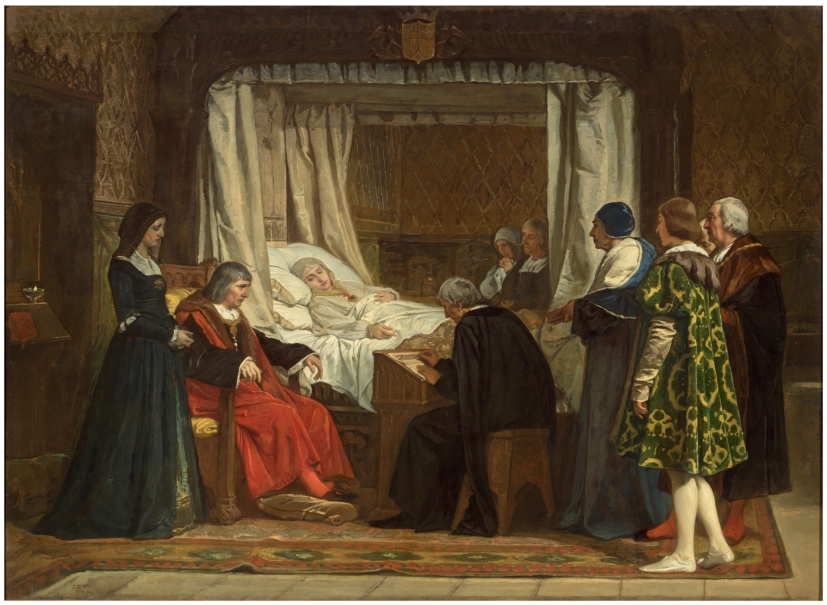
Queen Isabella the Catholic dictating her Will
1864. Oil on canvas.Room 061B
This is a masterpiece of the 19th-century history painting that paved the way for the crucial transformation of this genre in Spain. The acclaimed work was submitted by Rosales to the National Exhibition of 1868, where he was awarded the first medal, thus gaining recognition in official artistic circles and causing a great upheaval among the Spanish painters of his generation.
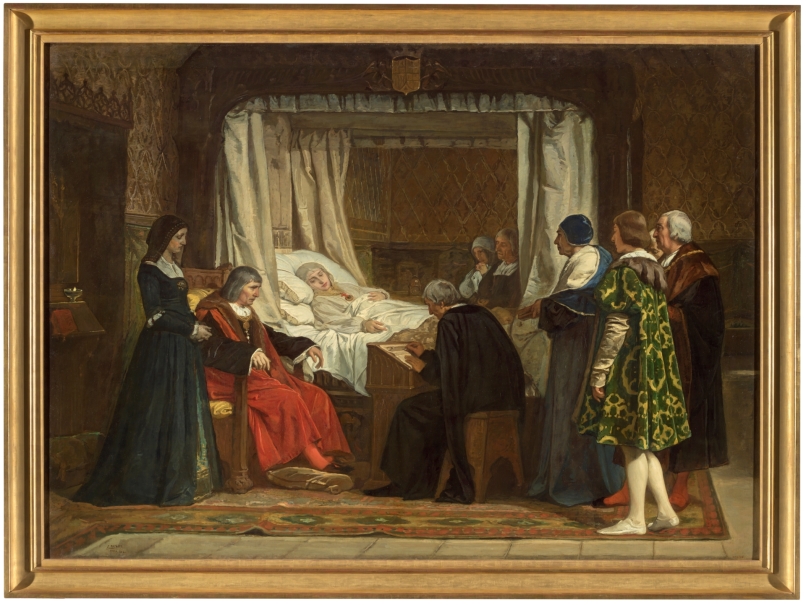
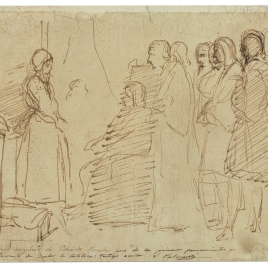
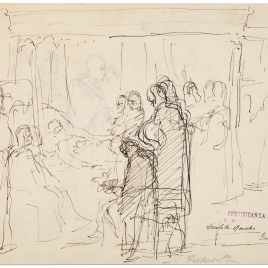
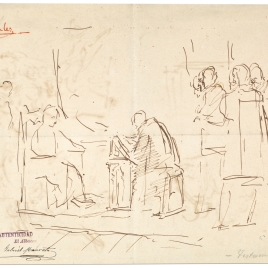
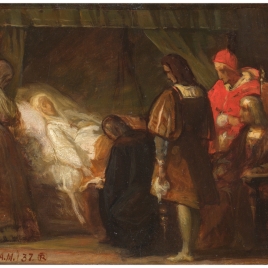
The dying Queen Isabella (1451-1504) is portrayed lying on her bed, which is covered with a canopy and adorned with the coat of arms of Castile, in the dimly lit royal bedchamber of the Castillo de la Mota. With her head resting on two high cushions and wearing her characteristic veil fastened to her chest by a brooch with the shell and cross of Santiago, she orders with a gesture of her hand, the writing of her last will. She dictates it to the scribe Gaspar de Gricio, who is seated at his desk beside her bed. On the left sits the despondent King Ferdinand, facing away from a small oratory lit by an oil lamp. He is depicted absorbed in thought, with a mournful face and a blank stare, resting the weight of his arms on the armchair and his feet on a velvet cushion. Standing beside him is his daughter Joanna, with her hands clasped and her gaze lowered. On the far end of the bed, the queen is attended in her last moments by several members of her court, headed by Cardinal Cisneros, distinguishable by his dignified robes, among other nobles. In the darkness of the room, the Marquises of Moya, faithful servants of the dying sovereign, can be seen behind the canopy.
As has been repeatedly remarked, this emblematic masterpiece of Spanish painting, usually known by the ambiguous title of The Testament of Isabella the Catholic, was the reaffirmation of Rosales´s artistic distinction in the great pictorial tradition of the Spanish Golden Age, epitomised in the work of Velázquez. After his triumph in Madrid, it sparked a true aesthetic revolution in the artistic scenario of its time and a radical change of direction in the evolution of Spanish painting of the previous century. Hence, from this work onwards, most of the great Spanish painters of the 19th century focused on the atmospheric realism of Velázquez´s world, with its reduced and accurate palette. In fact, this was to have a major influence on Rosales’ fellow artists of his generation who lived with him in Rome.
The greatest achievement of the new realism that Rosales introduced with this painting was his special sensitivity in capturing the subtlest nuances of inner feelings in the faces of the various people attending the event, as well as the particular reaction of each of them to the queen´s words, which were slowly unravelling nothing less than the future of the throne of Spain.
Díez, José Luis, 'Eduardo Rosales. Doña Isabel La Católica dictando su testamento'. El siglo XIX en el Prado, Madrid, Museo Nacional del Prado, 2007, p.205-211 n.37