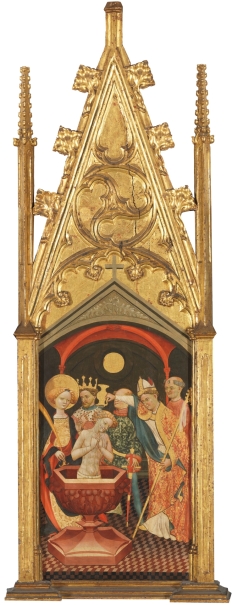
Conan’s baptism before Saint Ursula and her father
1425 - 1450. Tempera on panel.Not on display
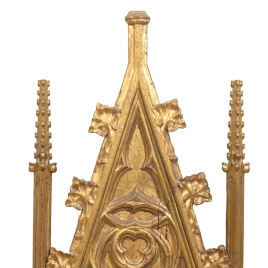
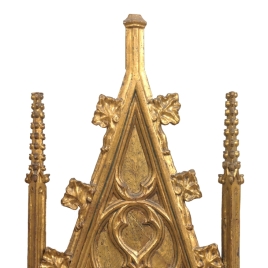
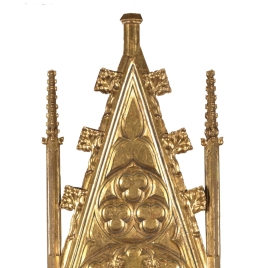
This work, together with the three others (P007630, P007631, P007633), used to be part of the upper register of an altarpiece devoted to the legend of the Eleven Thousand Virgins in the church of San Pablo de los Dominicos in Palencia.
This monastery suffered the consequences of the 1835 Ecclesiastical Confiscations that left it practically abandoned and subject to damage until it was returned to the Dominicans in 1884. There is a 19th-century photograph of the entire altarpiece, possibly from around 1879 (Ruiz Vernacci Archive; Pérez Suescun and Rodríguez López, 1995). The dismantling and subsequent sale must have taken place shortly thereafter, since four of those pieces were in England in 1909, acquired by F. Beaufort Palmer. In 1920, they were exhibited at the Royal Academy in London and were transferred to Lord Laverhulme’s collection, eventually entering into Lady Lever Art Gallery in Port Sunlight, near Liverpool. The altarpiece consisted of four upper panels – which are those in the Prado’s collection – and four other lower panels, as well as a wide predella, which was split up and, as a result, some of panels are lost. Four figures of saints belonging to this predella – in groups of two in two – are kept in the Johnson Collection in Philadelphia, having come from the Cobot Collection in Barcelona. Two others are in the Zorn Museum in Mora, Sweden.
The altarpiece quite accurately depicts the story of Saint Ursula as told in The Golden Legend. This story begins with the description of Saint Ursula, who was born in Brittany to a Christian king named Notus or Maurus and who was famous for her striking beauty. The King of England sent a delegation to Brittany in order to ask for Ursula’s hand in marriage.
This is the third panel, which depicts the baptism of the prince – whom Geoffrey of Monmouth called Conan in his Historia Regnum Britanniae – who willingly consented to all the conditions and commanded he be immediately baptised. The scene represents the betrothed young prince being submerged into a large baptismal font. A bishop is christening him in the presence of his father the king, a clergyman, and the king’s squire. Saint Ursula is also depicted with a nimbus and the martyr’s palm. The development or relevance that has been given to this episode is worth highlighting, taking into account that the sources barely mention it. The presence of Saint Ursula is surprising, since she apparently did not attend her husband’s christening.
The four panels originate from the altarpiece devoted to Saint Ursula in the church of San Pablo, in Palencia. They belonged to the Gorostiza Collection in Bilbao, from which they were transferred to an unknown art collector before having been auctioned by Sotheby’s in 1992 and acquired by the Museo del Prado with funds from Villaescusa bequest.