David with the Head of Goliath
Ca. 1600. Oil on canvas.Room 007A
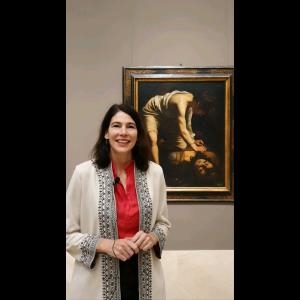
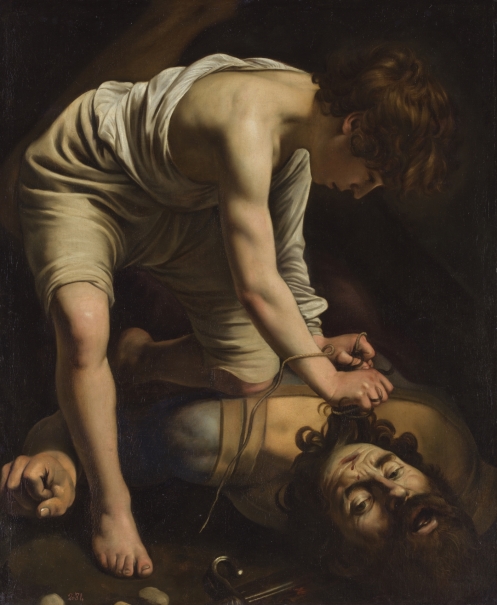
Compared with the many other treatments of this well-known biblical episode, the scene depicted in the Prado picture is somewhat unusual. It captures the moment when the young David, having felled the giant Goliath by striking him on the forehead with a stone hurled from his sling, “ran and stood upon the Philistine, and took his sword, and drew it out of the sheath thereof, and slew him, and cut off his head therewith. … And David took the head of the Philistine, and brought it to Jerusalem” (1 Samuel 17:51 and 54). The young man, emerging from a shadowy background, straddles the giant’s body, reaching down to seize Goliath’s severed head – lying in the immediate foreground – by the hair, and tie it with a rope.
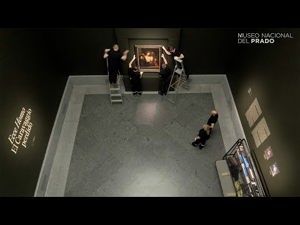
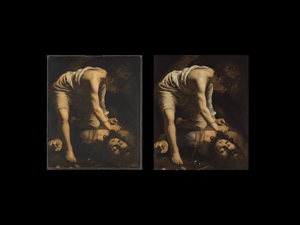
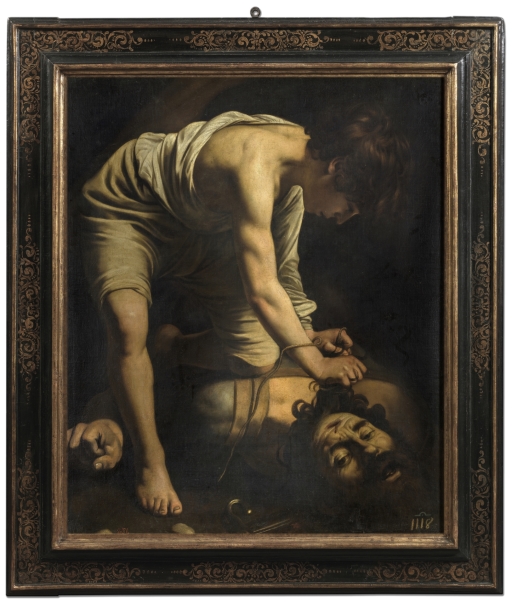
The Prado David with the Head of Goliath, one of the least popular paintings in the much-explored Caravaggio canon, has enjoyed mixed critical fortune, and considerable doubt persists as to its provenance. The arrival of this painting in Spain and its presence in the Royal Collections are aspects that presented numerous unknowns, some of which have been resolved by the research carried out during the restoration process in 2023. The earliest known record of its presence in the royal collection was in the Buen Retiro palace in 1789, after the death of King Charles III, through the inventory number 1118, which appears in the lower right-hand margin of the canvas - now veiled in watercolour to lessen its aesthetic impact. In that inventory, the painting is recorded as being considerably taller than it is today, as it should have been approximately 187 cm high at the time but is now only 110.4 cm. This markedly vertical format seemed a priori to be related to a series of early copies of the painting, in which the composition appears enlarged at the top, with Goliath´s full foot, and at the bottom, with the hilt of David´s sword and a series of small stones around it, which David kept in his bag. It is very likely that this was the idea originally developed by Caravaggio in the work, although the size recorded in 1789 is even larger than that of the earlier copies.
The increase in height of the original canvas to 187 cm is likely to have been carried out in 1787, when the paintings in the Buen Retiro were renumbered and some of them were restored, as is known to have been the case with David and Goliath. Such a circumstance is not entirely out of keeping with the artistic display practices of the time, as it was relatively common in the 18th century to re-create paintings in order to achieve symmetrical effects in palace interiors.
New X-ray tests carried out on the work have revealed the existence of another inventory number in an invisible layer of the pictorial layer. This is a "449" painted in white in the lower left-hand margin of the canvas, having been covered over before it entered the Prado collections. This number can now be related to a previous inventory of the Buen Retiro paintings, carried out in 1771, although it is possible to find it even earlier in another of 1716. It was at that time that a number was first assigned to the paintings on the royal site, David and Goliath being numbered 449. It can also be traced back to the past and can be found in the inventory of the artistic assets held there on the death of Charles II. Compared to its condition in 1789, the canvas appears in both inventories - 1716 and 1700 - with smaller dimensions, close to what it is today (110.4 x 91.3 cm), corroborating the fact that the canvas had been enlarged well into the 18th century. The painting continued to be enlarged from 1787 until the early years of the following century, and was still there in 1808, when it was located in the Buen Retiro. Following the turbulence of the Napoleonic occupation, the David and Goliath was moved to the Royal Palace where the painting was removed, as attested to in the inventory of the royal residence in 1814.
In the Prado, this canvas was first listed as item “2081”, attributed to Caravaggio, in the inventory drawn up in 1849; the reference number is still legible in the lower left corner of the painting. The attribution was repeated in 1872, and again in 1901 (inv. 77) and 1910 (inv. 65). In any case, the presence of old copies in Madrid suggests that the Prado canvas must have been in Spain at an early stage. Yet it fails to match the descriptions provided in any seventeenth-century inventories. It certainly bears little resemblance to the “half-length figure of David” by Caravaggio reported by Giovan Pietro Bellori in the collection of Juan de Tassis, Count of Villamediana; judging by the description, and the fact that it is thought to date from Caravaggio’s sojourn in Naples, this is much more likely to be the picture on the same theme in the Kunsthistorisches Museum, Vienna. As for the original provenance of the painting, a mention in the will of Galeotto Uffreducci (or Eufreducci, 1566–1643) may shed some light on the issue. In his testament, drawn up on 26 January 1643, Uffreducci – a canon at the church of Santa Maria Maggiore in Rome – bequeathed to his friend Monsignor Giulio Rospigliosi, the future Pope Clement IX, “a David by Caravaggio”. The picture is not listed in any known inventories of the assets of Rospigliosi, who was a leading figure in artistic, literary, and musical circles. It should be borne in mind, however, that in 1632 he was appointed to the chapter of Santa Maria Maggiore, where he must have met Uffreducci, and that in the spring of 1644 he travelled to Madrid as papal nuncio to the Spanish court, taking with him – according to letters to his family – many items from Rome to furnish a dwelling worthy of his rank. During his nine years in Spain, Rospigliosi had the opportunity to engage closely with Philip IV and see his collection, and some of the objets d’art he brought from Italy may well have found their way into Spanish art-collecting circuits. At present, however, the only certainty is that the David listed in the Alcázar inventories from 1666 onwards as “school of Caravaggio” is not this painting but rather – judging by the description and measurements – a canvas by Tanzio da Varallo (c. 1580–1632/33), which was on loan to the Spanish embassy in Buenos Aires.
Attribution of the Prado canvas to Caravaggio has not always been unanimous: general, if sometimes reluctant, acceptance of the painting’s authorship was achieved only after it had been restored in 1946–47, and once Roberto Longhi had rehabilitated the painting in 1951. Major confirmation came with the publication, by Mina Gregori, of an X-ray of Goliath’s head: in Caravaggio’s initial composition, the giant was depicted immediately after his death, wild-eyed, his mouth open in a scream, in that respect closely resembling Holofernes in the Judith and Holofernes at the Palazzo Barberini, or the Uffizi Medusa. The final version, however, is more restrained, whether at the request of the client or by choice of the artist, if Caravaggio was still unsure how to proceed. And in fact the whole poetic substance of the picture lies precisely in that sensitive balance “between delicate idyll and atrocious drama”. The still-firm brushstrokes and controlled facture, the ochre-based palette, the depiction of David using the lost profile technique – reminiscent, for example, of the angel accompanying Saint Matthew in the Contarelli chapel at the church of San Luigi dei Francesi in Rome, or of Isaac in the Uffizi painting – all suggest that it cannot have been painted much later than the turn of the century.
Technical tests carried out in 2023 as part of the process of restoring the painting have revealed another hitherto unnoticed regret: Caravaggio originally wrapped David´s right ankle in cloths that appear to hold a sandal, although they could also be related to the tradition of pugilists to strengthen their joints before the fight. In any case, the painter decided to dispense with this detail. (Information updated by the Department of Italian and French Painting to 1800 on 24/04/2024, with contributions by Terzaghi 2023).
Terzaghi, María Cristina, 'Michelangelo Merisi da Caravaggio. David with the head of Goliath'. in: Guido Reni, Madrid, Museo Nacional del Prado, 2023, p.184-186 nº 15