formularioRDF
The itinerary <em>TITULORECORRIDO</em> has been successfully created. Now you can add in works from the Collection browser
<em>TITULOOBRA</em> added to <em>TITULORECORRIDO</em> itinerary

Close Continuar a ficha de la obra Continuar a ficha de la obra
02-06-2026
Manuel Castellano

Madrid, 1826 - Madrid, 1880

Manuel Castellano See author's file

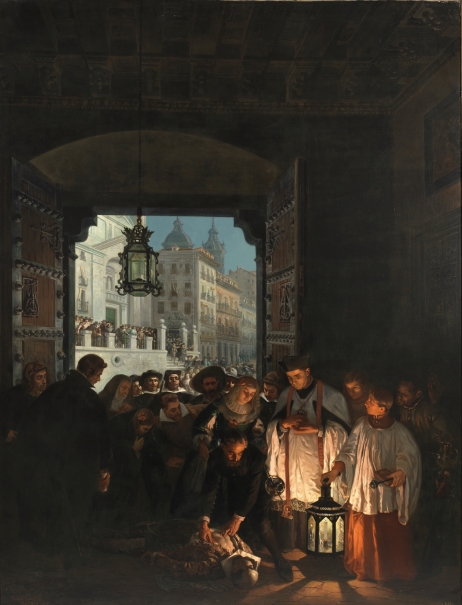
Death of the Count of Villamediana

1868. Oil on canvas.
On display elsewhere

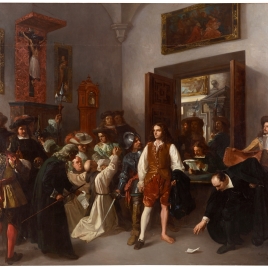
The artist painted this picture in 1868 and submitted it to the National Exhibition of 1871, where it received a second medal out of regulation. The theme that Castellano chose is part of one of the most legendary episodes of the Spanish Austrian court. Juan de Tassis y Peralta (1582–1622), Count of Villamediana took part in it. He was one of the most distinguished characters of the reign of Philip IV. As a knight he led a turbulent and dissipated life. He was a good horseman and skilled in the art of lancing bulls. As well as being a good and scathing poet, he was a gallant and arrogant womaniser. For this reason, he had to leave Spain for Naples and Lombardy. On his return to Madrid, he even rivalled Philip IV in love affairs. This is because a rumoured affair between him and Queen Isabella of Bourbon herself, to whom the poet alluded in his verses under the nickname of Francelisa. However, it seems that the real reason for this dispute was another lady of the Court, Doña Francisca de Tavora, whom both gentlemen were courting. There are multiple versions of what allegedly triggered the king´s jealousy against the count. What is certain is that the count died from a wound on 21 August 1622 when travelling in his carriage with his friend Don Luis Méndez de Haro. A masked man had pierced him with the blade of a Valencian crossbow near the church of San Ginés. This scene represents the moment in which the lifeless body has been taken to the doorway of the palace of the Count of Oñate, the residence of Villamediana´s father, "where the whole Court attended to see the wound". This is the phrase with which the painting was illustrated in the catalogue of the National Exhibition of Fine Arts of 1871, belonging to Francisco de Quevedo´s work "Great Annals of Fifteen Days".

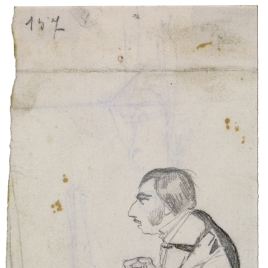
Díez García, José Luis, "La muerte del Conde de Villamediana", de Manuel Castellano (1826-1880) y sus dibujos preparatorios, 1988, p.96-109
Technical data

Related artworks

Inventory number
P003925
Author
Manuel Castellano
Title
Death of the Count of Villamediana
Date
1868
Technique
Oil
Support
Canvas
Dimension
Width: 220 cm; Height: 290 cm
Provenance
Acquired from the artist for the Museo Nacional de Pintura y Escultura (Museo del Prado), 1873; Museo de Arte Moderno, 1896–1971
Entry date
1971

Bibliography +

Espinós, Adela; Orihuela, Mercedes y Royo Villanova, Mercedes, "El Prado disperso". Cuadros depositados en Madrid. VIII. Museo Municipal, Boletín del Museo del Prado, III, 1982, pp. 132.

Díez García, José Luis, "La muerte del Conde de Villamediana", de Manuel Castellano (1826-1880) y sus dibujos preparatorios, IX, 1988, pp. 96-109.

Fernández-Galiano, Luis, El Espacio Privado. Cinco Siglos en Veinte Palabras, Ministerio de Cultura, Madrid, 1990, pp. 350.

Museo Nacional del Prado, Museo del Prado: inventario general de pinturas (II). Museo de la Trinidad, Museo del Prado, Espasa Calpe, Madrid, 1991.

Díez, José Luis, La pintura de historia del siglo XIX en España, Consorcio Madrid 92 Museo del Prado, Madrid, 1992, pp. 260-269 nº.24.

Museo Nacional del Prado, Museo del Prado: inventario general de pinturas. Nuevas Adquisiciones. Museo Iconográfico. Tapices, III, Museo del Prado, Espasa Calpe, Madrid, 1996.

Barón, J., The Spanish presence at Philadelphia's Centennial Exhibition and Chicago's world's Columbian, Collecting spanish art. Spain's golden age and America's Gilded Age., New York, NY, 2012, pp. 65-93 [70].

Díez, J.L (dir.), Pintura del Siglo XIX en el Museo del Prado. Catálogo general, Museo Nacional del Prado, Madrid, 2015, pp. 131.

Other inventories +

Inv. Nuevas Adquisiciones (iniciado en 1856). Núm. 386.
Autor = Dn Manuel Castellano / 386.Un cuadro en lienzo; muerte del conde de Villamediana...y luego arrebatadamente fué llebado al portal de su casa donde concurrió toda la corte a ver la herida. / Alto 2,90 ancho 2,20. / Adquirido por el Govierno con fha 28 de junio de 1873, figuró en la exposición de 1871 y tubo medalla de 2ª clase, siendo adquirido en la cantidad de 2500 pesetas

Catálogo Museo del Prado, 1889. Núm. 2.

Actas del envío de cuadros del Prado al Museo de Arte Moderno. Núm. 386.

Catálogo Museo de Arte Moderno, 1899. Núm. 64.
SECCIÓN DE PINTURA EN SUS DIVERSAS CLASES, DIBUJOS Y GRABADOS EN LAMINAS. / CASTELLANO (D. Manuel) [...] 64.- Muerte del Conde de Villamediana. / Alto 2'90 metros. Ancho 2'20 metros.

Inv. General del Museo de Arte Moderno, 1899-1902. Núm. 173.

Registros-Inventarios Museo Nacional de Arte Moderno, 1900-1936. Núm. 23-C y 36-C.

Catálogo Museo de Arte Moderno, 1900. Núm. 71.
SECCIÓN DE PINTURA EN SUS DIVERSAS CLASES, DIBUJOS Y GRABADOS EN LÁMINAS. / Castellano (D. Manuel) [...] 71.- Muerte del Conde de Villamediana. / Alto 2'90 metros. Ancho 2'20 metros.

Inscriptions +

Manuel Castellano / MADRID 1868
Signed and dated. Front, lower left corner

E
Back

Castellanos
Stretcher

T.386.
Inscribed in yellow. Front, lower right corner

Museo Municipal 336
Scrap of paper. Stretcher

M. 769
Stretcher

Exhibitions +

La pintura de historia del Siglo XIX en España
Madrid
01.10.1992 - 01.12.1992

El espacio privado
Madrid
05.10.1990 - 06.01.1991

Location +

Madrid - Museo de Historia de Madrid (Deposit)

Displayed objects +

Lantern / Street Lamp: Farol fijo suspendido del techo, de forma hexagonal. El vidrio encontró una de sus más valiosas aplicaciones en el campo de la iluminación, cuya importancia fue creciendo desde su empleo en los faroles más sencillos hasta los sistemas tecnológicamente más avanzados de nuestros días. Esta aplicación está basada en dos de las principales características de este material: su transparencia y su elevada resistencia térmica, que le permiten dejar pasar la luz al mismo tiempo que proteger el foco calorífico que la genera.

Farol de mano de gran tamaño y aspecto suntuoso. Los faroles más primitivos y de construcción más simple fueron los portátiles de mano, que irían evolucionando hacia formas más complejas y decorativas como en este caso. Este tipo de faroles suele basarse en una especie de caja con forma cilíndrica o poligonal formada por una puerta y pequeñas ventanas transparentes o translúcidas que dejan pasar la luz a través de ellas, impidiendo a la vez que la llama pueda ser apagada por el viento. Por su parte superior estos faroles se hallan rematados por una cubierta de forma más o menos cónica provista de superficies caladas y una abertura para su ventilación térmica y la salida del humo (Fernández Navarro, J. M.; Capel del Águila, F.: El vidrio en la pintura del Museo Nacional del Prado, 2012).

Textiles for ecclesiastical vestments: Traje de sacerdote y de monaguillo

Pince nez: Anteojos binoculares de pinza autoportantes

Update date: 02-06-2026 | Registry created on 28-04-2015

Visor 360

Drag with the cursor to rotate the piece

Other works by Manuel Castellano

Print on demand

Print artworks available in our catalogue in high quality and your preferred size and finish.

Image archive

Request artworks available in our catalogue in digital format.

Up