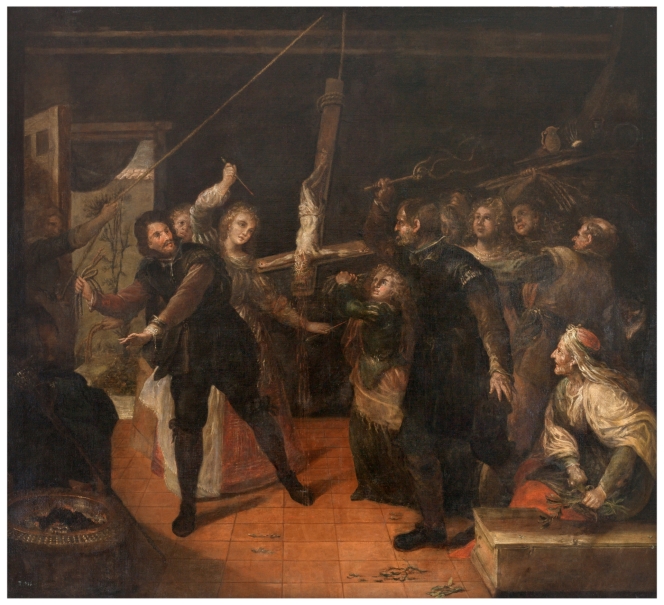
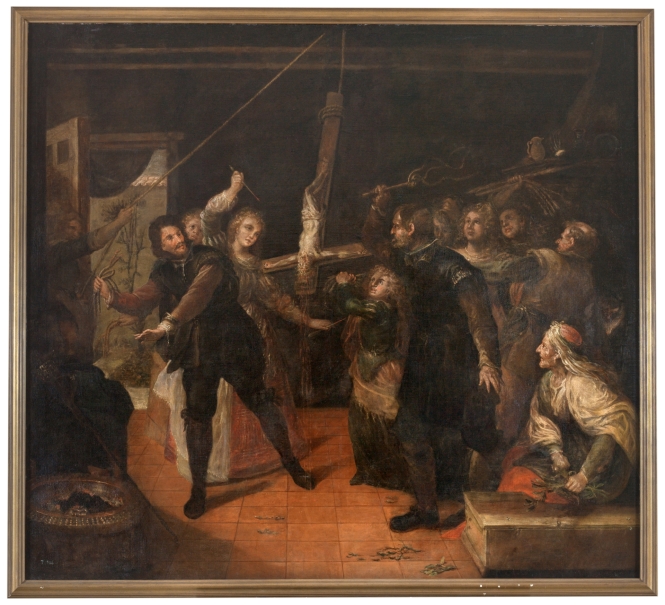
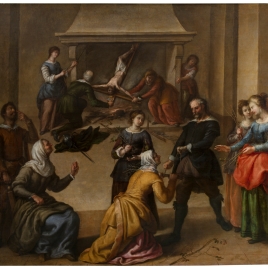
Desecration of a crucifix (Family of heretics scourging a crucifix)
1647 - 1651. Oil on canvas.Not on display
The artist produced this painting along with three others for the chapel of the Christ of Patience in the Madrid convent of the Capuchins. The aim was to graphically recall the outrageous sacrilegious profanation. This event was the reason for the construction of the temple, which was erected as an expiatory act.
These events took place in Madrid around 1630. A family of reputed Portuguese Judaizers (Galatians 2:14) lived in the house of the lawyer Parquero, located in the Las Infantas street. The family was made up of a married couple, two very beautiful daughters and a six year old boy, who had already had some problems with the Inquisition court. At home they had a crucifix of half a yard high (41 cm) placed under the canopy to show off their Christian faith. On Wednesdays and Fridays, at night, a group of fifteen allegedly anti-Christian Jewish conspirators met there and, tortured the image by dragging it with ropes and thorn rods in several ways. On one occasion, the crucifix is said to have complained about the suffering martyrdom and even gushed blood which splashed on its executioners. Consequently, they decided to burn it and to destroy it with axes. The son of the family alerted the Holy Office, which found out what had happened and imposed the usual punishment by burning at the stake.
According to a sign that the paintings had in the church and the copy made in 1709 by Father and Brother Matheo Anguiano, it is possible to know the exact moment of the Artist´s representation: "They hung him upside down and they whipped him relentlessly, and on one occasion he spilled blood that stained the branches and fell on the bricks." This event became a political issue when the Count-Duke of Olivares was held responsible, on account of the tolerant attitude towards the Jews that he was considered to be defending. The crisis passed after the application of the exemplary punishment and the erection of the temple that was inaugurated in 1651 under the invocation of the "Patience of Christ". Judging by the paintings, since the information given by Palomino (1734) and Ponz (1793) is contradictory, they were commissioned to Francisco Camilo, who painted the one that depicts: "They had the Holy Crucifix hanging, head down in the cannon of the chimney, from where they took him out to whip him with different cords and branches" (P05107). Francisco Fernandez stated: "They dragged the Holy Crucifix and whipped him; and in this act he complained and with a clear, tender and loving voice he told them: Why do you mistreat me, being your true God" (P03873). On the other hand, Andres Vargas averred: "Disturbed and hardened they determined to burn the Holy Crucifix and in a lighted brazier they passed him through the flames. And so that it would not be discovered how badly treated he was, they tore him to pieces and without the form of a Crucifix they burned him" [Museo del Prado (s. no.) destroyed in the City Hall of Porriño]. This work, which was believed to have disappeared, was even said to have been signed by Francisco Camilo. Rescued from the deposit in which it was kept, it has no signature and the attribution to Camillo that it bore should be changed, once restored, to that of Francisco Rizi, of whom Palomino said, and Ponz repeated, that he painted a picture from this series, in addition to the monumental canvas of the "Expolio" for the high altar of the aforementioned church (P02995). Because of their measurements, the paintings by Fernández and Vargas made a pair, and the same happened with those by Camilo and Rizi, which is why both paintings could also be considered as by the same artist. The series dates from before the inauguration of the chapel, between 1647 and 1651. Compared to Camilo’s painting, Rizi’s shows a different way of grouping the figures, staging the story, and understanding the space. In Camilo´s, the narrative shifts between two registers, and the execution is clumsy in terms of perspective. Furthermore, Camilo’s lacks the tension present in Rizi´s its composition is still symmetrical. It also does not share the atmosphere that characterizes Rizi´s painting. Moreover, their coloring has nothing to do with each other and some of the figures, for example, the seated old woman seems to stem from other patterns used by Rizi. Their technique is also very similar, since Camilo´s looseness and sketchiness are also typical of Rizi. In the chimney bell, together with its ceramic jug, there is a hint of Velázquez´s forge.
Urrea, Jesús, Pintores del reinado de Felipe IV, Madrid, Museo del Prado, Caja de Ahorros de Navarra, 1994, p.90