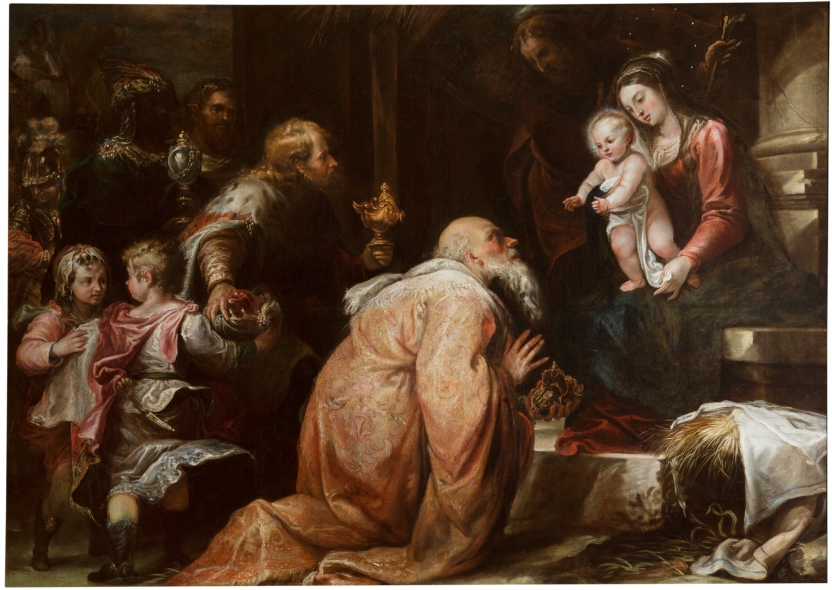
The Adoration of the Magi
Ca. 1663. Oil on canvas.On display elsewhere
The composition adapts the layout of the work, which was painted on the same subject in 1645 for the cathedral of Toledo, to a landscape format. The artist fills the new space with the figure of King Melchior, bald and with a long white beard. The king who led the veneration in the Toledo canvas is now presented transformed into the traditional figure of Gaspar. While, without modification, the figure of Balthasar, the Gaspar of Toledo is turned by the artist into simply a crowned member of the entourage. The figure of the new Melchior, luminous and brilliant in his lavish clothing, plays a key role in the composition, as he is the most brilliantly illuminated figure against the dark background. The motif of the little pages, with their clothes in rapid movement, and the Virgin holding the Child, who advances towards the kneeling king, remain almost identical. This reveals a consistency in the iconographic resolutions the artist considered successful, maintained with little change throughout his entire production. Their origin is evidently to be found in Rubens´ schemes, which Rizi was able to adopt from very early on.
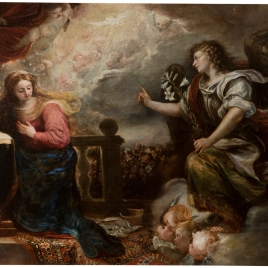
The four canvases in the Museo del Prado (The Annunciation, P5319; The Visitation, P3136; The Adoration of the Magi, P5318; and The Presentation of Jesus in the Temple, P2962), and a few others which were destroyed, were part of a series painted around 1663, the date on which The Annunciation is signed. As Angulo (1958) pointed out when describing some of Rizi’s pieces, their landscape format suggests that they were not an altarpiece but a series intended for the naves of a church, the galleries of a cloister or the sacristy of an important church.
They were transferred to the Museo de la Trinidad where some were collected under the name of Rizi and others as anonymous. Not all of them were included in the Catalogue of Cruzada, and they were subsequently dispersed and deposited in various institutions. The Nativity, deposited in 1882 at the Supreme Court, was destroyed in the fire of 1915, and there is no preparatory sketch or copy of it. Another canvas, of almost identical dimensions, which depicts Saint John the Baptist preaching, was deposited in 1893 in the chapel of the now defunct Society of the Protectors of the Poor. Today it is unaccounted for, and it is uncertain whether it really belongs to the same set.
The series represents the artist, on the verge of his fiftieth year, at one of his high points of productivity and creative maturity, and some of the pieces can be considered masterpieces from his hand.
Pérez Sánchez, Alfonso E., Carreño, Rizi, Herrera y la pintura madrileña de su tiempo, Madrid, Ministerio de Cultura. Banco Herrero, 1986, p.253