Elephants in a Circus
Ca. 1640. Oil on canvas.Muguruza P1 Escalera 3
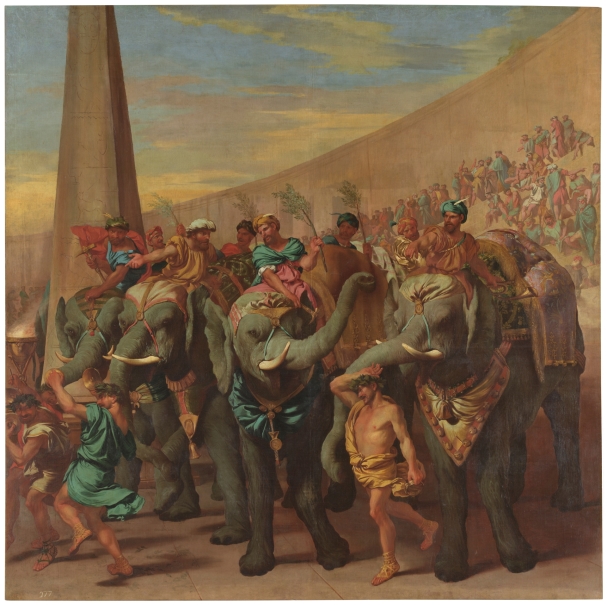
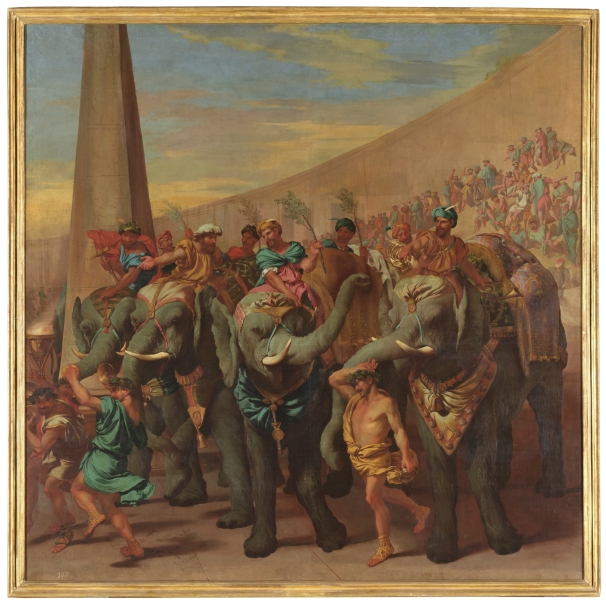
As frequently occurred in the cycle on the History of Ancient Rome commissioned for the decoration of the Buen Retiro Palace, Andrea di Lione drew elements of his painting from the abundant Antiquarian literature that began to be published in the middle of the sixteenth century. Today we can trace this procedure with considerable confidence. The starting point for the present work was Tabula III, a plate included in Antoine Lafréry’s Speculum Romanae Magnificentiae (1575), which shows two camels, a giraffe and five elephants, three of which are reproduced with great precision in a red-chalk drawing by Lione that appeared on the art market in 2003 (Christie’s Paris, 27 March 2003, lot 29). Starting with this, Lione arranged the elephants in two rows and set the scene in a Roman circus, the seats of which are filled with magnificent little figures similar in style to those of Aniello Falcone. In the foreground Lione added four dancers and musicians who closely resemble those in Nicolas Poussin’s bacchic scenes.
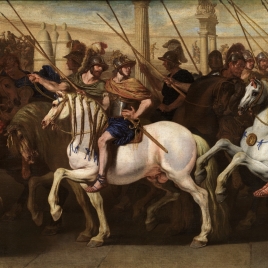
Authors discussing these paintings often try to explain them as depictions of concrete historical events, in an effort to establish analogies with the king of Spain. It seems much more likely, however, that the artists sought simply to illustrate public entertainment in ancient Rome. Onofrio Panvinio was a prolific author of works depicting Roman customs that may have served as a model for the Buen Retiro cycle. The most important of his works for the present subject is De Ludis Circensibus (1600), from which Lione may have drawn the idea for this depiction of the sort of parades carried out in circuses as a prelude to the main event. These included the participation of elephants and cavalrymen outfitted for the Pugna equestris. Such riders appear in a painting for the Buen Retiro by Falcone, now at the Museo del Prado.
There are considerable doubts about the chronology of Lione’s works. His biography is far from complete, and overlapping influences persist throughout his extensive oeuvre. After studying with Mannerist painter Belisario Corenzio in Naples, Lione moved to Falcone’s workshop, and the latter may be responsible for his participation in the Buen Retiro series.
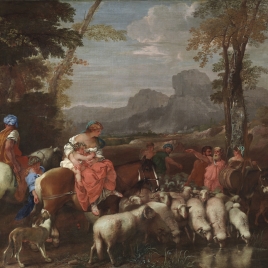
Lione’s vibrant colours also very clearly reflect the influence of Giovanni Benedetto Castiglione, whom he may have met when the latter visited Naples in 1635, and again on a possible trip to Rome in the 1640s. From Castiglione’s prints Lione took certain compositions with people and animals set in wooded landscapes, two magnificent examples of which are now at the Museo del Prado. Castiglione’s persistent influence on Lione, even in his final works, considerably complicates the artist’s chronology. Finally, his relationship to Poussin is clear, especially in his treatment of figures.
All of these influences complicate efforts to date Elephants in a circus, c.1640. Martín Soria was the first to propose a date of 1655 for the work, based on the veristic treatment of the elephants, which he thought, mistakenly, were copied from nature. That date is too late for the present painting. Alfonso E. Pérez Sánchez noted this detail and advanced its chronology to the early 1640s (Text drawn from Úbeda de los Cobos, A.: Italian Masterpieces. From Spain´s Royal Court, Museo del Prado, 2014, p. 198).