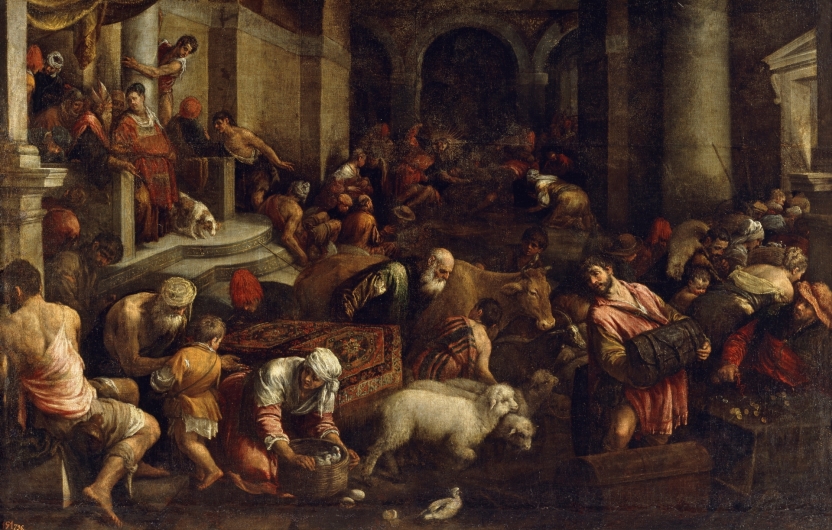
Expulsion of the Merchants from the Temple
Ca. 1568. Oil on canvas.Not on display
Although for this first version Jacopo borrowed elements from early works such as the young man peeking his head round the column, which appears in the 1536 La fornace ardente (Bassano del Grappa, Museo Civico), he drew mainly from Stefano Cernotto´s Expulsion of the Merchants from the Temple (Venice, Accademia, deposited at the Ceni Foundation). Cernotto, an artist of Dalmatian origin who worked in Venice between 1530 and 1545, painted his Expulsion about 1535 for the second courtroom of the Magistrato del Monte Nuovissimo at the Palazzo dei Camerlenghi in Venice, where he coincided with Jacopo, as they were both assistants to Bonifacio de Pitati. Cernotto´s influence on Jacopo was significant and long lasting and is even more evident in the later versions. The emphasis on description and a fondness for anecdote are characteristic of Cernotto, as is the setting of the scene in a broad, vaulted indoor space modulated by arches and columns. Also taken from Cernotto is the manner in which the indoor area opens onto the exterior by means of an architraved doorway located on an intermediate plane, through which the merchants leave the Temple. Other smaller borrowings can be seen in the location of the money changer´s table on the right and the inclusion in the foreground of everyday elements such as the basket of eggs and the lamb. There are even more references to Cernotto´s work in the late London version: the merchant with rabbits, the pose of the boy and the dog and, in Francesco´s replica, the oculus above the door (Text drawn from Falomir, M.: Los Bassano en la España del Siglo de Oro, Museo Nacional del Prado, 2001, p. 221).