General Evaristo Fernández San Miguel, I Duke of San Miguel
1854 - 1856. Oil on canvas.Not on display
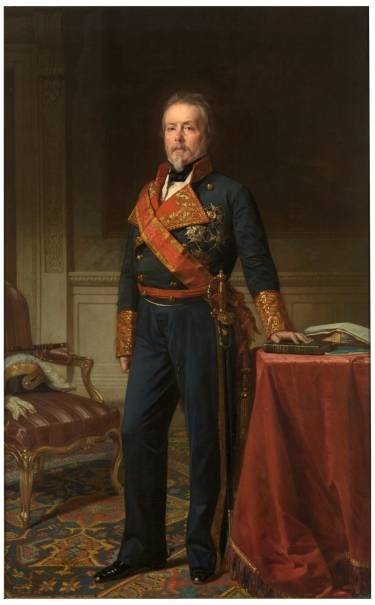
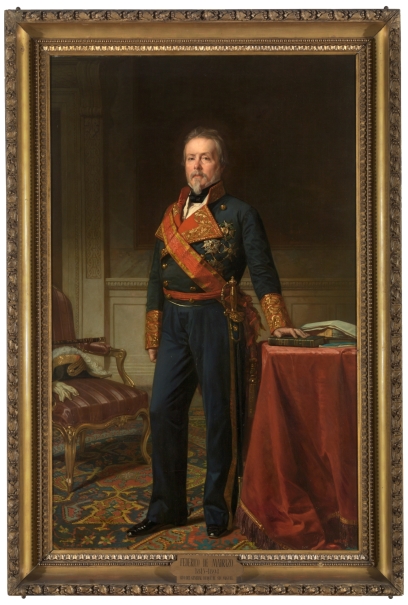
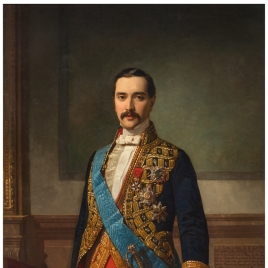
This work is a full-length portrait. The subject is a man sixty-nine years old, who wears the uniform of captain general of the armies. He holds the holy cross and sash of Saint Ferdinand, the laureate of the same order, and the great crosses of Saint Hermenegild and Charles III. He has the sash and sabre of a general around his waist, and his hand rests on the second volume of the History of Philip II. He is himself the author of this book, which lies on a table covered with a velvet tablecloth, where other books and papers are also on display. The portrait is set inside a carpeted salon, with the cocked hat and gloves of his uniform and the distinctive flare of his rank on an armchair.
He began his military career in 1805 as a cadet in the first volunteer battalion of Aragon. He was appointed captain during the Peninsular War, during which he was taken prisoner and transferred to France, where he remained until the return of Ferdinand VII in 1814. He was a military man of a liberal disposition and a friend of Riego. He composed the lyrics of his famous hymn and was appointed Minister of State on the 5th of August 1822 during the Three Liberal Years. He thereafter held various political and military posts until he was appointed Captain General of Espartero´s Armies, when Madrazo depicted him.
This is arguably the finest military portrait of Federico de Madrazo’s career, in which he established the compositional outlines of this portrait prototype, which would remain in force for the rest of the century. Queen Isabella II personally commissioned it for her own collections in 1854. However, its completion was not until 1856, when Madrazo resumed work on it with the help of his pupil, the painter Juan Barroeta y Anguisolea. Barroeta’s contribution however is confined to the architecture of the background and perhaps also to the armchair on which the uniform´s accessories rest. Although, according to previous accounts, the assistant work was carried out in a single session and retouched by Madrazo himself the following day.
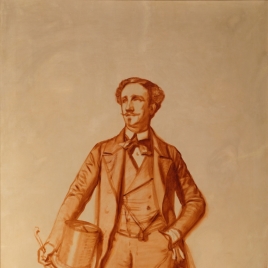
A preparatory drawing for the portrait is preserved. It only depicts the general outlines of the figure, which appears with his legs together, a pose that the artist later modified in the painting.
Díez, José Luis, Federico de Madrazo y Kuntz (1815-1894), Madrid, Museo Nacional del Prado, 1994, p.251 nº45; 464-465 nº86