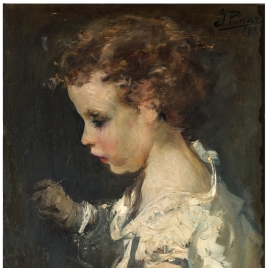
Girl
1890 - 1895. Oil on canvas.Not on display
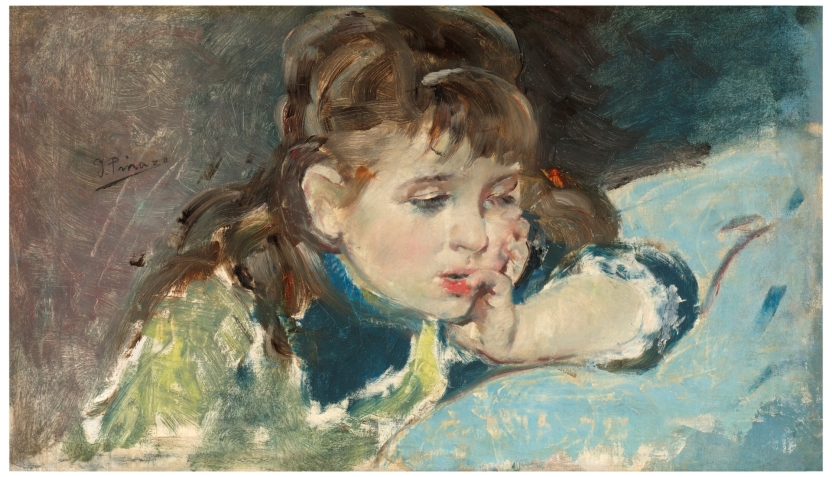
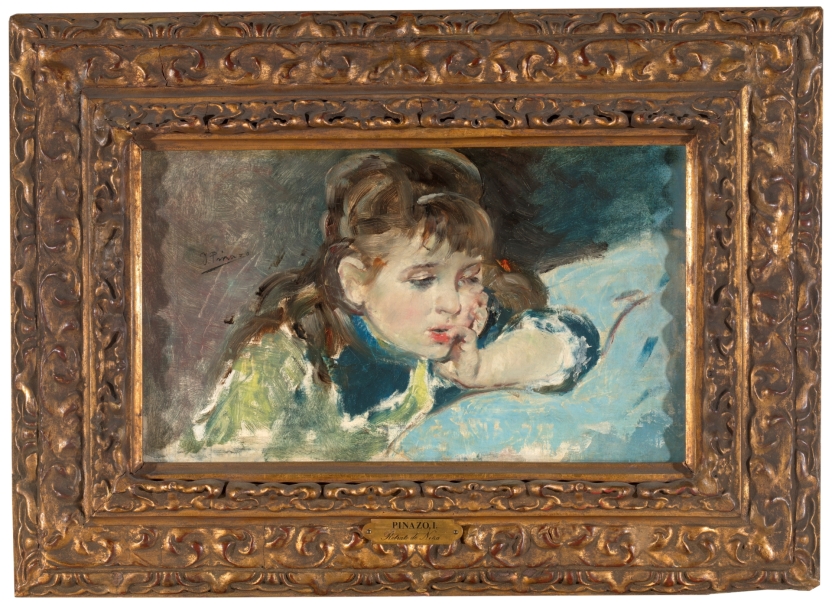
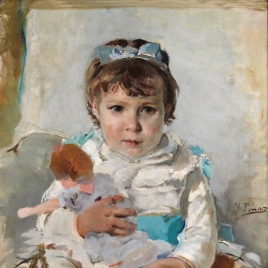
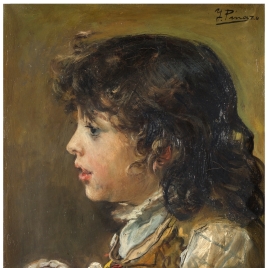
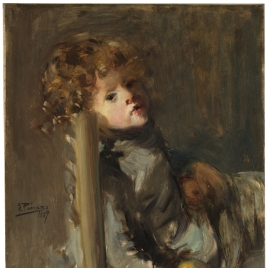
The child portrait became something of a speciality in Ignacio Pinazo’s output, no doubt a reflection of his personal life, he highly valued the family and found in his sons, José and Ignacio, the best models. From 1876 onwards, coinciding with his second stay in Rome, the painter made children the protagonists of some of his imaginative works, such as ‘Icarian Games’ and ‘The Switchman’, both from 1877. The birth of his first-born son José in 1879 was the inspiration for one of his most fertile themes, intimately related to his emotional and family environment. A considerable number of paintings, studies and drawings across the range of his production focus on the world of children. The painter treated this subject with enormous freedom, without falling into the sentimental tones more typical of social painting of the time. The artist´s main contribution lies in his appreciation of the fragments of life in which he could reflect art for its own sake, as opposed to the significance of the subject matter, of such concern in official spheres. Children, and here we have a good example of this, represent freshness and spontaneity in the expression of feelings, allowing the Valencian painter to experiment with form, gesture and pictorial process at the same time. From his use of darker, more expressive shades, of Goyaesque origin, emerges a duality common to Pinazo’s portrait work as a whole, in this case, capturing the creative child, in movement, playing and acting. Then, more in keeping with the conventions defining Valencian painting at that time, the use of luminous, lighter tones to suggest an observant and reflective child, bringing us closer to the most advanced contemporary sensibility. At the more colourful end of his range, the depiction of Child stands out. It is deservedly one of the artist´s most admired children´s portraits. The girl depicted is his niece Antoñita, posed with allusion to the gesture of the main figure in The Golden Age, painted in 1881 on his return from Rome. The title of the work probably expresses the painter´s conception of childhood as a period of purity and naturalness, a golden age of golden innocence. Pinazo chose a highly original horizontal format that focuses our attention on the absorbed contemplation in the girl´s face. The artist captures a precise moment almost photographically, turning this work into a portrait of a gaze as F. Javier Pérez Rojas - who kindly provided us with the identification of the model - has rightly observed. Endowed with an enormous plastic richness, the profile of the figure is sketched with a dark brush, and the background is barely covered with colour, emphasising the presence of the face, which is strongly illuminated from the left. The colour builds the figure in a harmonious and continuous process, transforming from brown to blue, green and yellow. He employs broader brushstrokes in the background, hair and shadows, very expressive in their juxtaposition and interweaving, while using profusely nuanced short touches, in the two fundamental elements of the portrait, the eyelids, eyelashes, chin, and the half-open mouth. The mouth itself is coloured with a transparent carmine, while a thicker, brief white stain at its corner seems to retain and suspend breath of the painting’s subject. The harmony of form and colour and the extraordinary technical audacity in the use of brush and palette knife show the indisputable modernity of the Valencian painter´s aesthetic convictions
Ara, J., Niña (h. 1882-1883). En Barón, J.: El retrato español en el Prado. De Goya a Sorolla, Madrid, Museo Nacional del Prado, 2007, p.170, nº58