formularioRDF
The itinerary <em>TITULORECORRIDO</em> has been successfully created. Now you can add in works from the Collection browser
<em>TITULOOBRA</em> added to <em>TITULORECORRIDO</em> itinerary

Close Continuar a ficha de la obra Continuar a ficha de la obra
02-06-2026

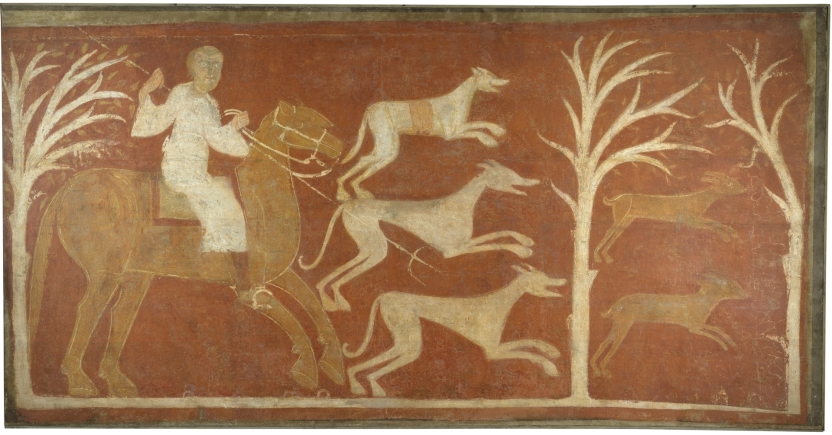
Hare Hunt, Hermitage of San Baudelio, Casillas de Berlanga (Soria)

Ca. 1125. Fresco painting on mural transferred to canvas.
Room 051C

In this Hare Hunt, the hunter, on horseback and with a trident in his hand, whips three dogs towards the hares –a symbol of concupiscence– to lead them to the trap he has set for them. It is part of a set of six paintings originally intended to decorate the walls of the 11th-century Mozarabic chapel of San Baudelio, whose interior architecture is evoked in the rooms of the Museum where they are exhibited.

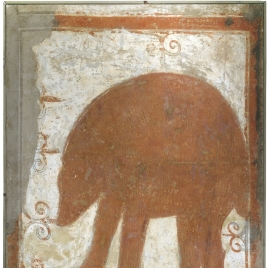
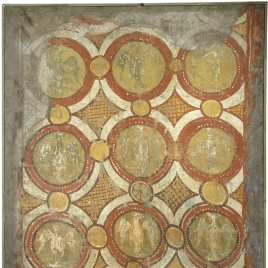
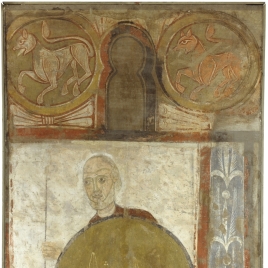
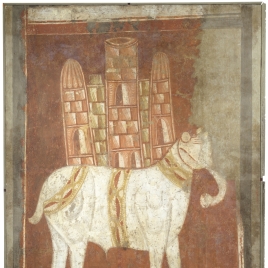
These pieces were part of the twenty-three fragments removed from the building in 1926 and transferred to canvas to be taken to the United States, where they were distributed among the museums of Boston, Indianapolis, Cincinnati, and The Cloisters in New York. In 1957 six of these fragments were brought to the Museo del Prado as an indefinite temporary loan from the Metropolitan Museum of Art in New York. They belonged to the profane decoration of the lower register of the body of the hermitage on the north wall –Hare Hunt (P007265) and Deer Hunt (P007268)– and on the front of the choir gallery –Elephant (P007264), Bear (P007263), Soldier (P007266), and Curtain (P007267)–. The remaining two registers included scenes from the New Testament: in the upper register is the Birth and childhood of Christ, and in the middle register, his public life and Passion. At first, the thematic and formal differences between the different paintings suggested different dates. The secular pieces display more dynamic attitudes, moving away from the static and graphic approach of the sacred pieces, typical of the Romanesque period. Nonetheless, when compared with other similar Romanesque paintings –French, Italian and Spanish– they are considered to be contemporary, executed by two workshops of the same circle, based in the borderlands between Castile and Aragon, and part of a unitary group of works in which secular scenes are imbued with sacred symbolism (Pintura española del Románico al Renacimiento [Spanish Painting from the Romanesque to the Renaissance], Museo del Prado, 2010, p. 6).

In this specific work, an incised medieval graffito is preserved on the head of the lower hare. It is a very simple textual structure that follows the model of the roboratio: symbolic invocation and arrangement structure, which is here reduced to minimum expression. Its transcription is: ‘+ MI GO PEDRET ME FECIT’, i.e.: [cross] Mingo Pedret me fecit [Made by Mingo Pedret]. Typologically, the graffito follows the most common formulas: anthroponym followed by notifying verb. The writing box is approximately 40 centimetres long and contains a freehand inscription, with no previous markings, and with a poorly cared-for ordinatio. The epigraph consists of a schematic cross in the form of an invocatio, plus four words (17 letters), loose and clear, predominantly capitalised, arranged in an irregular line and at two heights. There are no interpositional signs or nexuses, and there is only a sign, abbreviated by contraction, above the letter I, represented by a horizontal line. The G has closed the lower loop on itself, giving it the uncharacteristic shape of an inverted B; the M is represented by three parallel vertical strokes joined by a horizontal one at the top, unusual in the epigraphic habitus of the 12th and 13th centuries; the first T, in its present state, cuts the horizontal stroke, but originally it extended to the left (from the viewer´s point of view), now hidden by a reintegration.

The incision was made on the polychrome plaster (intonaco) with a sharp instrument that could pierce the pictorial layer and reach the underlying layer (arricio), where the incision also left a mark. The pigments did not penetrate the incisions and the cut reveals no burrs. The epigraph was written on graphite on some paintings (second facing) dated between 1129 and 1134, terminus post quem. From a palaeographic point of view, the writing used is transitional between Carolingian and Gothic, closer to the former. It can be dated to around 1200.

The graphite is situated 296 centimetres above the ground, and the perimeter support on that side rises 38 centimetres above the ground. It is not, as is usually the case, at the height of a standing human being, even located on the continuous bench. In order to make the incision, the artist must have had to climb on some kind of scaffold that had been provided ad hoc or in the context of some kind of alteration. The verb ‘fecit’ must be linked to an action related to public works or furniture. It is suspected that in San Baudelio there may have been a small secondary side altar like the one, of uncertain chronology, that was installed leaning on the south shoulder of the arch of glory over the original masonry perimeter support and that covered the decorative draperies. The trend in the Romanesque of Soria is for these altars to be symmetrical, and one possibility is that the graffito refers to this altar that has disappeared today, or even to both, but the little information available makes it impossible to confirm this.

Lorenzo Arribas, José Miguel, Un grafito histórico en el Museo del Prado procedente de la ermita de San Baudelio. Boletín del Museo del Prado., 2019-2021, p.6-10 f.1
Technical data

Related artworks

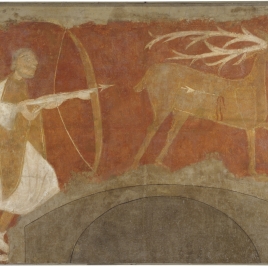
Deer Hunt, Hermitage of San Baudelio, Casillas de Berlanga (Soria)
Fresco painting on mural transferred to canvas, Ca. 1125
Anonymous
Bear, Hermitage of San Baudelio, Casillas de Berlanga (Soria)
Fresco painting on mural transferred to canvas, Ca. 1125
Anonymous
Curtain, Ermita de San Baudelio, Casillas de Berlanga (Soria)
Fresco painting on mural transferred to canvas, Ca. 1125
Anonymous
Soldier, Hermitage of San Baudelio, Casillas de Berlanga (Soria)
Fresco painting on mural transferred to canvas, Ca. 1125
Anonymous
Elephant, Hermitage of San Baudelio, Casillas de Berlanga (Soria)
Fresco painting on mural transferred to canvas, Ca. 1125
Anonymous
Inventory number
P007265
Author
Anonymous
Title
Hare Hunt, Hermitage of San Baudelio, Casillas de Berlanga (Soria)
Date
Ca. 1125
Technique
Fresco painting
Support
Mural transferred to canvas
Dimension
Height: 183 cm; Width: 355 cm
Series
Pinturas murales de San Baudelio de Casillas de Berlanga.
Provenance
San Baudelio de Casillas de Berlanga, Soria, 1926; Metropolitan Museum of Art, New York, 1926-1957; entered the Prado Museum as an indefinite temporary deposit of the Metropolitan Museum of Art, 1957.
Entry date
1957

Bibliography +

Garnelo, José, Descripción de las pinturas de la Ermita de San Baudelio, Boletín de la Sociedad Española de Excursiones, 32, 1924, pp. 97.

Cook, Walter W. S., Romanesque Spanish Mural Painting, XI, The College Art Association of America, Nueva York, 1929.

Gaya Nuño, Juan Antonio, La pintura románica en Castilla, Instituto Diego Velázquez, del C.S.I.C., Madrid, 1954.

Cook, Walter W.S., Las pinturas románicas de San Baudelio de Berlanga, Goya: Revista de Arte, 7, 1955, pp. 2-11.

Camón Aznar, José, Pinturas mozárabes de San Baudelio de Berlanga, Goya: Revista de Arte, 26, 1958, pp. 76.

Sánchez Cantón, Francisco Javier (1891-1971)), Seis Fragmentos de Decoracion Mural de San Baudelio de Berla, Centro de Estudios Sorianos, Soria, 1959.

Sánchez Cantón, Francisco Javier, Adquisiciones del Museo del Prado (1956-1962), Archivo Español de Arte, XXXV, 1962, pp. 303-324 [303-304].

Zozaya, Juan, Algunas observaciones en torno a la ermita de San Baudelio de Casillas de Berlanga, Cuadernos de la Alhambra, 12, 1976, pp. 307-338.

Rogers, Millard F., Spanish Painting in the Cincinnati Art Museum, Cincinnati, Cincinnati, 1978, pp. 15-17 y 43-48 (lám.).

La Pintura Española, Electa, Milán, 1995, pp. 52.

Muñoz Jiménez, José Miguel, Las pinturas de San Baudelio de Berlanga y el tapiz de Bayeux: la posible inspiración nórdica del ciclo profano, Goya: Revista de Arte, 253-4, 1996, pp. 12 y ss..

Sandete, Mª José, San Baudelio. Del páramo al Prado, Galeria Antiquaria, 188, 2000, pp. 52-58.

Escolano Benito, Agustin, La Ermita de San Baudelio de Berlanga : las Pinturas de la B, Junta de Castilla y Leon, Valladolid, 2001.

Portús Pérez, Javier, La colección de pintura española en el Museo del Prado, Edilupa, Madrid, 2003, pp. 19.

Martínez Ruiz, María José, La enajenación de obras de arte en Castilla y León en el siglo XX (1900-1936). Tesis doctoral, Universidad de Valladolid, Valladolid, 2005.

Teres Navarro, Elías, El expolio de las pinturas murales de la ermita mozárabe de San Baudelio de Berlanga, Goya, 2007, pp. 199-214.

Martínez Ruiz, María José, La enajenación del patrimonio en Castilla y León (1900-1936), Junta de Castilla y León, Consejera de Cultura, Salamanca, 2008, pp. 213-276.

Teres Navarro, Elias, El expolio de las pinturas murales de la ermita mozárabe : S..., Ochoa Editores, 2008.

Las Edades del Hombre (15ª. Soria. 2009), Paisaje interior, Fundación Las Edades del Hombre, 2009, pp. 163-183.

Museo Nacional del Prado, Pintura española del Románico al Renacimiento, Museo Nacional del Prado, Madrid, 2010, pp. 6.

Guardia Pons, Milagros, San Baudelio de Berlanga, una encrucijada, Universitat Autònoma de Barcelona, 2011.

Martínez Ruiz, Mª José, 'La venta y el expolio del patrimonio románico de Castilla y León: el caso de las pinturas murales'. En: La diáspora del románico hispano: de la protección al expolio, Fundación Santa María la Real, Palencia, 2013, pp. 13-57 [19-36].

Lorenzo Arribas, José Miguel, Un grafito histórico en el Museo del Prado procedente de la ermita de San Baudelio, Boletín del Museo del Prado., XXXVII, 2019-2021, pp. 6-10 f.1.

Terés Navarro, Elías, Secuencia histórica de la propiedad de la Ermita de San Baudelio (Casillas de Berlanga, Soria), actual Anexo del Museo Numantino, Boletín del Museo Arqueológico Nacional, 40, 2021, pp. 339-352.

Merino de Cáceres, José Miguel; Martínez Ruiz, Mª José, De Fuentidueña a Manhattan. Patrimonio y diplomacia en España (1952-1961), Ediciones Cátedra, 2023, pp. 310-313, 321-324.

Manzarbeitita Valle, Santiago, La musealización de los murales románicos de Santa Cruz de Maderuelo y San Baudelio de Casillas de Berlanga en el Museo del Prado, Arte medievale, IV serie anno XV, 2025, pp. 123-140.

Inscriptions +

† MI GO PEDRET ME FECIT
Incised. Front, Lower right area

Location +

Room 051C (On Display)

Expuesto
Update date: 02-06-2026 | Registry created on 28-04-2015

Visor 360

Drag with the cursor to rotate the piece

Print on demand

Print artworks available in our catalogue in high quality and your preferred size and finish.

Image archive

Request artworks available in our catalogue in digital format.

Up