Henry O’Shea
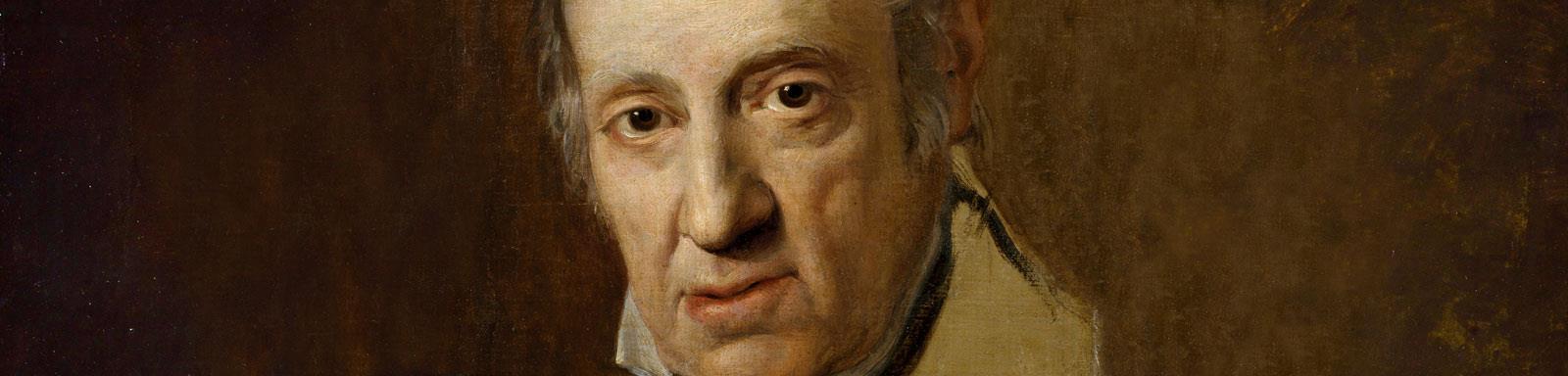
After 1828. Oil on canvas.Not on display
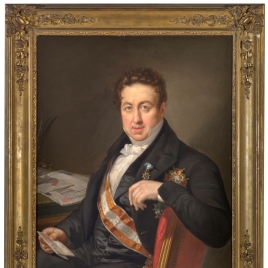
Henry O´Shea (Limerick, Ireland, 1782–1860), banker. Married for the third time (1839) to Sabina Seuphan Spalding (P08180).
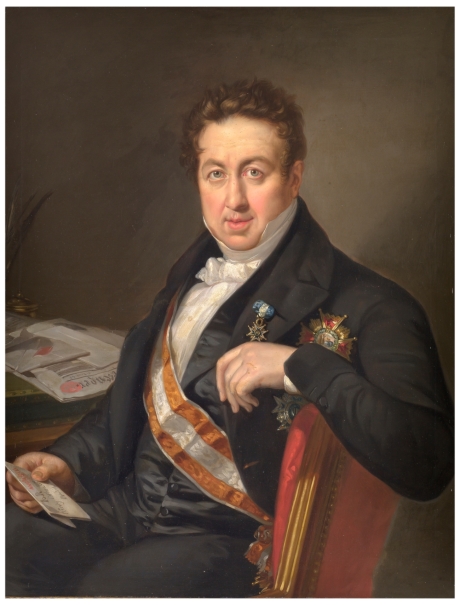
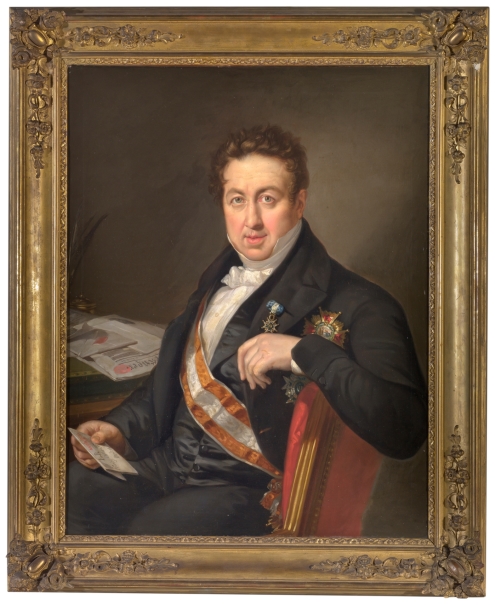
This work is a half-length portrait, in which the banker is seated. He is turned towards the viewer with his left arm resting on the back of the chair. On his frock coat, he wears the large cross and sash of the Order of Isabella the Catholic, as well as the commander´s badge and the scallop of the Order of Charles III. In his right hand, he holds a note which indicates his British origin, as does a newspaper on the table in front of which he is portrayed.
Henry O´Shea must have been an acquaintance of Vicente López. In response to an official request –dated 7th of December 1826– for information on the conduct of this merchant, who was established in Madrid during the Three Liberal Years, the painter replied that ‘although I did not have the honour of dealing with him during the aforementioned (constitutional) system because Don Enrique was in Valencia, I have nevertheless been frequenting his house in this Court for two years and I have become acquainted with him. He is a very appreciable subject both for his morality and for the beautiful customs that adorn him, and he shows an extraordinary respect for the Royal Person of H. M. and his sacred rights. In addition to what I have stated above, I have heard from very trustworthy and truthful people, the relevant trades he practised in Valencia, that he has seriously risked his life by visiting the worthiest General Don Francisco Xavier Elio (rest in peace) in his dungeon. Moreover, he has offered him money and whatever he needed for his precious existence. This is an evident proof of the honesty, charity, and appreciable circumstances of the said Henry O’Shea.’
Lopez´s familiarity with O´Shea may explain the self-assurance of the pose with which he is portrayed, as well as the intensity of his gaze and the affable gesture on his face.
Díez García, José Luis, Vicente López (1772-1850) II. Catálogo razonado, Madrid, Fundación de Apoyo a la Historia del Arte Hispánico, 1999, p.166