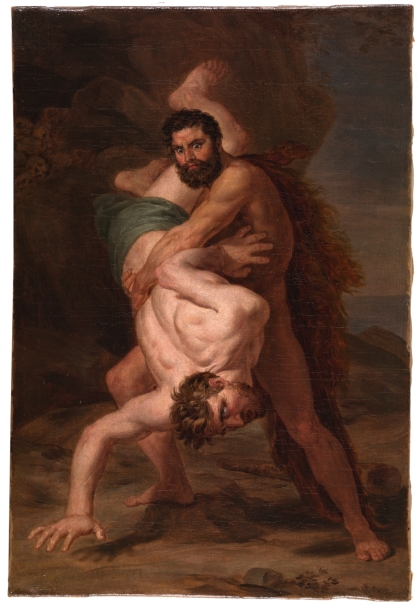
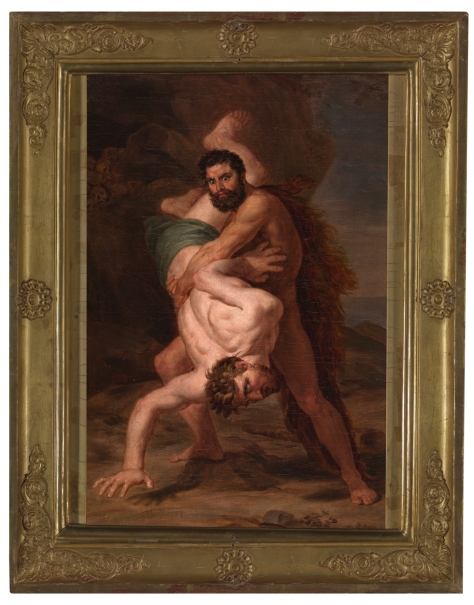
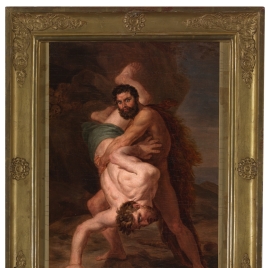
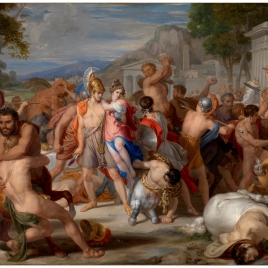
Hercules and Antaeus
Ca. 1828. Oil on canvas.Not on display
Rafael Texedor Díaz, also known as ‘Tegeo’, first studied in his homeland and then afterwards at the San Fernando Academy in Madrid. He later went to Rome in 1824 to complete his studies as suggested by his master, the painter José Aparicio (1773–1838) who was born in Alicante. The artist gained considerable recognition with his many religious works during his years in Rome, which paved the way for his admittance to the Academy as an honorary member in 1828 on his return to Madrid. On the official occasion of his admission, the artist produced one of his first major works, clearly influenced by the Florentine Mannerist sculpture he had studied on his recent trip, Hercules and Antaeus (Madrid, Academia de San Fernando), of which this small painting is the sketch.
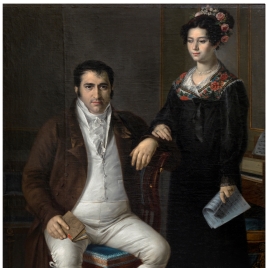
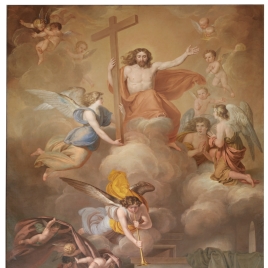
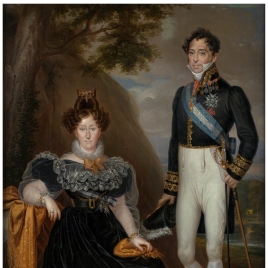
Tegeo was a complex artist in whom the academic eclecticism of an entire generation, halfway between Neoclassicism and Romanticism, is clearly reflected. His refined and precise language, with a characteristic sharp and emphatic drawing, moved from the declamatory style of his early compositions, in which the imprint of the classical tradition is very perceptible, to the delicate simplicity and plastic sensitivity of the artist’s period of maturity
G. Navarro, Carlos, 'Rafael Tegeo'. En: El siglo XIX en el Prado, Madrid, Museo Nacional del Prado, 2007, p.488