Ángela Tegeo
Ca. 1832. Oil on canvas.Not on display
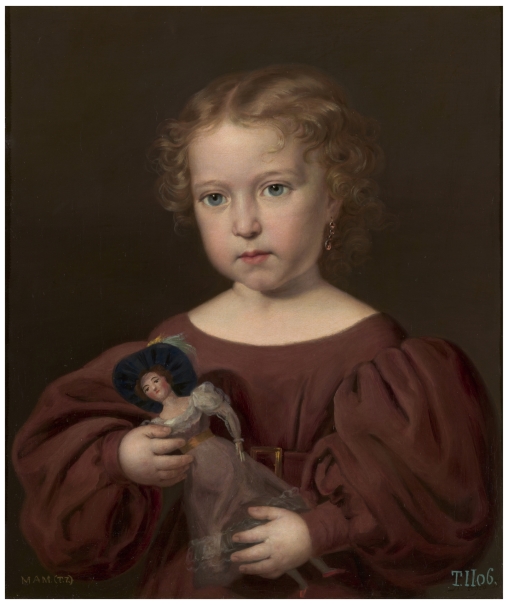
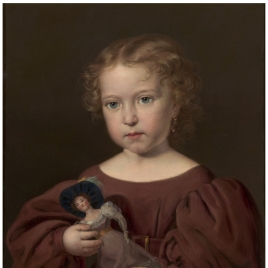
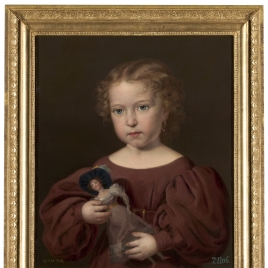
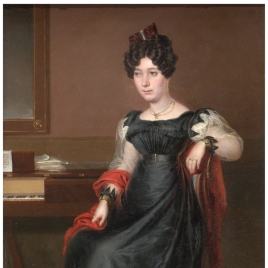
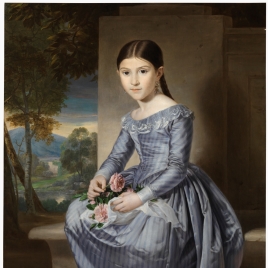
This portrait is one of the most delicate of Tegeo´s portraits of his children and captures the familial affection and tenderness that a three-year-old girl has inspired, in the attentive view of her father, an artist particularly gifted in capturing grace, and the fragility and charm of children´s figures. He was equally gifted in capturing the environment that surrounded them, expressed through some particular background detail symbolising an incipient existence or, as in this case, through an everyday object timelessly embodying the familiar, and the carefree in a girl’s childhood. Ángela was the first-born daughter of the painter y de María de la Cruz Benítez Bragaña, who was portrayed individually in another canvas in Museo del Prado (P004680). They must have married around 1828, by which time Tegeo had returned from Italy and had settled permanently in Madrid. There he became acquainted with the Benítez family through the family portrait of Paula Bragaña and her children, who would later become his mother-in-law and brothers-in-law. A cleverly directed spotlight emphasises the smoothness and the still soft quality of her pale skin, against which brightness of her blue eyes stand out. She fixes them slightly to the right on some point of interest, tilting her face to one side, revealng one of the gold and topaz pendant earrings that frame her thin, silky hair; her golden curls fall unruly over her forehead. Dressed in the fashion of the early 1930s, she wears a brown dress with an off-the-shoulder neckline and puffed sleeves covering her arms. A wide waistband encircles her waist, revealing part of a large golden buckle. Between her plump hands, in which the painter has succeeded in capturing the sensation of delicacy typical of her tender age, she holds a doll which she shows to the viewer. Notably, and in keeping with expectations regarding the imitation of maternal roles from childhood, the girl is not carrying a doll baby appropriate to her age, but a real mannequin, a so-called ‘lady de biscuit’, with a painted mask and wooden body, elegantly dressed in all the head-to-toe accessories, the recommended fashion of the time for an adolescent girl. The ballet flats, flowing fabrics, cinched waist, puffed sleeves and a feathered pamela, may delight the girl as a model of her dream future. The domesticity of the setting is captured with the sparseness of decorative and environmental elements with which Tegeo usually complemented his portraits, demonstrating his mastery in the use of highly worked landscape backgrounds, and in the description of objects and personal belongings with tactile suggestions of unquestionable quality. This aesthetic, halfway between classicism and romanticism, is reflected in works of excellent execution, also featuring children, such as Niña ante el paisaje (Young Girl Seated in a Landscape, P007619), the portrait of The Barrio Family (P004658), from the Prado collection, and the child portrait of Santos Cuenca playing with a little bird, in a private collection
Gutiérrez Márquez, A., Ángela Tegeo, hija del pintor (h. 1832). En Barón, J.: El retrato español en el Prado. De Goya a Sorolla, Madrid, Museo Nacional del Prado, 2007, p.96, n. 20