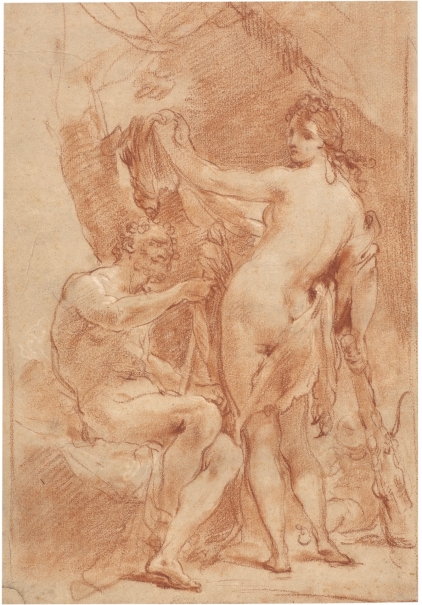
Hercules and Omphale
1780 - 1790. White chalk, Red chalk on brown paper.Not on display
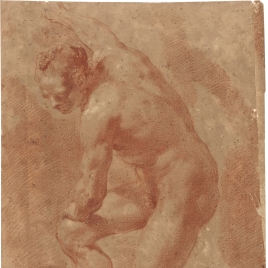
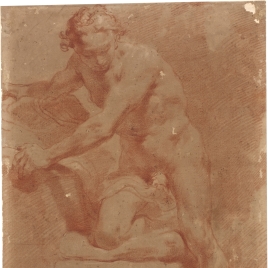
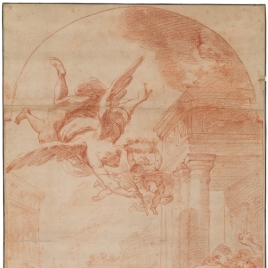
This drawing is part of a series of works by Gandolfi depicting Hercules and Omphale. It includes drawings held by the Pinacoteca di Forlì, a possible sketch in a private collection in Milan, and a painting that was in the Venetian Brass Collection, possibly the same exhibited at Agnews, London, in May 1966, according to the Warburg Institute’s iconography database.
All of these works clearly reveal one of Gandolfi’s main traits: his knowledge of eighteenthcentury Venetian art and the work of other eighteenth-century European artists (Prisco Bagni pointed out the similarities of the sketch with Hercules and Omphale, c.1700, by Sebastiano Ricci). Manuela Mena Marqués has suggested that the Museo del Prado’s drawing is a copy of a painting by Bartholmeus Spranger at the Kunsthistorisches Museum, Vienna. There are certainly similarities between the two, which is possible given that the work was well known through prints by A. Eisenhout (1598) and Egidius Sadeler II (1570-1629).
Having slain Iphitus, the son of the king of Oechalia, Hercules was condemned to be sold as a slave and to serve as one for three years. He was purchased by Omphale, Queen of Lydia, and in the scene shown here sits and spins wool while she wears a lion’s skin and carries the club used by the hero to kill the animal. This is one of the scenes traditionally used to demonstrate the reversal of social roles in the early modern era. In the present drawing, Omphale is a resolute woman who looks out at the viewer, while Hercules is depicted as a weak figure who contemplates her with a questioning air.
Painter, sculptor, engraver and draughtsman Gaetano Gandolfi was the brother of artist Ubaldo Gandolfi. He trained at the Accademia Clementina in Bologna and later studied Venetian painting during a one-year tour of Venice in 1760. He was invited by Richard Dalton, librarian to King George III of England, to spend six months in London in 1787, and travelled there by way of Paris. His contact with the artistic traditions of both countries influenced his later style and left a clear mark on his work.
Carlos Varona, María Cruz de, 'Gaetano Gandolfi. Hercules and Omphale'. Italian masterpieces from Spain's royal court, Museo del Prado, National Gallery of Victoria Thames & Hudson, 2014, p.238