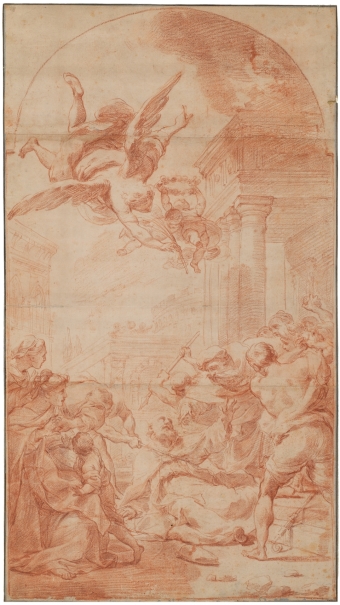
The martyrdom of Saint Eusebius
Ca. 1784. Red chalk on dark yellow paper.Not on display
This drawing is a preparatory study for The martyrdom of Saint Eusebius, which Gaetano Gandolfi was commissioned to paint in 1784 by the Archbishop of Alba. It was intended for that saint’s chapel, then under construction at Vercelli Cathedral in Piedmont. Besides the present work from the Museo del Prado, four other drawings related to this important commission reveal the laborious and calculated process of carrying out a work of this type.
The scene represents the moment when Saint Eusebius, Vercelli’s first bishop and an outstanding opponent of Arianism, was speared and stoned to death by his executioners. Of the remaining drawings, two show the entire composition and two are studies of details. The drawing auctioned at Sotheby’s, London, in July 2001 (43.1 x 30.4 cm) is a study for the central figures of the saint and executioner, while another in a private collection (41.5 x 30.0 cm) depicts the woman and youth at the extreme left of the painting. Besides these drawings, there is also a painted sketch at the Duomo in Vercelli.
The presence of both compositional and technical differences between the drawings and the final painting reveal how laborious its creation was. In this drawing from the Museo del Prado, and in the other two drawings depicting the entire composition, the woman in the left foreground looks directly at the martyrdom. In one of the partial drawings, however, she violently turns her covered face towards the viewer in an effort to avoid the scene’s horror. The saint in the Museo del Prado’s drawing has a different face and a longer beard than in the final painting, while in the drawing auctioned in 2001 the figure is the same as in the finished painting. This drawing’s careful and elaborate technique is understandable given the importance of the figures in the final work.
This may indicate that the Museo del Prado’s drawing corresponds to an initial phase of the project and that Gandolfi would later have made changes to the partial drawings and, finally, to the painted sketch, which is practically identical to the final work. These changes focused on the composition’s most important aspect -the figure of the saint at the moment of his martyrdom- but the alteration of the female figure is also significant, as her direct gaze at the violent scene may have been considered inappropriate (Text drawn from Carlos Varona, M. C. de,: Italian Masterpieces. From Spain´s Royal Court, Museo del Prado, 2014, p. 246).