Jacinto Octavio Picón
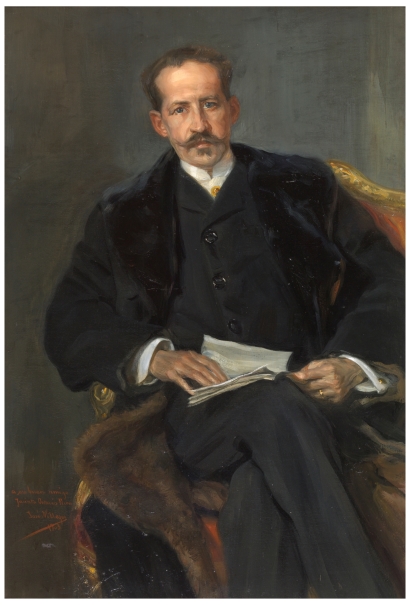
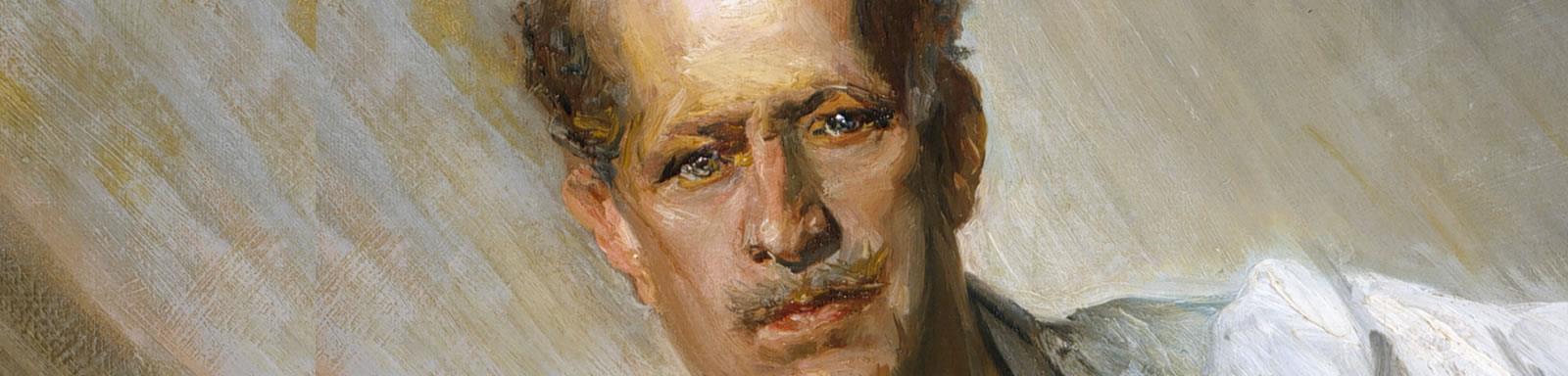
1903. Oil on canvas.Not on display
Jacinto Octavio Picón (Madrid, 8 September 1852–Madrid, 19 November 1923), son of the journalist and magistrate Felipe Picón and Octavia Bouchet, a French lady, who studied law between 1869 and 1873. An administrative officer in the Ministry of Overseas France during the Republic. Later, he was literary correspondent for El Imparcial, moving to Paris and later to Algeria. He excelled above all in short stories and novels, achieving fame with his first work, Lázaro (1882), followed by La hijastra del amor (1884), Juan Vulgar (1895), El enemigo (1887), La honrada (1890) and Dulce y sabrosa (1891), which earned him a name among naturalist writers. He was also a fine art critic in El Correo. In 1900 he joined the Spanish Royal Academy, where he was appointed perpetual librarian in 1914, and in 1902 he joined the San Fernando Fine Arts Academy with a speech on El desnudo en el arte (‘The Nude in Art’). Holding to republican ideals, he was a member of parliament representing Madrid in 1903. In his later years he was vice chairman of the Board of Trustees of the Museo del Prado and secretary of the National Iconography Board.
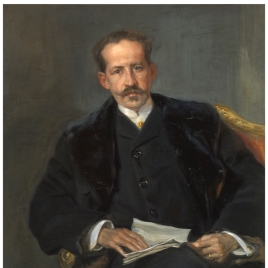
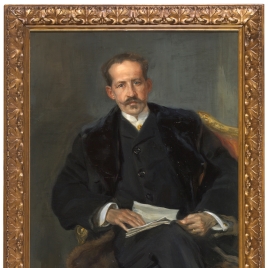
Among the large number of portraits of Jacinto Octavio Picón, the Museo del Prado has, thanks to his own generous bequest, those by Nicolás Megía (P004506), Emilio Sala (P007584) and, in bronze, Mariano Benlliure (E00772), which is perhaps the most significant. In fact, it is a gift from the artist, then director of the Museo del Prado, who painted it in 1903, in gratitude for the speech given by Jacinto Octavio Picón, in response to his acceptance speech at the San Fernando Royal Academy of Fine Arts on 1st March of that year. The portrait shows him resting pages on his knee, alluding to his dedication to literature. He is seated on the end of a red upholstered couch, wearing a fur-lined coat, appropriate to the cold nature he had, according to his friends. As is typical of many of Villegas´s portraits, his head and shoulders are tilted to one side, inducing a sense of movement and immediate presence that is also common in his self-portraits (P006461), giving a tensile quality to the mood. The artist usually completed his portraits in a few sessions. Thus, in the portrait he painted around 1900, of his Andalusian friend Luis Palomo (private collection), who also appears seated, there is an inscription on the back of the canvas indicating that it was painted in three sessions of less than two hours. In this way, the speed of execution, using a very lively brushstroke, preserved the spontaneity of the model´s expression. In this case, the sitter, now in his fiftieth year, is the simple and clear personification of uprightness, loyalty and the most affable courtesy, as Antonio Maura recalled in his obituary address to the Spanish Academy. Moreover, as Agustín González de Amezúa reflected in the 1925 prologue to the second edition of the book Picón had dedicated in 1899 to the Life and Works of Diego Velázquez: the fine, well-placed head denotes energy and self-possession; the noble, unclouded forehead, intelligence and daydream. The grown and combed moustaches in straight and sharp guides, proper of the style of his time, do not manage to hide the bitter and disenchanted rictus of his mouth. [...] There is in the whole of his person, although his complexion is impoverished and almost skeletal, everything that was his style: dignity, simplicity and elegance, together.
Barón, Javier, Jacinto Octavio Picón (1903). En: Barón, J.: El retrato español en el Prado. De Goya a Sorolla, Madrid, Museo Nacional del Prado, 2007, p.168, n. 57