Jesus at Tiberias
1909. Oil on canvas.Not on display
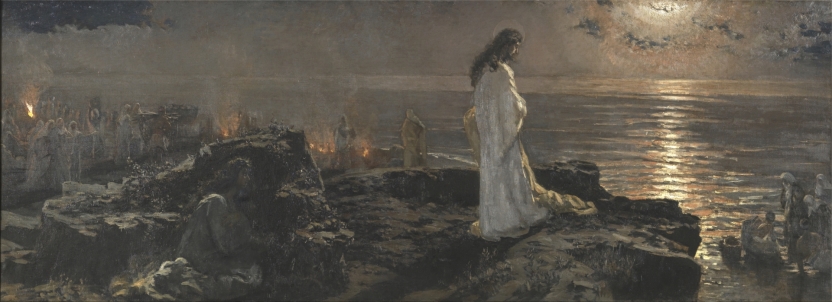
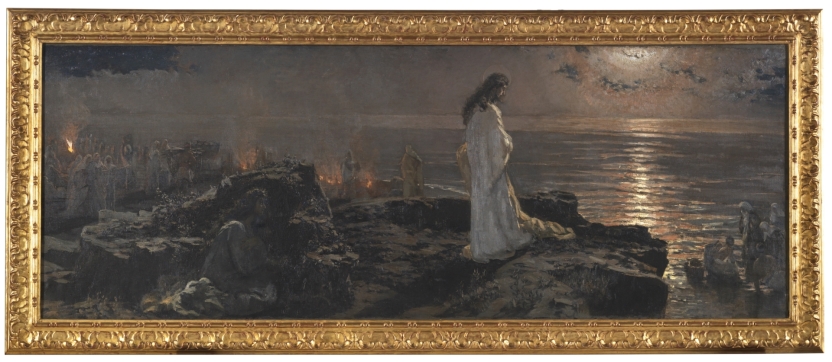
A highly personal interpretation of one of the Gospel passages that takes place on the shores of Lake Tiberias, repeatedly referred to in the Bible as the Sea of Galilee or by the name of Genezareth. The artist’s evocative fantasy deliberately disregards any iconographic orthodoxy to present us with one of his most surprising and novel paintings in this genre, both in its composition and in its plastic language and aesthetic treatment. Indeed, the landscape format of the canvas, which provides an almost cinematographic panoramic view of the scene, in which the lake itself, the twilight sky and its reflection in the water and the rest of the landscape elements take centre stage, together with the almost phantasmagorical appearance of the crowd and the treatment of the fusiform silhouette of Jesus himself, as well as the interpretation of the sunlight and the bonfires glimpsed on the shores of the lake, show the absolute pre-eminence of purely pictorial values in this master’s work and his incursion in the early years of the century into Symbolist approaches to the plastic arts. Muñoz Degraín thus displayed his particular interpretation of the spirituality of the religious event, which subordinates the prominence of the figures to the beautiful landscapes of the Gospel narrative. This is an aspect of which the most representative example is perhaps his splendid painting entitled Twilight at Magdala in the Museo de Bellas Artes de Valencia.
The painting was submitted by Muñoz Degrain along with those titled River Jordan, Sowers of Jericho and Cape Noval to the National Exhibition of 1910, for which he was awarded the Medal of Honour for the competition.
Museo Nacional del Prado, Maestros de la pintura valenciana: del siglo XIX en el Museo, Madrid, Museo Nacional del Prado Autoridad Portuaria, 1997, p.134-135 nº17