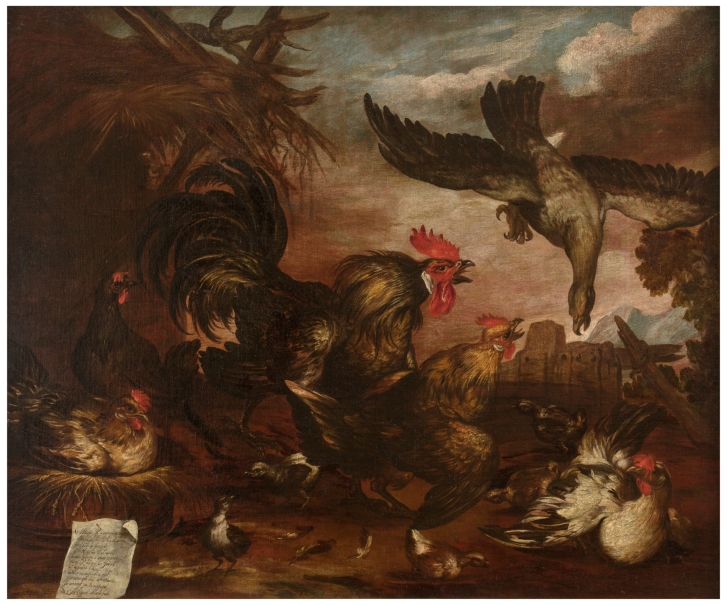
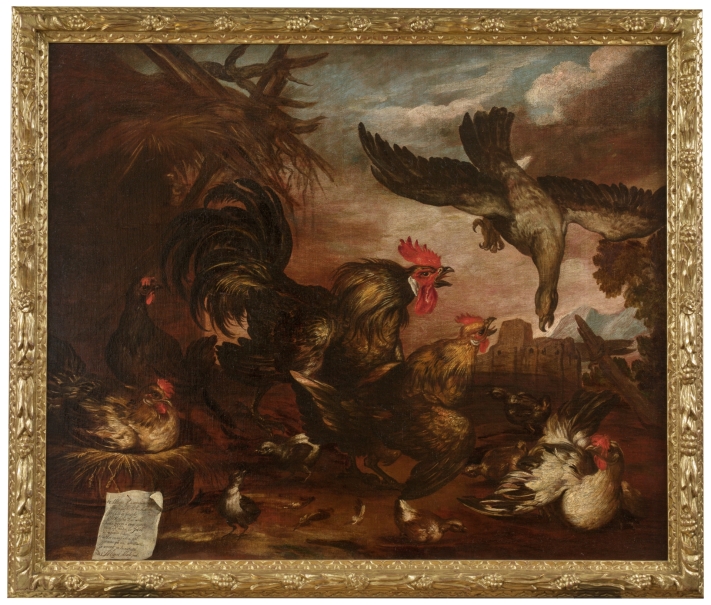
Kite attacking a Henhouse
1650 - 1670. Oil on canvas.Not on display
Miguel March is known primarily for his religious paintings, but this Valencian artist also painted genre scenes—especially still lifes with domestic settings of the sort presented here. Portús (2006: 26), considers this work important for the intellectual history of the still life in Spain, and he adds that Marcos Antonio Orellana refers to it in an 18th-century text as a beautiful canvas showing a kite attacking a henhouse, where the rooster and egg-laying hens fearfully rise up to defend their chicks, all rendered with beautiful naturalness. Moreover, the contents of this work are not limited to a mere depiction of the event, as a sheet of paper that appears as if by chance in the lower left corner of the canvas bears some verses by March himself, which clarify that, as with all still lifes, the painter has blurred the border separating reality and imagination in order to convert fiction into a new reality.
The scene takes place outside a hut and is particularly violent in its depiction of a fight between different types of birds: the raptor diving down from the sky, and the domestic fowl rushing to defend their offspring. The highly dynamic foreground contrasts with the distant buildings and mountain range in the background. Along with the patches of sky among the clouds, these are the only touches of cool colors, unlike the decidedly warm tones that dominate the rest of the canvas. Infrequent in Spanish animal paintings, this work’s general characteristics more closely resemble Flemish or even Dutch painting, where the subject matter is quite common and often linked to the interpretation of fables or allegories that were well known in that period (text from Luna, J. J.: El bodegón español en el Prado. De Van der Hamen a Goya, Museo Nacional del Prado, 2008, p. 98).