La boulonnaise
1922 - 1923. Oil on canvas.Room C
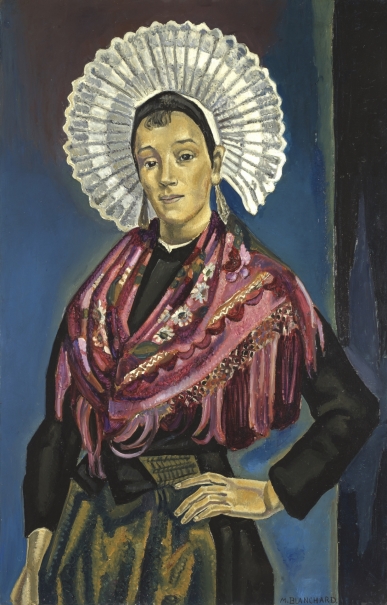
This painting depicts a fisherwoman from the French region of Boulonnais, in the domain of Pas-de-Calais. These matelotes or verrotières were fisherwomen and shell-fisherwomen who also helped offload fish from boats. They often posed pridefully with their hands on their hips, which is how María Blanchard painted this woman.
This work demonstrates Blanchard’s grasp of figure-based painting after her cubist period, which had finished in 1918. Her mastery of the tenets of that movement is evident here, particularly in the way she painted the hands as well as in the solidity of the compositional structure and the rigorous study of the rhythms of the shapes. Her preference – which was characteristic in this period – for an almost monumental representation of the female explains why the figure occupies almost the entire canvas. The apex of the figure in a circular headdress – known as a soleil, a starchly trimmed piece of white lace – grants her a peculiar look, as if it were a halo that exalts the woman. The whiteness of her headdress and the thick material with which it is painted enhances her presence. The flowers on the shawl echo the shape of the lace, the effect of which is a multiplication of the essentially feminine suggestion linked to its emphatic circularity. Expressing determination and independence, her face is framed by long earrings – called ‘kites’ or ‘dorlots’ – that are shaped like clusters and that were worn with such popular dresses in Boulogne-sur-Mer. The painter slightly modified the attire, deleting the Calais white lace cuff that they occasionally wore as well as the long gold chain that would hang from their necks, thus modernising it. Both the ochre apron and the pink shawl with white flowers over the black silk dress show Blanchard’s taste for chromatic elements during those years. An intense expressiveness results from the use of a deep blue for the background of the composition and the lighter-toned silhouetting of the figure´s outline, which, together with the headdress, creates a kind of aura. The result is an image of great iconic force that conveys a powerful energy, as do some of the matriarchs painted by the artist at that time. Blanchard´s preference for expressive and structural values, far removed from the apparently feminine categories of ‘sensibility’ or ‘grace’ that could easily be applied to other artists as such as Marie Laurencin, meant that she did not fit into the historians’ schema.
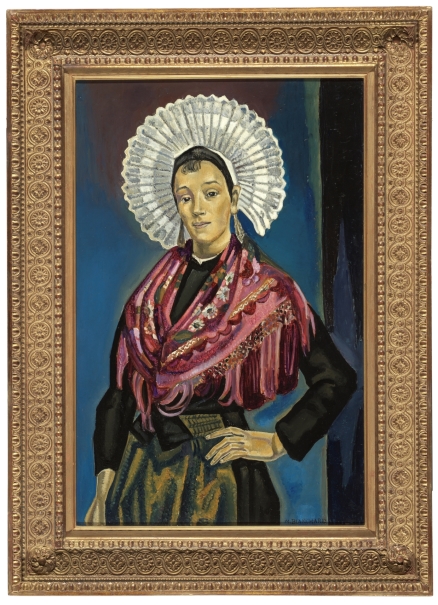
The picture was part of an important solo exhibition of 21 of her works that took place between 14 and 25 April 1923 in the Galerie du Centaure in Brussels, which leads us to date this painting to before that exhibition. The exhibition was sponsored by the art delears Ceux de demain, composed of Jean Delgouffre, Frank Flausch, and Jean Grimar, with whom the artist had an excellent relationship. The catalogue’s preface was written by André Lhote, a painter and friend of hers. During the exhibition, the canvas was shown under the title La boulonnaise; afterwards, it was hardly ever exhibited again. The painting is in a golden frame with plain rinceau transoms between a couple of pearled mouldings and an oval decorated edge.
Barón, Javier, 'Maria [Gutiérrez] Blanchard. La boloñesa.'. en: Memoria de actividades 2021 Museo Nacional del Prado, Ministerio de Cultura y Deporte, 2022, p.25-27