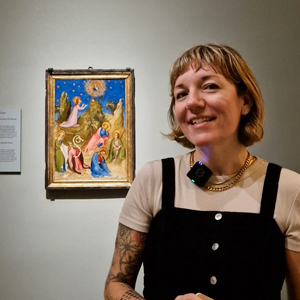
The Agony in the Garden with the Donor Louis I of Orléans
1405 - 1408. Tempera grassa on baltic oak planks.Room C
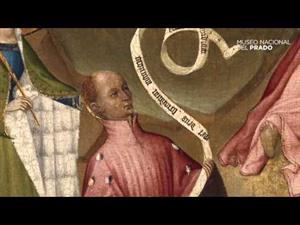
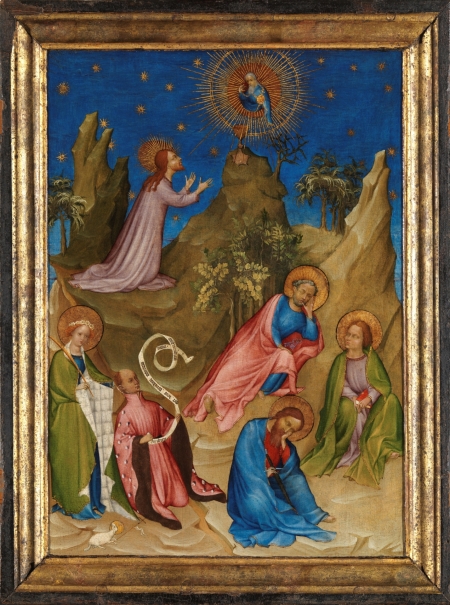
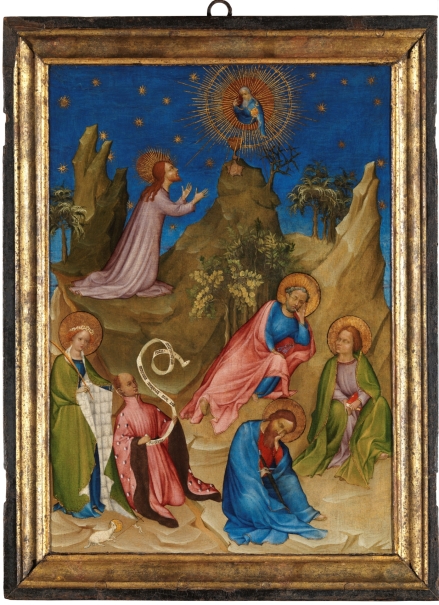
Representation of Christ praying in the Garden of Gethsemane on the Mount of Olives. These passages give an account the moment after the Last Supper when Jesus, accompanied by three disciples – Peter, James and John – retreats to pray in this place near Jerusalem. The painter depicts God the Father surrounded by rays, wearing a blue robe and holding the orb in his left hand while blessing Christ with his right. He is positioned above the usual chalice, a metaphor for the suffering that Jesus must endure as part of His impending sacrifice. The image reflects the idea expressed in the three sacred texts when Christ says: ‘O my Father, if it be possible, let this cup pass from me: nevertheless not as I will, but as thou wilt.’ On the left is Saint Agnes, accompanied by a lamb (in Latin agnus), an iconographic symbol that refers to her name. Her left hand supports the head of the donor, who is holding a scroll with the opening verse of Psalm 51 of the Bible, Miserere mei: ‘Have mercy upon me, O God, according to thy loving kindness’, uttered in contexts of penance and pleas for forgiveness. The donor has been tentatively identified as Louis of Orléans (1372–1407), a son of the French King Charles V, who was appointed as regent in 1392.
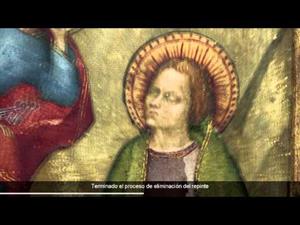
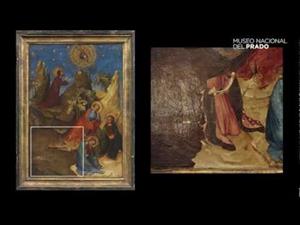
Historians have not paid attention to the work until recently. It was first documented in 1960, when it was referred to in a publication as a Primitive Italian panel from the quattrocento, presumed to be Sienese or Florentine. It reappeared in 2011 on the Madrid market as an anonymous painting and was studied and restored at the Museo del Prado. Removal of the overpaint revealed Louis of Orléans to be the donor. In view of the style – characteristic of the International Gothic prevalent at the early fifteenth-century French court – Pilar Silva Maroto suggested a possible attribution to Colart de Laon on the basis of the painter’s close relationship with the nobleman, for whom he worked from 1391 until his death in 1407, dating the painting to the last years of that period. This attribution has so far not been disputed.
The Prado Agony in the Garden was once part of a triptych, of which it would have been the central panel, as indicated by the fact that the frame is the original and by the hinge marks on its sides. The triptych was complete until 1960 at least and is a very interesting example of a relatively common visual model that combined a pictorial image in the central panel and sacred texts in the side panels. The left panel reproduced in Latin the passages from Matthew 26:38–39 and the right-hand panel transcribed the verses of Luke 22:43–45. Unfortunately no longer extant, these side panels illustrate a common devotional use of sacred texts in combination with religious images.
As Silva Maroto maintained, the work is consistent with the International Gothic style, particularly in the slender, stylised canon of the figures and the curved rhythms of the composition, which is completely devoid of naturalism and whose figures and details are highly synthetic in appearance. The inclusion of a donor in a gospel scene like Christ praying on the Mount of Olives is not unusual if we consider other surviving examples such as an Anonymous stone panel dating from around 1433 in the catedral of Notre Dame in Tournai showing the donor, Canon Jean de la Wastine, holding a ribbon scroll and presented by a saint, in this case John the Baptist. Silva Maroto established a link between the funerary nature of the Tournai painting and a possible identical aspecto of the Prado panel, based on the inclusion of the words of the Miserere mei on the scroll held by the subject and the absence of a female donor. It led her to conclude that the Prado painting may have been commissioned after the duke’s death by his wife Valentina Visconti, an idea reinforced by this Milanese family’s strong links with Saint Agnes, who presents the Duke. This would not affect Silva Maroto’s attribution of the painting to Colart de Laon, because after the Duke of Orléans died, the artist continued to work for his family and circle.
Pérez Preciado, José Juan, Fifteenth-century netherlandish painting at the Museo Nacional del Prado. Catalogue raisonné, Madrid, Museo Nacional del Prado, 2024, p.347-351 nº.44